

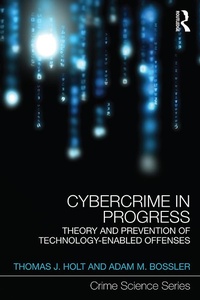
Cybercrime in Progress
Theory and prevention of technology-enabled offenses
Published on 14. December 2015
236 pages
978-1-317-68898-3 (ISBN)
Description

The emergence of the World Wide Web, smartphones, and computers has transformed the world and enabled individuals to engage in crimes in a multitude of new ways. Criminological scholarship on these issues has increased dramatically over the last decade, as have studies on ways to prevent and police these offenses. This book is one of the first texts to provide a comprehensive review of research regarding cybercrime, policing and enforcing these offenses, and the prevention of various offenses as global change and technology adoption increases the risk of victimization around the world.
Drawing on a wide range of literature, Holt and Bossler offer an extensive synthesis of numerous contemporary topics such as theories used to account for cybercrime, policing in domestic and transnational contexts, cybercrime victimization and issues in cybercrime prevention. The findings provide a roadmap for future research in cybercrime, policing, and technology, and discuss key controversies in the existing research literature in a way that is otherwise absent from textbooks and general cybercrime readers.
This book is an invaluable resource for academics, practitioners, and students interested in understanding the state of the art in social science research. It will be of particular interest to scholars and students interested in cybercrime, cyber-deviance, victimization, policing, criminological theory, and technology in general.
Drawing on a wide range of literature, Holt and Bossler offer an extensive synthesis of numerous contemporary topics such as theories used to account for cybercrime, policing in domestic and transnational contexts, cybercrime victimization and issues in cybercrime prevention. The findings provide a roadmap for future research in cybercrime, policing, and technology, and discuss key controversies in the existing research literature in a way that is otherwise absent from textbooks and general cybercrime readers.
This book is an invaluable resource for academics, practitioners, and students interested in understanding the state of the art in social science research. It will be of particular interest to scholars and students interested in cybercrime, cyber-deviance, victimization, policing, criminological theory, and technology in general.
Reviews / Votes
"Cybercrime scholarship is moving from the descriptive to the analytical, with a rapidly accumulating evidence base. This book contains a valuable overview of major issues in cybercrime research, from theory testing to practical preventive measures. Informative, eminently readable, and richly documented, its impressive compilation and ordering of research findings will enlighten a generation of cybercrime students. "Peter Grabosky, Professor Emeritus, Australian National University, Australia
"Cybercrime in Progress is by far the most comprehensive yet incisive book on cybercrime available anywhere. It is written with clarity, authority and vision, so well written, in fact, that it would be an appropriate text for any undergraduate or graduate class. The title Cybercrime in Progress captures the essence of cybercrime: it is a moving and fluid target, changing constantly, creating new opportunities for offenders; new challenges for society's traditional responses to crime. Many people may think that cybercrime is too technical to understand. This book will change all that. Holt and Bossler are masters of their craft: they succinctly sum up the short history of cybercrime, point to the gaps in our responses to it, and tell us exactly what we must do in the future if we are to control it."
Graeme Newman, Distinguished Teaching Professor, University at Albany, USA
"Thomas Holt and Adam Bossler have done a really great job in locating cybercrimes and the future development of online criminal opportunities within the context of the various criminological debates. This book should not only help students undertake their studies into cybercrime, but also assist established scholars in coming to grips with this interesting, but constantly shifting area of interdisciplinary study."
David S. Wall, Professor of Criminology, University of Leeds, UK
More details
Series
Language
English
Place of publication
London
United Kingdom
Publishing group
Taylor & Francis Ltd
Target group
College/higher education
Product notice
Reflowable
Illustrations
1 Tables, black and white
File size
1,17 MB
ISBN-13
978-1-317-68898-3 (9781317688983)
Copyright in bibliographic data and cover images is held by Nielsen Book Services Limited or by the publishers or by their respective licensors: all rights reserved.
Schweitzer Classification
Other editions
Additional editions
Thomas Holt | Adam Bossler
Cybercrime in Progress
Theory and prevention of technology-enabled offenses
Book
04/2017
1st Edition
Routledge
€83.00
Shipment within 10-20 days
Thomas Holt | Adam Bossler
Cybercrime in Progress
Theory and prevention of technology-enabled offenses
Book
12/2015
1st Edition
Routledge
€233.10
Shipment within 10-20 days
Persons
Thomas J. Holt is an Associate Professor in the School of Criminal Justice at Michigan State University, specializing in cybercrime, policing, and policy. He received his Ph.D. in Criminology and Criminal Justice from the University of Missouri-Saint Louis in 2005. He has published extensively on cybercrime and cyberterror in outlets such as Crime and Delinquency, Sexual Abuse, the Journal of Criminal Justice, Terrorism and Political Violence, and Deviant Behavior.
Adam M. Bossler
is an Associate Professor of Criminal Justice and Criminology at Georgia Southern University. He earned his doctorate in criminology and criminal justice from the University of Missouri-St. Louis. His research focuses on examining the application of traditional criminological theories to cybercrime offending and victimization, how law enforcement responds to cybercrime, and exploring innovative correctional programs. His most recent publications can be found in Crime & Delinquency, Youth & Society, American Journal of Criminal Justice, Policing, and Journal of Criminal Justice.
Adam M. Bossler
is an Associate Professor of Criminal Justice and Criminology at Georgia Southern University. He earned his doctorate in criminology and criminal justice from the University of Missouri-St. Louis. His research focuses on examining the application of traditional criminological theories to cybercrime offending and victimization, how law enforcement responds to cybercrime, and exploring innovative correctional programs. His most recent publications can be found in Crime & Delinquency, Youth & Society, American Journal of Criminal Justice, Policing, and Journal of Criminal Justice.
Content
1. Technology and Cybercrime 2. Issues in Empirical Assessments of Cybercrime 3. Applications of Criminological Theory to Cybercrimes 4. Issues in Domestic and Transnational Cybercrime Investigation 5. Issues in the Prevention of Cybercrime 6. The Future of Cybercrime and Digital Forensic Research.
