

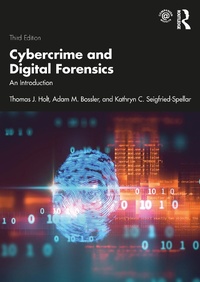
Cybercrime and Digital Forensics
An Introduction
3rd Edition
Published on 30. May 2022
812 pages
978-1-000-55337-6 (ISBN)
Description

This book offers a comprehensive and integrative introduction to cybercrime. It provides an authoritative synthesis of the disparate literature on the various types of cybercrime, the global investigation and detection of cybercrime and the role of digital information, and the wider role of technology as a facilitator for social relationships between deviants and criminals. It includes coverage of:
* key theoretical and methodological perspectives;
* computer hacking and malicious software;
* digital piracy and intellectual theft;
* economic crime and online fraud;
* pornography and online sex crime;
* cyber-bullying and cyber-stalking;
* cyber-terrorism and extremism;
* the rise of the Dark Web;
* digital forensic investigation and its legal context around the world;
* the law enforcement response to cybercrime transnationally;
* cybercrime policy and legislation across the globe.
The new edition has been revised and updated, featuring two new chapters; the first offering an expanded discussion of cyberwarfare and information operations online, and the second discussing illicit market operations for all sorts of products on both the Open and Dark Web.
This book includes lively and engaging features, such as discussion questions, boxed examples of unique events and key figures in offending, quotes from interviews with active offenders, and a full glossary of terms. It is supplemented by a companion website that includes further exercises for students and instructor resources. This text is essential reading for courses on cybercrime, cyber-deviancy, digital forensics, cybercrime investigation, and the sociology of technology.
* key theoretical and methodological perspectives;
* computer hacking and malicious software;
* digital piracy and intellectual theft;
* economic crime and online fraud;
* pornography and online sex crime;
* cyber-bullying and cyber-stalking;
* cyber-terrorism and extremism;
* the rise of the Dark Web;
* digital forensic investigation and its legal context around the world;
* the law enforcement response to cybercrime transnationally;
* cybercrime policy and legislation across the globe.
The new edition has been revised and updated, featuring two new chapters; the first offering an expanded discussion of cyberwarfare and information operations online, and the second discussing illicit market operations for all sorts of products on both the Open and Dark Web.
This book includes lively and engaging features, such as discussion questions, boxed examples of unique events and key figures in offending, quotes from interviews with active offenders, and a full glossary of terms. It is supplemented by a companion website that includes further exercises for students and instructor resources. This text is essential reading for courses on cybercrime, cyber-deviancy, digital forensics, cybercrime investigation, and the sociology of technology.
Reviews / Votes
"The third edition of Cybercrime and Digital Forensics presents an updated and vital introduction to key topics in the study of cybercrime. The authors deliver an accessible textbook for students and a foundational resource for those new to the field, with expanded content on cyberwarfare and illicit markets, among other case studies. Cybercrime and Digital Forensics remains a comprehensive and must-read sourcebook in the field of cybercrime."Anastasia Powell, Associate Professor of Criminology and Justice Studies, RMIT University, Australia
"The new edition of Cybercrime and Digital Forensics continues to provide a foundation for the study of cybercrime and the government's response to it. Moreover, the new material demonstrates that the authors have kept up with research and trends on cybercrime as they discuss the emergence of cyberwarfare and the role of the Dark Web in supporting illicit markets. As the demand for cybersecurity specialists grows, this book is a needed primer that covers theoretical, empirical, and practical knowledge for the next generation of professionals."
George W. Burruss, PhD, Department of Criminology and Cyber Florida, University of South Florida, USA
"With its broad scope and the captivating style, this new edition of Cybercrime and Digital Forensics is a timely update of this seminal book, which remains a key reference point for anyone - scholars and professionals alike - looking for an introduction to cybercrimes."
Anita Lavorgna, PhD, SFHEA, Associate Professor in Criminology, University of Southampton, UK
"Cybercrime is a complex phenomenon that blends technical, social and policy dimensions interacting in novel ways. This book presents this complexity in an approachable format and highlights its most salient features to learners from different backgrounds. The authors distill decades of cybercrime expertise in a volume that enables the reader to link practical material with theoretical insights. The abundance of international examples also ensures this book provides students with a truly global perspective on cybercrime."
Benoit Dupont, Professor of Criminology and Canada Research Chair in Cybersecurity, Universite de Montreal, Canada
More details
Edition
3rd edition
Language
English
Place of publication
London
United Kingdom
Publishing group
Taylor & Francis Ltd
Target group
College/higher education
Illustrations
2 Tables, black and white; 6 Line drawings, color; 27 Halftones, black and white; 33 Illustrations, black and white
ISBN-13
978-1-000-55337-6 (9781000553376)
Copyright in bibliographic data and cover images is held by Nielsen Book Services Limited or by the publishers or by their respective licensors: all rights reserved.
Schweitzer Classification
Other editions
Additional editions
Thomas J. Holt | Adam M. Bossler | Kathryn C. Seigfried-Spellar
Cybercrime and Digital Forensics
An Introduction
Book
05/2022
3rd Edition
Routledge
€124.50
Shipment within 15-20 days
Thomas J. Holt | Adam M. Bossler | Kathryn C. Seigfried-Spellar
Cybercrime and Digital Forensics
An Introduction
Book
05/2022
3rd Edition
Routledge
€270.60
Shipment within 15-20 days
Persons
Thomas J. Holt is Professor in the School of Criminal Justice at Michigan State University. His research focuses on all forms of cybercrime and the police response to these offenses. Dr. Holt's work has appeared in outlets such as British Journal of Criminology, Crime & Delinquency, and Terrorism & Political Violence. His research has been funded by the Australian Research Council, the Department of Homeland Security, the National Institute of Justice, and the National Science Foundation.
Adam M. Bossler is Professor and Chair of the Department of Criminal Justice and Criminology at Georgia Southern University. His research interests focus on the applicability of criminological theories to cybercrime offending and victimization and the law enforcement response to cybercrime. His research has been funded by the Department of Justice, National Science Foundation, and United Kingdom Home Office. He has co-authored three books, co-edited the Palgrave Handbook of International Cybercrime and Cyberdeviance, and written for various peer-reviewed journals, including Criminology & Public Policy, Policing, International Journal of Offender Therapy and Comparative Criminology, Journal of Criminal Justice, and Deviant Behavior. In addition to being a co-founder of ancient astronaut criminology, he is also a member of the American Society of Criminology Division of Cybercrime, the International Interdisciplinary Research Consortium on Cybercrime (IIRCC), and the European Society of Criminology's Working Group on Cybercrime.
Kathryn C. Seigfried-Spellar is Associate Professor in the Cyberforensics program in the Department of Computer and Information Technology (CIT) at Purdue University. She is a member of the Tippecanoe High Tech Crime Unit and has Special Deputy status for the Tippecanoe County Prosecutor's Office. Dr. Seigfried-Spellar's primary research area of interest is the personality characteristics and socio-legal factors associated with cyberdeviance, specifically internet crimes against children. Dr. Seigfried-Spellar has published in the area of digital forensics, specifically the ability to conduct a behavioral analysis of digital forensic evidence from child pornography investigations. She is a Fellow of the Digital and Multimedia Sciences section of the American Academy of Forensic Sciences (AAFS), member of the American Psychological Association (APA), and member of the International Association of Law Enforcement Intelligence Analysts (IALEIA).
Adam M. Bossler is Professor and Chair of the Department of Criminal Justice and Criminology at Georgia Southern University. His research interests focus on the applicability of criminological theories to cybercrime offending and victimization and the law enforcement response to cybercrime. His research has been funded by the Department of Justice, National Science Foundation, and United Kingdom Home Office. He has co-authored three books, co-edited the Palgrave Handbook of International Cybercrime and Cyberdeviance, and written for various peer-reviewed journals, including Criminology & Public Policy, Policing, International Journal of Offender Therapy and Comparative Criminology, Journal of Criminal Justice, and Deviant Behavior. In addition to being a co-founder of ancient astronaut criminology, he is also a member of the American Society of Criminology Division of Cybercrime, the International Interdisciplinary Research Consortium on Cybercrime (IIRCC), and the European Society of Criminology's Working Group on Cybercrime.
Kathryn C. Seigfried-Spellar is Associate Professor in the Cyberforensics program in the Department of Computer and Information Technology (CIT) at Purdue University. She is a member of the Tippecanoe High Tech Crime Unit and has Special Deputy status for the Tippecanoe County Prosecutor's Office. Dr. Seigfried-Spellar's primary research area of interest is the personality characteristics and socio-legal factors associated with cyberdeviance, specifically internet crimes against children. Dr. Seigfried-Spellar has published in the area of digital forensics, specifically the ability to conduct a behavioral analysis of digital forensic evidence from child pornography investigations. She is a Fellow of the Digital and Multimedia Sciences section of the American Academy of Forensic Sciences (AAFS), member of the American Psychological Association (APA), and member of the International Association of Law Enforcement Intelligence Analysts (IALEIA).
Content
1. Technology and Cybercrime
2: Law Enforcement, Privacy, and Security in Dealing with Cybercrime
3. Computer Hackers and Hacking
4. Malware and Automated Computer Attacks
5. Digital Piracy and Intellectual Property Theft
6. Online Fraud
7. Pornography, Image-Based Sexual Abuse, and Prostitution
8. Child Sexual Exploitation Material Offenses
9. Cyberbullying, Online Harassment, and Cyberstalking
10. Online Extremism and Cyberterror
11. Cyberwarfare and Information Operations Online
12. Illicit Market Operations Online
13. Cybercrime and Criminological Theories
14. Evolution of Digital Forensics
15. Acquisition and Examination of Forensic Evidence
16. Legal Challenges in Digital Forensic Investigations
17. The Future of Cybercrime, Terror, and Policy
2: Law Enforcement, Privacy, and Security in Dealing with Cybercrime
3. Computer Hackers and Hacking
4. Malware and Automated Computer Attacks
5. Digital Piracy and Intellectual Property Theft
6. Online Fraud
7. Pornography, Image-Based Sexual Abuse, and Prostitution
8. Child Sexual Exploitation Material Offenses
9. Cyberbullying, Online Harassment, and Cyberstalking
10. Online Extremism and Cyberterror
11. Cyberwarfare and Information Operations Online
12. Illicit Market Operations Online
13. Cybercrime and Criminological Theories
14. Evolution of Digital Forensics
15. Acquisition and Examination of Forensic Evidence
16. Legal Challenges in Digital Forensic Investigations
17. The Future of Cybercrime, Terror, and Policy
