

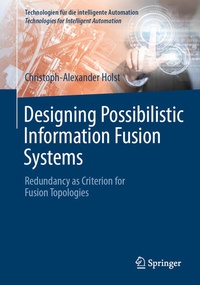
Designing Possibilistic Information Fusion Systems
Description

Intelligent technical systems process information from multiple sources, but are confronted with uncertainties inherent in the information which is often imprecise, incomplete, or inconsistent. As the number of information sources increases, so does the uncertainty, as well as the risk that individual sources are unreliable. This leads to a lack of confidence in analyses and decisions. This thesis presents the Redundancy-hardened Robust Fusion System (R2FS), which aims to exploit redundancies in information sources to increase robustness against changes in source reliability. Leveraging the strengths of possibility theory, it identifies redundancies in information sources, even in environments where information is scarce and characterised by a high degree of epistemic uncertainty. Based on the novel dual redundancy metric proposed in this thesis, redundant sources are aligned in a distributed fusion topology. It is demonstrated that the R2FS outperforms established possibilistic fusion rules in terms of robustness due to the exploitation of redundancy in the distributed topology. This book concludes with a discussion of the current state of uncertainty modelling, highlighting how uncertainty modelling techniques currently used in information fusion could benefit machine learning applications.
More details
Other editions
Additional editions
Person
Dr.-Ing. Christoph-Alexander Hols t is member of the executive board of the Institute Industrial IT (inIT) and research group manager of the Discrete Systems working group (image processing and pattern recognition, sensor and information fusion). He completed his master's degree in the international programme Information Technology at the Ostwestfalen-Lippe University of Applied Sciences and Arts. He received his doctoral degree (Dr.-Ing.) from the Brandenburg University of Technology Cottbus-Senftenberg. His research focuses on methods of information fusion, uncertainty modelling and machine learning systems in the context of resource-constrained systems and scarce data.
Content
Introduction.- Preliminaries.- Scientific State of the Art.- Open Research Topics.- Approach.- Evaluation.- Conclusion and Outlook.
