

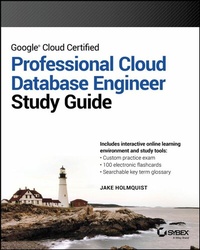
Google Cloud Certified Professional Cloud Database Engineer Study Guide
Description

Discover a smarter and faster way to prep for the Google Professional Cloud Database Engineer certification exam
In the Google Cloud Certified Professional Cloud Database Engineer Study Guide, recognized Cloud and AI leader Jake Holmquist walks you through the recently released Google Professional Cloud Database Engineer certification exam. This Sybex Study Guide provides 100% coverage of every tested domain competency, from capacity and usage planning to cloud database migrations, applications, access management, backup and recovery, monitoring, and more-everything you need to design and build scalable and highly available cloud database solutions.
Whether you are looking to grow your career or position yourself for real-world success at your first job as a Google Cloud database practitioner, the author explains how to succeed on the challenging exam on your first attempt.
In the book, you'll find:
- Hundreds of practice questions-complete with answers and answer explanations-to help you prepare for the test
- Coverage of critical database subject areas you'll need to understand to design, create, manage, and troubleshoot Google Cloud databases
- One year of complimentary access to the Sybex online test bank and learning environment, complete with chapter review questions, a practice exam, digital flashcards, and a searchable key term glossary
Perfect for anyone planning on taking the Google Professional Database Engineer certification exam, the Google Cloud Certified Professional Cloud Database Engineer Study Guide is also a must-read for practicing database professionals hoping to refresh their knowledge or seeking a practical desk reference.
More details
Other editions
Additional editions
Person
ABOUT THE AUTHOR
JAKE HOLMQUIST is a cloud architect and AI leader at Kin + Carta, a Google Cloud IT Services and IT Consulting partner in the United Kingdom. He has over twenty-five years' experience with cloud transformation and digital innovation. He is a Google Champion Innovator, community evangelist, and 5x Certified Google Cloud Professional.
Content
Introduction xxi
Assessment Test xxxiv
Answers to Assessment Test xxxix
Chapter 1 Data Storage Technologies 1
Chapter 2 Database Storage Models and Data Types 35
Chapter 3 Databases in Google Cloud 61
Chapter 4 Database Capacity and Usage Planning 117
Chapter 5 Designing for High Availability and Disaster Recovery 137
Chapter 6 Designing Secure Database Connectivity and Access 159
Chapter 7 Monitoring, Troubleshooting, and Optimizing Performance 177
Chapter 8 Managing and Automating Database Operations 207
Chapter 9 Implementing Backup and Recovery Strategies 225
Chapter 10 Planning and Executing Database Migrations 245
Chapter 11 Deploying and Validating Database Solutions 269
Appendix Answers to the Review Questions 295
Index 337
Introduction
Why should you become a Google Cloud Database Engineer? Because data is the foundation of modern business and artificial intelligence. In today's digital world, the amount of data being generated is staggering-in fact, the amount of data created each day is measured in hundreds of exabytes, and this rate of growth is accelerating exponentially. This explosion of information needs to be stored, managed, secured, and made accessible. By mastering Google Cloud's database services, you position yourself as a crucial expert in a rapidly expanding field. Regardless of the specific cloud or on-premises solutions you work with, understanding Google Cloud's powerful and integrated data platform will broaden your expertise and give you a significant professional edge. This expertise allows you to make informed decisions on how to design scalable, reliable, and cost-effective data solutions that power everything from simple web applications to complex analytics and groundbreaking AI models.
The Google Cloud Certified Professional Cloud Database Engineer certification is a credential that validates your expertise in designing, creating, managing, and troubleshooting Google Cloud database solutions. This exam certifies that you have the necessary skills to select the right database for the job-whether it's a relational database like Cloud SQL or Spanner, a NoSQL solution like Bigtable or Firestore, or an in-memory store like Memorystore. It proves you can not only deploy these systems but also handle migrations, manage day-to-day operations, and implement robust security and disaster recovery plans. Achieving this certification demonstrates to employers that you are a top-tier professional capable of handling their most critical data assets.
The purpose of this book is to provide you with everything you need to pass the Professional Cloud Database Engineer exam. Because the exam covers the full life cycle of cloud database management, those are the topics emphasized in this guide. You'll learn how to design database solutions for performance and scalability, migrate data from other systems, manage and monitor cloud databases effectively, and implement security and compliance best practices. We will dive deep into Google Cloud's suite of data tools, showing you how to unlock insights using powerful analytics services like BigQuery. Even after you've earned your certification, this book will remain an invaluable on-the-job reference for your day-to-day work.
Don't just study the questions and answers! The questions on the actual exam will be different from the practice questions included in this book. The exam is designed to test your knowledge of a concept or objective, so use this book to learn the objectives behind the questions.
The Google Cloud Certified Professional Cloud Database Engineer Exam
Google Cloud offers a robust and diverse portfolio of managed database services designed to meet the needs of any application, from small-scale projects to massive, globally distributed systems. The platform provides solutions for traditional relational workloads, highly scalable NoSQL use cases, globally consistent transactional systems, and powerful data warehouses for analytics. As a Cloud Database Engineer, your expertise in choosing, deploying, managing, and migrating to these services is critical for building modern, data-driven applications.
Why Become a Google Cloud Certified Professional Cloud Database Engineer?
In a competitive IT landscape, holding a certification is a key differentiator that validates your skills and dedication. Here are several powerful reasons to pursue your Google Cloud Database Engineer certification:
- Accelerate Your Career Advancement Certification serves as tangible proof of your professional achievement and expertise. It signals to your current and future employers that you have a deep understanding of Google Cloud's database solutions. According to Google, 8 in 10 Google Cloud learners say that having a certification contributes to faster promotion. By earning this credential, you position yourself as a leader and a go-to expert within your organization, opening doors for new responsibilities and career growth.
- Increase Your Marketability to Employers In today's job market, certified professionals stand out. Hiring managers are actively seeking candidates who have verified skills. Google reports that 8 in 10 leaders from organizations using Google Cloud say they prefer to recruit and hire professionals who hold cloud certifications. This certification makes you a more attractive candidate, can lead to a higher starting salary, and reduces the training burden for new employers.
- Gain In-Demand, Job-Ready Skills The process of studying for this certification isn't just about passing an exam; it's about acquiring practical, real-world skills. The curriculum is designed to equip you with the knowledge to design, manage, and troubleshoot complex database solutions on Google Cloud. As a result, 85 percent of Google Cloud learners say that cloud certifications give them the skills to fill in-demand roles. You will gain the confidence and competence to tackle challenging database projects from day one.
- Build Credibility and Trust The Professional Cloud Database Engineer certification is a respected credential that formally validates your technical abilities. This validation raises your credibility with peers, stakeholders, and clients, establishing you as a trusted database professional capable of managing an organization's most critical data assets.
- Boost Customer and Stakeholder Confidence Whether you work as a consultant or as part of an in-house team, your certification builds confidence. Clients and internal stakeholders are more likely to trust the recommendations and architectural decisions of a certified professional. This trust is essential when you are responsible for an organization's most critical asset: its data.
How to Become a Google Cloud Certified Professional Cloud Database Engineer
Earning your certification is a straightforward process. The primary requirement is to pass the Professional Cloud Database Engineer certification exam. This exam assesses your ability to design, implement, manage, and troubleshoot Google Cloud database solutions.
The exam is administered by Google and can be taken at a designated testing center or as a remotely proctored exam. To register, you will need to create an account on Webassessor (https://webassessor.com/googlecloud), Google's test delivery partner. From there, you can locate a nearby testing center or schedule a remote session that fits your schedule.
For the most up-to-date information on exam registration, fees, and testing locations, please visit the official Google Cloud certification website at https://cloud.google.com/learn/certification. Upon passing the exam, you will receive a digital certificate and a badge that you can add to your resume and professional networking profiles to showcase your achievement.
Exam policies can change from time to time. We highly recommend that you check both the Google Cloud and Webassessor sites for the most up-to-date information when you begin your preparing, when you register, and again a few days before your scheduled exam date.
What Does This Book Cover?
This book covers topics outlined in the Google Cloud Professional Cloud Database Engineer exam here:
https://cloud.google.com/learn/certification/cloud-database-engineer - Chapter 1: Data Storage Technologies This chapter introduces the fundamental concepts of data storage technologies on Google Cloud. It explores the differences between block, object, and file storage and examines specific Google Cloud options like Persistent Disk, Hyperdisk, Local SSD, and Google Cloud Storage, detailing their features and use cases.
- Chapter 2: Database Storage Models and Data Types This chapter categorizes data into structured, unstructured, semi-structured, and vector types, detailing the characteristics and use cases for each. It also provides an overview of the different database types available on Google Cloud, including in-memory, relational, NoSQL, and vector databases, explaining how to select the best option for specific needs.
- Chapter 3: Databases in Google Cloud This chapter offers a comprehensive overview of the specific database solutions on Google Cloud. It covers the differences between managed, unmanaged, and partner database offerings, how to select solutions that meet compliance requirements, and how to leverage these technologies for modern use cases like generative AI.
- Chapter 4: Database Capacity and Usage Planning Using the Google Cloud Implementation Methodology as a framework, this chapter focuses on database capacity and usage planning. It covers how to assess current workloads, project future requirements, size database compute and storage based on performance, and perform a comparative cost analysis to select the right solution.
- Chapter 5: Designing for High Availability and Disaster Recovery This chapter details how to design resilient database solutions on Google Cloud to meet uptime requirements. It evaluates the trade-offs between multiregional, regional, and zonal deployment strategies and covers the design of backup and recovery solutions based on RTO...
