

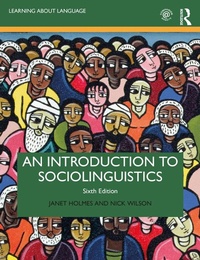
An Introduction to Sociolinguistics
6th Edition
Published on 27. February 2022
732 pages
978-1-000-53399-6 (ISBN)
Description

Sociolinguistics is the study of the interaction between language and society. In this classic introductory work, Janet Holmes and Nick Wilson examine the role of language in a variety of social contexts, considering both how language works and how it can be used to signal and interpret various aspects of social identity. Divided into three parts, this book explains basic sociolinguistic concepts in the light of classic approaches, as well as introducing more recent research.
This sixth edition has been revised and updated throughout, using key concepts and examples to guide the reader through this fascinating area, including:
* New material on gender, social media and online use of language, codeswitching, and language policy
* An updated companion website that is fully cross- referenced within this book and features video and audio materials and links to useful websites
* Revised examples and exercises that include new material from Asia and South America
* Fully updated further reading and references sections
An Introduction to Sociolinguistics is an essential introductory text for all students of sociolinguistics and a splendid point of reference for students of English language studies, linguistics, and applied linguistics.
This sixth edition has been revised and updated throughout, using key concepts and examples to guide the reader through this fascinating area, including:
* New material on gender, social media and online use of language, codeswitching, and language policy
* An updated companion website that is fully cross- referenced within this book and features video and audio materials and links to useful websites
* Revised examples and exercises that include new material from Asia and South America
* Fully updated further reading and references sections
An Introduction to Sociolinguistics is an essential introductory text for all students of sociolinguistics and a splendid point of reference for students of English language studies, linguistics, and applied linguistics.
Reviews / Votes
"This excellent and accessible textbook is tried and tested. I have used it for undergraduate courses in Europe and Asia for more than 20 years with great success. The 6th edition discusses even more languages and countries, and each chapter includes a methodology section which will help students engage in sociolinguistic research."Hans Ladegaard, The Hong Kong Polytechnic University, China
"For those (students or laypersons) fascinated in the role, functions, forms, and uses of language - and policies relating to them - in our (and others') social worlds, then this is the introduction for you. It is uniquely reader-friendly with global examples of a myriad of concepts central to sociolinguistics, aligned with intriguing exercises (and their answers) that ensure complete understanding and mastery."
Howie Giles, University of California, USA, and University of Queensland, Australia
More details
Series
Edition
6th edition
Language
English
Place of publication
London
United Kingdom
Publishing group
Taylor & Francis Ltd
Target group
College/higher education
Illustrations
26 Tables, black and white; 54 Line drawings, black and white; 27 Halftones, black and white; 81 Illustrations, black and white
ISBN-13
978-1-000-53399-6 (9781000533996)
Copyright in bibliographic data and cover images is held by Nielsen Book Services Limited or by the publishers or by their respective licensors: all rights reserved.
Schweitzer Classification
Other editions
Additional editions
Janet Holmes | Nick Wilson
An Introduction to Sociolinguistics
Book
02/2022
6th Edition
Routledge
€63.70
Shipment within 15-20 days

Janet Holmes | Nick Wilson
An Introduction to Sociolinguistics
Book
02/2022
6th Edition
Routledge
€209.80
Shipment within 15-20 days
Persons
Janet Holmes is Emeritus Professor of Linguistics and Associate Director of the Language in the Workplace Project at Victoria University of Wellington, New Zealand. She has published extensively in sociolinguistics, specialising in workplace discourse and language and gender. Her many books include Research Methods in Sociolinguistics: A Practical Guide, co-edited with Kirk Hazen.
Nick Wilson is a Lecturer in Applied Linguistics at the University of Limerick, Ireland, and an honorary Senior Lecturer in Linguistics at Macquarie University, Australia. His published research focuses on how language is used in sports teams and his current research is on how people use swearing and taboo language in interaction.
Nick Wilson is a Lecturer in Applied Linguistics at the University of Limerick, Ireland, and an honorary Senior Lecturer in Linguistics at Macquarie University, Australia. His published research focuses on how language is used in sports teams and his current research is on how people use swearing and taboo language in interaction.
Content
List of Figures
List of Images
List of Maps
List of Tables
Preface to Sixth edition
Preface to Fifth Edition
Preface to Fourth Edition
Preface to Third Edition
Preface to Second Edition
Preface to First Edition
Author's Acknowledgements
Publisher's Acknowledgements
The Online Companion
1. What do sociolinguists study?
Section I: Multilingual Speech Communities
2. Language choice in multilingual communities
3. Language maintenance and shift
4. Linguistic varieties and multilingual nations
5. National languages, language policy, and language planning
Section II: Language Variation: Focus on Users
6. Regional and social dialects
7. Gender and age
8. Ethnicity and social networks
9. Language change
Interlude: Identity in Sociolinguistics
Section III: Language Variation: Focus on Uses
10. Style, context and register
11. Speech functions, politeness and cross-cultural communication
12. Gender, politeness and stereotypes
13. Language, cognition and culture
14. Analysing Discourse
15. Attitudes and applications
16. Conclusion
References
Appendix: phonetic symbols
Glossary
Index
List of Images
List of Maps
List of Tables
Preface to Sixth edition
Preface to Fifth Edition
Preface to Fourth Edition
Preface to Third Edition
Preface to Second Edition
Preface to First Edition
Author's Acknowledgements
Publisher's Acknowledgements
The Online Companion
1. What do sociolinguists study?
Section I: Multilingual Speech Communities
2. Language choice in multilingual communities
3. Language maintenance and shift
4. Linguistic varieties and multilingual nations
5. National languages, language policy, and language planning
Section II: Language Variation: Focus on Users
6. Regional and social dialects
7. Gender and age
8. Ethnicity and social networks
9. Language change
Interlude: Identity in Sociolinguistics
Section III: Language Variation: Focus on Uses
10. Style, context and register
11. Speech functions, politeness and cross-cultural communication
12. Gender, politeness and stereotypes
13. Language, cognition and culture
14. Analysing Discourse
15. Attitudes and applications
16. Conclusion
References
Appendix: phonetic symbols
Glossary
Index
