

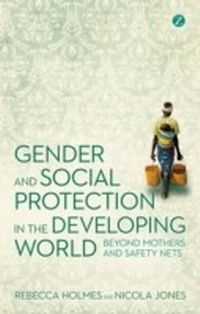
Gender and Social Protection in the Developing World
Beyond Mothers and Safety Nets
1st Edition
Published on 14. March 2013
336 pages
978-1-78032-044-1 (ISBN)
Description

Millions of pounds of international development funds are invested annually in social protection programmes to tackle poverty. Poverty is perpetuated by risk and vulnerability, much of which is gendered. Despite this, little attention has been paid to gender-sensitive policy and programme design and implementation.
Gender and Social Protection in the Developing World introduces a much-needed gender lens to these debates. Drawing on empirical evidence from poor households and communities in Africa, Asia and Latin America, the book provides rich insight into the effects of a range of social protection instruments. It concludes that with relatively simple changes to design and with investment in implementation capacity, social protection can contribute to transforming gender relations at the individual, intrahousehold and community levels.
With a foreword by Stephen Devereux.
Gender and Social Protection in the Developing World introduces a much-needed gender lens to these debates. Drawing on empirical evidence from poor households and communities in Africa, Asia and Latin America, the book provides rich insight into the effects of a range of social protection instruments. It concludes that with relatively simple changes to design and with investment in implementation capacity, social protection can contribute to transforming gender relations at the individual, intrahousehold and community levels.
With a foreword by Stephen Devereux.
Reviews / Votes
Holmes and Jones convincingly demonstrate that only social protection policies developed with a gender lens can alter the causes of poverty and vulnerability. Their prescriptions for programme change have the potential to transform lives on the ground. This book should be required reading for academics and practitioners alike. * Liesl Haas, Department of Political Science, California State University * This publication highlights a key gap in the current design of social protection programs and policies. Taking into account the barriers that women face in accessing resources, mainstreaming gender equality in social protection interventions is critical. This publication contributes to a rethinking of current interventions on social protection. * Lilian Keene-Mugerwa, Platform For Labour Action * Holmes and Jones should be congratulated for making this compelling case for gender-sensitive social protection programming. Their considerable experience and expertise ensures this book will be an essential read for hardened "social protectionistas", students, researchers and practitioners. * Professor Armando Barrientos, Senior Research Fellow, World Brooks Poverty Institute, University of Manchester * Examining the strengths and weaknesses of different approaches to social protection in reducing extreme poverty, Rebecca Holmes and Nicola Jones argue that their effectiveness would be greatly increased if they took proper account of gender relations. Unless gender inequality is understood to be playing a major role in perpetuating poverty, current programmes will fail to achieve their potential. Analytically strong with richly illustrated examples based on research carried out in five continents, this book makes an important and welcome contribution to the ongoing debate over how to tackle poverty. * Professor Maxine Molyneux, Director of the Institute of the Americas, University College London * Providing a rich evidence base on gendered risk and vulnerabilities, this is a valuable analysis of social protection programmes through a gender lens. The authors document the potential and limits of social protection tools in transforming women's lives, providing valuable lessons to policy makers and practitioners that can improve the gender sensitivity and transformative potential of their programmes. * Sarah Cook, Director of the United Nations Research Institute for Social Development * A timely and critical addition to the literature on this subject - the authors guide the reader to an approach to social protection that leads towards real transformation. Comprehensive yet context specific, this book provides an excellent balance of theory with practical guidance. A must-read for governments, donors, NGOs, consultants, students and academics. * Suzette Mitchell, UN Women (Vietnam) *More details
Edition
1. Auflage
Language
English
Place of publication
United Kingdom
Publishing group
Bloomsbury Publishing PLC
Target group
College/higher education
ISBN-13
978-1-78032-044-1 (9781780320441)
Copyright in bibliographic data and cover images is held by Nielsen Book Services Limited or by the publishers or by their respective licensors: all rights reserved.
Schweitzer Classification
Other editions
Additional editions
Rebecca Holmes | Nicola Jones
Gender and Social Protection in the Developing World
Beyond Mothers and Safety Nets
Book
03/2013
Zed Books Ltd
€37.40
Shipment within 3-4 weeks
Rebecca Holmes | Nicola Jones
Gender and Social Protection in the Developing World
Beyond Mothers and Safety Nets
Book
03/2013
Zed Books Ltd
€126.28
Article exhausted; check different version
Persons
Rebecca Holmes is a Research Fellow in the Social Protection Programme at the Overseas Development Institute. Her research and policy work focuses on the linkages between social protection and social policy, and she has particular expertise in gender analysis. With a geographical focus on South and South-East Asia, her research includes studies on gender and social protection effectiveness, social protection and social inclusion, and social protection in fragile and post-conflict states. She has published widely for a range of governmental, nongovernmental and donor audiences on social protection, and has spoken at a variety of public events and conferences on social protection.
Nicola Jones has a PhD in political science and is a Research Fellow in the Social Development Programme at the Overseas Development Institute. Her research, advice and public affairs work focuses on gender analysis, social protection and poverty reduction policies, child well-being, and the linkages between knowledge, policy and power. Since 2007 she has led a number of multi-country studies on the intersection between social justice and social protection in Africa, Asia, Latin America and the Middle East. She is currently a lead researcher in a cross-country study on citizen perceptions of cash transfers in sub-Saharan Africa and the Middle East, and is managing a regional review of gender-responsive social protection in Southeast Asia for UN Women. Nicola has published widely for a range of academic, policy and practitioner audiences, including six co-authored books. The most recent are: Knowledge Policy and Power in International Development: A Practical Guide (2012) and Children in Crisis: Seeking Child-sensitive Policy Responses (2012).
Nicola Jones has a PhD in political science and is a Research Fellow in the Social Development Programme at the Overseas Development Institute. Her research, advice and public affairs work focuses on gender analysis, social protection and poverty reduction policies, child well-being, and the linkages between knowledge, policy and power. Since 2007 she has led a number of multi-country studies on the intersection between social justice and social protection in Africa, Asia, Latin America and the Middle East. She is currently a lead researcher in a cross-country study on citizen perceptions of cash transfers in sub-Saharan Africa and the Middle East, and is managing a regional review of gender-responsive social protection in Southeast Asia for UN Women. Nicola has published widely for a range of academic, policy and practitioner audiences, including six co-authored books. The most recent are: Knowledge Policy and Power in International Development: A Practical Guide (2012) and Children in Crisis: Seeking Child-sensitive Policy Responses (2012).
Content
Introduction: why social protection needs a gender lens
1. Key concepts in gender and social protection
2. The gendered patterning of vulnerability, risk and resilience
3. Transferring income and assets: assessing the contribution to gender-sensitive poverty reduction
4. Working one's way out of poverty: public works through a gender lens
5. Insuring against shocks: the gendered dimensions of insurance
6. Ensuring access to state provision: towards more gender-sensitive subsidy schemes
7. Why politics matters: a gendered political economy approach to social protection
8. Conclusions and recommendations: advancing gender-sensitive social protection
1. Key concepts in gender and social protection
2. The gendered patterning of vulnerability, risk and resilience
3. Transferring income and assets: assessing the contribution to gender-sensitive poverty reduction
4. Working one's way out of poverty: public works through a gender lens
5. Insuring against shocks: the gendered dimensions of insurance
6. Ensuring access to state provision: towards more gender-sensitive subsidy schemes
7. Why politics matters: a gendered political economy approach to social protection
8. Conclusions and recommendations: advancing gender-sensitive social protection
