

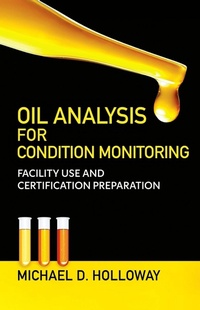
Oil Analysis for Condition Monitoring
Description

Oil Analysis for Condition Monitoring bridges the gap between theoretical knowledge and real-world application in industrial settings. It is designed to serve as both a practical manual for technicians and engineers engaged in condition monitoring, and as a comprehensive reference for those seeking to master lubricant behavior, contaminant profiling, and diagnostic interpretation.
Each chapter progresses from foundational concepts to expert-level diagnostics, culminating in a structured framework for training, certification preparation, and professional growth. The material draws upon years of field experience, laboratory analysis, technical standards, and the evolving best practices of world-class maintenance programs. Analytical methods are explored with clear explanations of their purpose, test procedures, and result interpretations, providing readers with straightforward guidance.
This work offers a roadmap to elevate maintenance culture from reactive to predictive, and ultimately to prescriptive practice, equipping readers to grow their knowledge, competence, and credibility within the field of reliability engineering. It serves as a thorough preparation guide for professional certifications offered by the International Council for Machinery Lubrication, the Society of Tribologists and Lubrication Engineers, the National Lubricating Grease Institute, and the Society for Maintenance and Reliability Professionals, as well as for certifications from independent organizations focusing on machinery lubricant analysis.
Whether you are a technician collecting samples in the field, an analyst interpreting data in the lab, or a manager seeking to improve asset performance, this book is for you. It serves as both a foundation and a launchpad for solving today's problems and preparing for tomorrow's demands. Additionally, it will be a valuable reference for the staff of any oil analysis laboratory, supporting operational excellence in daily practice and long-term program success.
Welcome to the deeper side of understanding and using oil analysis.
Unique Features
- Provides clear explanations of oil analysis, key parameters, contaminants, degradation mechanisms, and advanced wear diagnostics, along with an outline for initiating an in-service oil analysis program.
- Builds from fundamentals of oil analysis to complex forensic diagnostics, and emerging applications such as the current use of AI and machine learning.
- The final section of the book includes a series of progressive questions and answers designed to develop superior competency, guiding readers from basic recall to advanced synthesis of the topics.
More details
Person
Michael D. Holloway has more than 39 years of experience in industry, and holds all ICML certifications, as well as the Certified Lubrication Specialist (CLS) and Oil Monitoring Analyst (OMA) certifications from STLE as well as the Certified Lubricating Grease Specialist (CLGS) from NLGI. He has authored and co-authored more than a dozen books, including Maintenance Lubrication Technician (MLT I & II) Certification Exam Guide, by Industrial Press. Michael started 5th Order Industry as the independent content-development vehicle for competency development and certification preparation classes. He was just recently appointed Executive Vice President of Sales and Strategy at Avivid Water Technology.
Content
Ch. 1-Introduction to Oil Analysis and Condition Monitoring; Ch. 2-Key Parameters in Oil Analysis; Ch. 3-Contaminants and Degradation Indicators; Ch. 4-Sampling and Data Interpretation; Ch. 5-Applying Analysis to Maintenance Strategy; Ch. 6-Oil Chemistry and Complex Interactions; Ch. 7-Advanced Contaminant and Wear Analysis; Ch. 8-Diagnosing and Interpreting Complex Cases; Ch. 9-Designing a Predictive Maintenance Program; Ch. 10-The Analysis of Lubricating Oil; Ch. 11-Commercial Oil Analysis; Ch. 12-Physical Properties; Ch. 13-Chemical Properties; Ch. 14-Contamination; Ch. 15-Performance; Ch. 16-Wear Debris; Ch. 17-Complementary Oil Analysis Tests and Advanced Forensics; Ch. 18-Integrating AI and Machine Learning into Oil Analysis Diagnostics.
