

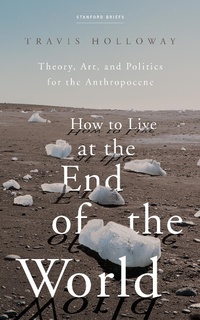
How to Live at the End of the World
Theory, Art, and Politics for the Anthropocene
Published on 3. May 2022
138 pages
978-1-5036-3359-9 (ISBN)
Description

Assessing the dawn of the Anthropocene era, a poet and philosopher asks: How do we live at the end of the world?
The end of the Holocene era is marked not just by melting glaciers or epic droughts, but by the near universal disappearance of shared social enterprise: the ruling class builds walls and lunar shuttles, while the rest of us contend with the atrophy of institutional integrity and the utter abdication of providing even minimal shelter from looming disaster.
The irony of the Anthropocene era is that, in a neoliberal culture of the self, it is forcing us to consider ourselves as a collective again. For those of us who are not wealthy enough to start a colony on Mars or isolate ourselves from the world, the Anthropocene ends the fantasy of sheer individualism and worldlessness once and for all. It introduces a profound sense of time and events after the so-called "end of history" and an entirely new approach to solidarity.
How to Live at the End of the World is a hopeful exploration of how we might inherit the name "Anthropocene," renarrate it, and revise our way of life or thought in view of it. In his book on time, art, and politics in an era of escalating climate change, Holloway takes up difficult, unanswered questions in recent work by Donna Haraway, Kathryn Yusoff, Bruno Latour, Dipesh Chakrabarty, and Isabelle Stengers, sketching a path toward a radical form of democracy-a zoocracy, or, a rule of all of the living.
The end of the Holocene era is marked not just by melting glaciers or epic droughts, but by the near universal disappearance of shared social enterprise: the ruling class builds walls and lunar shuttles, while the rest of us contend with the atrophy of institutional integrity and the utter abdication of providing even minimal shelter from looming disaster.
The irony of the Anthropocene era is that, in a neoliberal culture of the self, it is forcing us to consider ourselves as a collective again. For those of us who are not wealthy enough to start a colony on Mars or isolate ourselves from the world, the Anthropocene ends the fantasy of sheer individualism and worldlessness once and for all. It introduces a profound sense of time and events after the so-called "end of history" and an entirely new approach to solidarity.
How to Live at the End of the World is a hopeful exploration of how we might inherit the name "Anthropocene," renarrate it, and revise our way of life or thought in view of it. In his book on time, art, and politics in an era of escalating climate change, Holloway takes up difficult, unanswered questions in recent work by Donna Haraway, Kathryn Yusoff, Bruno Latour, Dipesh Chakrabarty, and Isabelle Stengers, sketching a path toward a radical form of democracy-a zoocracy, or, a rule of all of the living.
Reviews / Votes
"We may talk casually about the end of the world, but Travis Holloway convincingly argues that the Anthropocene has emerged as a new epic for our time, offering us a narrative of human history, art, and politics capable of shaping the beginning of a new and more collective world."-Anthony Morgan, editor of The Philosopher "A magnificent achievement. Beautifully written and of our time. Going far beyond Arendt's project of thinking a politics of the human condition, Travis Holloway offers a radical concept of the political as a 'democracy of all of the living.'"-Peg Birmingham, DePaul University, editor of Philosophy Today "A powerful and generative text that will help the reader negotiate these disorienting times. Holloway carefully engages with decolonial thought and with the contested category of the Anthropocene to produce a richer sense of the present."-Dipesh Chakrabarty, University of Chicago, author of The Climate of History in a Planetary Age "It requires great concern and care for all forms of life, a poetic imagination, critical thinking and a wide range of interests, from art, politics to geology, to write a book like Travis Holloway's How to Live at the End of the World: Theory, Art and Politics for the Anthropocene."-Sanjeeb Mukherjee, Socialist Perspective "Poet and philosopher Travis Holloway will have none of the current shilly-shallying in his compact book How to Live at the End of the World. The jig is up, and various establishments (including the arts) will have no choice but to confront the inevitably unifying conditions dictated by the Anthropocene. Like it or not, we are on the brink of catastrophe, faced with the collective loss of a reliable and habitable future. Short and provocative, this is my kind of 'how to' book."-Bill Marx, Arts FuseAll prices
More details
Edition
New edition
Language
English
Place of publication
United States
Publishing group
Stanford University Press
Target group
Professional and scholarly
Edition type
New edition
Illustrations
6 tables, 3 figures
ISBN-13
978-1-5036-3359-9 (9781503633599)
Copyright in bibliographic data and cover images is held by Nielsen Book Services Limited or by the publishers or by their respective licensors: all rights reserved.
Schweitzer Classification
Other editions
Additional editions
Book
05/2022
Stanford Briefs
€17.50
Shipment within 15-20 days
Book
05/2021
Stanford Briefs
€18.00
Shipment within 15-20 days
Person
Travis Holloway grew up queer and workingclass in a rural factory town affected by free trade and globalization. He is Assistant Professor of Philosophy at SUNY Farmingdale and a poet and former Goldwater Fellow in Creative Writing at NYU.
Content
Introduction: A Philosophy for the End of the World
1. Time: A Counterhistory for Human Beings
2. Art: The Transition from Postmodern Art to the Anthropocene
3. Politics: Democracy at the End of the World
1. Time: A Counterhistory for Human Beings
2. Art: The Transition from Postmodern Art to the Anthropocene
3. Politics: Democracy at the End of the World

