

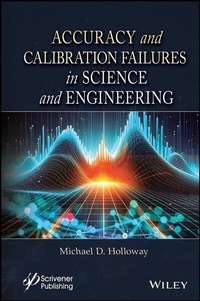
Accuracy and Calibration Failures in Science and Engineering
Description

Safeguard your operational integrity and data reliability with this essential technical and investigative guide, which critically examines and provides actionable frameworks to combat the dangerously undercommunicated risks of calibration drift and systemic measurement failures across all industries.
As industries grow more complex and digitized, the demand for precision and reproducibility has escalated, placing extraordinary reliance on sensors, analytical instruments, and automated data systems. This evolution has exposed systemic vulnerabilities such as outdated calibration protocols, unvalidated assumptions, and fragmented oversight across lifecycle stages. This book is a technical and investigative work that critically examines the overlooked, misunderstood, and dangerously undercommunicated issues of calibration drift, traceability loss, and systemic measurement failures across science, engineering, and industry. The book provides a structured, in-depth exploration of how calibration standards shift without timely notification and the cascading consequences this can have on data reliability, regulatory compliance, safety, and decision-making. The content spans from foundational concepts in calibration and metrology to detailed technical analyses of failure modes in sensors, instruments, and analytical systems. The book emphasizes the interconnectedness of human factors, systemic inertia, and institutional resistance to change, delivering actionable frameworks for building resilience, including updated ISO standards, failure mode and effects analysis, checklists, dashboards, and protocols.
More details
Other editions
Additional editions
Person
Michael D. Holloway is President of the 5th Order Industry, which provides training, failure analysis, and designed experiments. He has more than 40 years of experience in the industry, holding 16 professional certifications and one patent. He has authored ten books and contributed to several others. His expertise lies in failure analysis, reliability engineering, and designed experiments for science and engineering.
Content
Preface xix
1 Introduction: Today is a Good Day to Fail 1
2 The Shift in a Calibration Standard 5
3 Technical Root Causes Behind Calibration Failures 13
4 Calibration Drift in Action: Industry-Specific Failures 19
5 New and Notorious Failures: Analytical Failure and Calibration Risk 79
6 Bad Data Leads to Bad Things Beyond the Lab 105
7 M's Put to Use 124
8 Universal Reasons for Failure 131
9 Building Technical Safeguards 143
10 Summation and Systemic Safeguards 153
11 Historical Data Normalization Protocol 159
12 External Audits and Peer Comparisons 165
13 How to Build and Sustain This Culture 171
14 Steps for Suggested Safeguards 179
15 More Steps for Institutionalizing Retrospective Analysis 199
16 Implementation & Culture Change - Embedding Calibration
17 When Myth Gets It 229
18 Bad Judgment and Being Where You Do Not Belong 241
19 Calibration, Culture, and the Courage to Question 259
Appendix 263
Measurement Integrity Readiness Index (MIRI) 267
Terminology 273
Templates 277
Detailed Checklists by Industry 283
Interactive Workbook Section 291
Calibration Integrity Maturity Model & Scoring System 295
Recalibration Tracking Worksheets 299
Error Reporting & CAPA Analysis Templates 301
References and Source Documentation 303
Index 309
