

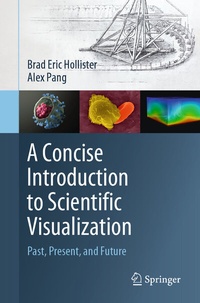
A Concise Introduction to Scientific Visualization
Description

Scientific visualization has always been an integral part of discovery, starting first with simplified drawings of the pre-Enlightenment and progressing to present day. Mathematical formalism often supersedes visual methods, but their use is at the core of the mental process. As historical examples, a spatial description of flow led to electromagnetic theory, and without visualization of crystals, structural chemistry would not exist. With the advent of computer graphics technology, visualization has become a driving force in modern computing.
A Concise Introduction to Scientific Visualization - Past, Present, and Future
serves as a primer to visualization without assuming prior knowledge. It discusses both the history of visualization in scientific endeavour, and how scientific visualization is currently shaping the progress of science as a multi-disciplinary domain.
More details
Other editions
Additional editions
Persons
Alex Pang is a Professor of Computer Science and Engineering at the University of California, Santa Cruz. He received his PhD in Computer Science from UCLA and his BS in Industrial Engineering from University of the Philippines. His research interests are in comparative and uncertainty visualization, flow and tensor visualization, and collaborative visualization. Professor Pang has received a certificate of recognition for previous NASA work, as well as an excellence in teaching award from UCSC. He has previously served as an associate editor of the IEEE Transactions on Visualization and Computer Graphics and was papers co-chair for the IEEE Visualization conference
Content
Preface.- Early Visual Models.- Illustration and Analysis.- Scientific Visualization in the 19 th Century.- A Convergence with Computer Science.- Recent Developments.- The Future.- Bibliography
