Panarchy
Description

Creating institutions to meet the challenge of sustainability is arguably the most important task confronting society; it is also dauntingly complex. Ecological, economic, and social elements all play a role, but despite ongoing efforts, researchers have yet to succeed in integrating the various disciplines in a way that gives adequate representation to the insights of each.
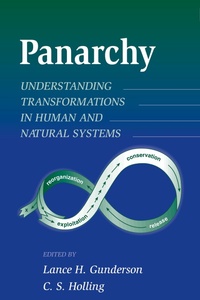
Panarchy, a term devised to describe evolving hierarchical systems with multiple interrelated elements, offers an important new framework for understanding and resolving this dilemma. Panarchy is the structure in which systems, including those of nature (e.g., forests) and of humans (e.g., capitalism), as well as combined human-natural systems (e.g., institutions that govern natural resource use such as the Forest Service), are interlinked in continual adaptive cycles of growth, accumulation, restructuring, and renewal. These transformational cycles take place at scales ranging from a drop of water to the biosphere, over periods from days to geologic epochs. By understanding these cycles and their scales, researchers can identify the points at which a system is capable of accepting positive change, and can use those leverage points to foster resilience and sustainability within the system.
This volume brings together leading thinkers on the subject -- including Fikret Berkes, Buz Brock, Steve Carpenter, Carl Folke, Lance Gunderson, C.S. Holling, Don Ludwig, Karl-Goran Maler, Charles Perrings, Marten Scheffer, Brian Walker, and Frances Westley -- to develop and examine the concept of panarchy and to consider how it can be applied to human, natural, and human-natural systems. Throughout, contributors seek to identify adaptive approaches to management that recognize uncertainty and encourage innovation while fostering resilience.
The book is a fundamental new development in a widely acclaimed line of inquiry. It represents the first step in integrating disciplinary knowledge for the adaptive management of human-natural systems across widely divergent scales, and offers an important base of knowledge from which institutions for adaptive management can be developed. It will be an invaluable source of ideas and understanding for students, researchers, and professionals involved with ecology, conservation biology, ecological economics, environmental policy, or related fields.
More details
Other editions
Additional editions