

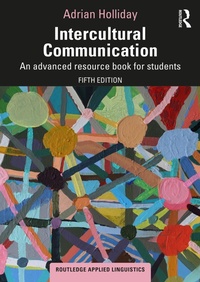
Intercultural Communication
An Advanced Resource Book for Students
5th Edition
Published on 23. March 2026
138 pages
978-1-040-52194-6 (ISBN)
Description

Intercultural Communication remains the definitive critical introduction to how we navigate cultural difference in everyday life. Now in its fifth edition, the book presents a bold reworking of its core structure, offering ten streamlined chapters that challenge essentialist thinking and centre the lived, shifting realities of intercultural encounters.
Through a rich blend of fictionalised ethnographic accounts, media analysis, and academic extracts, Adrian Holliday explores how culture is constructed and negotiated in settings ranging from universities and workplaces to families, migration, and tourism. Topics include self-representation, institutional discourses, classroom dynamics, popular media, and more. Each chapter ends with reflective questions and readings that support further exploration and small-scale research.
This new edition foregrounds interculturality as a practical and political practice, calling for critical curiosity, ethical self-awareness, and resistance to reductive stereotypes. With its accessible framework and engaging materials, Intercultural Communication is essential reading for advanced students and researchers in intercultural communication, applied linguistics, and related fields.
Through a rich blend of fictionalised ethnographic accounts, media analysis, and academic extracts, Adrian Holliday explores how culture is constructed and negotiated in settings ranging from universities and workplaces to families, migration, and tourism. Topics include self-representation, institutional discourses, classroom dynamics, popular media, and more. Each chapter ends with reflective questions and readings that support further exploration and small-scale research.
This new edition foregrounds interculturality as a practical and political practice, calling for critical curiosity, ethical self-awareness, and resistance to reductive stereotypes. With its accessible framework and engaging materials, Intercultural Communication is essential reading for advanced students and researchers in intercultural communication, applied linguistics, and related fields.
More details
Series
Edition
5th edition
Language
English
Place of publication
London
United Kingdom
Publishing group
Taylor & Francis Ltd
Target group
College/higher education
Illustrations
37 Line drawings, black and white; 37 Illustrations, black and white
File size
13,45 MB
ISBN-13
978-1-040-52194-6 (9781040521946)
Copyright in bibliographic data and cover images is held by Nielsen Book Services Limited or by the publishers or by their respective licensors: all rights reserved.
Schweitzer Classification
Other editions
Additional editions

Book
approx. 03/2026
5th Edition
Routledge
€213.10
Not yet published
Book
approx. 03/2026
5th Edition
Routledge
€64.80
Not yet published
Previous edition
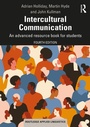
Adrian Holliday | Martin Hyde | John Kullman
Intercultural Communication
An advanced resource book for students
E-Book
04/2021
4th Edition
Routledge
€52.49
Available for download
Person
Adrian Holliday is Professor Emeritus of Applied Linguistics and Intercultural Education at Canterbury Christ Church University. He is the author of Contesting Grand Narratives of the Intercultural (Routledge, 2022) and co-author of Making Sense of the Intercultural (with Sara Amadasi; Routledge, 2020), with research interests spanning interculturality, qualitative methodology, and critical pedagogy.
Content
Preface
Introduction: Using the book
Chapter 1: Initial concepts
Chapter 2: Conference colleagues: 'I'm not Westernised' (Identity)
Chapter 3: Student voices: 'We are not all the same' (Identity)
Chapter 4: Professional identities: 'how we project ourselves' (Identity)
Chapter 5: Encountering the Other next door (Othering)
Chapter 6: Stamping identity on new language (Othering)
Chapter 7: The dangers of thinking we know (Othering)
Chapter 8: Refugee experience: professional vs. decentred knowledge (Representation)
Chapter 9: Complex images and tourism: Representation
Chapter 10: Institutional life: Representation
Introduction: Using the book
Chapter 1: Initial concepts
Chapter 2: Conference colleagues: 'I'm not Westernised' (Identity)
Chapter 3: Student voices: 'We are not all the same' (Identity)
Chapter 4: Professional identities: 'how we project ourselves' (Identity)
Chapter 5: Encountering the Other next door (Othering)
Chapter 6: Stamping identity on new language (Othering)
Chapter 7: The dangers of thinking we know (Othering)
Chapter 8: Refugee experience: professional vs. decentred knowledge (Representation)
Chapter 9: Complex images and tourism: Representation
Chapter 10: Institutional life: Representation
