

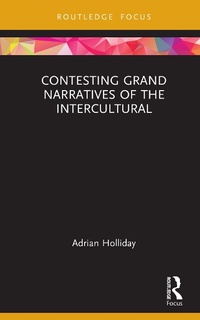
Contesting Grand Narratives of the Intercultural
1st Edition
Published on 24. December 2021
148 pages
978-1-000-52916-6 (ISBN)
Description

Contesting Grand Narratives of the Intercultural uses an autoethnographic account of the author's experience of living in Iran in the 1970s to demonstrate the constant struggle to prevent the intercultural from being dominated by essentialist grand narratives that falsely define us within separate, bounded national or civilisational cultures.
This book provides critical insight that:
DeCentres how we encounter and research the intercultural by means of a third-space methodology
Recovers the figurative, creative, flowing, and boundary-dissolving power of culture
Recognises hybrid integration which enables us the choice and agency to be ourselves with others in intercultural settings
Demonstrates how early native-speakerism pulls us back to essentialist large-culture blocks.
Aimed at students and researchers in applied linguistics, intercultural studies, sociology, and education, this volume shows how cultural difference in stories, personal space, language, practices, and values generates unexpected and transcendent threads of experience to which we can all relate within small culture formation on the go.
This book provides critical insight that:
DeCentres how we encounter and research the intercultural by means of a third-space methodology
Recovers the figurative, creative, flowing, and boundary-dissolving power of culture
Recognises hybrid integration which enables us the choice and agency to be ourselves with others in intercultural settings
Demonstrates how early native-speakerism pulls us back to essentialist large-culture blocks.
Aimed at students and researchers in applied linguistics, intercultural studies, sociology, and education, this volume shows how cultural difference in stories, personal space, language, practices, and values generates unexpected and transcendent threads of experience to which we can all relate within small culture formation on the go.
Reviews / Votes
"As an authoritative interpreter of the intercultural, Holliday has made yet another significant contribution, this time by autoethnographically interrogating the grand narrative of Orientalism juxtaposing it with native-speakerism. Cautioning against "replacing one Othering with another," he opens up "creative diversity beyond large-culture fixity." He has done so by combining the personal, the professional and the political, and more commendably, by de-centering himself as a researcher and intercultural traveler"Professor-Emeritus B. Kumaravadivelu, San Jose State University, California, USA.
"Holliday provides a brilliantly honest and acutely observed intercultural auto-ethnography based on his journal of Iran in the 70's. The careful weaving of the personal with the theoretical traces the 'splintering' of grand narratives into the contingency and detail of everyday experience beautifully"
Cristina Ros i Sole, Goldsmiths, University of London. "As an authoritative interpreter of the intercultural, Holliday has made yet another significant contribution, this time by autoethnographically interrogating the grand narrative of Orientalism juxtaposing it with native-speakerism. Cautioning against "replacing one Othering with another," he opens up "creative diversity beyond large-culture fixity." He has done so by combining the personal, the professional and the political, and more commendably, by de-centering himself as a researcher and intercultural traveler."
Professor-Emeritus B. Kumaravadivelu, San Jose State University, California, USA
"Holliday provides a brilliantly honest and acutely observed intercultural auto-ethnography based on his journal of Iran in the 70's. The careful weaving of the personal with the theoretical traces the 'splintering' of grand narratives into the contingency and detail of everyday experience beautifully."
Cristina Ros i Sole, Goldsmiths, University of London, UK
"Contesting Grand Narratives of the Intercultural offers timely and significant contributions that seek to unthink grant narratives through deCentred perspectives. Utilising a third-space methodology, Holliday foregrounds the politics of looking, the techniques of the body, the way in which we are perceived, and the attacks of cultural blocks that blind us to see threads of hybridity and takes us on a journey through thoughts, observations, reconstructed narratives, and deep personal reflections to demonstrate the (re)construction of culture on the go. We need this approach to un-learn, re-learn and co-learn so that we may develop open engagements and become responsive to unexpected hybridities."
Khawla Badwan, Senior Lecturer in TESOL and Applied Linguistics, Manchester Metropolitan University, UK
"Through an inventive autoethnography of spending years in Iran, Adrian Holliday develops an important argument about how the grand narratives of nation and civilization prevent us from seeing so much hybridity within and flow between the supposedly disparate bounded cultures. This is a delightful and perceptive read."
Asef Bayat, Catherin & Bruce Bastian Professor of Global and Transnational Studies, University of Illinois, Urbana-Champaign, USA
"Employing a thoughtful, balanced blend of theory and rich autoethnographic data, Holliday reflects on and analyzes his experiences during his years in Iran. His detailed observations are illuminating, his writing is engaging, and his analysis firmly counters the stereotypes and Othering embedded in essentialist grand narratives. This book is an important contribution to the study of the intercultural."
Stephanie Vandrick, Professor, University of San Francisco, USA
More details
Series
Edition
1. Auflage
Language
English
Place of publication
London
United Kingdom
Publishing group
Taylor & Francis Ltd
Target group
College/higher education
Illustrations
8 Line drawings, black and white; 8 Illustrations, black and white
ISBN-13
978-1-000-52916-6 (9781000529166)
Copyright in bibliographic data and cover images is held by Nielsen Book Services Limited or by the publishers or by their respective licensors: all rights reserved.
Schweitzer Classification
Other editions
Additional editions
Adrian Holliday
Contesting Grand Narratives of the Intercultural
Book
01/2024
1st Edition
Routledge
€33.00
Shipment within 10-20 days
Adrian Holliday
Contesting Grand Narratives of the Intercultural
Book
12/2021
1st Edition
Routledge
€77.30
Shipment within 15-20 days
Person
Adrian Holliday is a Professor of Applied Linguistics and Intercultural Education at Canterbury Christ Church University, UK.
Content
Chapter 1: Interrogating Cultural Difference | Chapter 2: Spaces | Chapter 3: Stories, Media and Histories | Chapter 4: Language and Concepts | Chapter 5: Classrooms, Time and Professionalism | Chapter 6: Revisiting An Experience
