

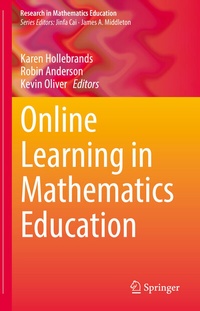
Online Learning in Mathematics Education
Description

This book brings together research from mathematics education and instructional design to describe the development and impact of online environments on prospective and practicing teachers' learning to teach mathematics. The move to online learning has steadily increased over the past decade. Its most rapid movement occurring in 2020 with most instruction taking place remotely. Chapters in this book highlight issues related to teacher learning in three main contexts: formal, informal, and experiential or practice-based. This volume brings together researchers from the different but related fields of instructional design and mathematics education to engage in dialogue around how we design and study the impacts of online learning in general and online mathematics education more specifically.
The book is very timely with most instruction taking place online and mathematics educators addressing challenges related to supporting teachers' formal, informal, and experiential learning online. A chapter in each section will synthesize ideas presented by instructional designers and mathematics educators as it relates to teacher learning in each context. At the end of each section, a retrospective chapter is presented to reflect on what the different perspectives offer to better understand mathematics teacher learning in online environments.This book is of interest to mathematics educators, researchers, teacher educators, professional development providers, and instructional designers.
Reviews / Votes
"This book's strength is that it is multidimensional, rich in theory, practice, research, references, and technology associated with supporting mathematics educators through and towards online learning. This book is a great source of knowledge, and we appreciate the placement of the chapters into each section. The chapter organization within each section provides the reader with a logical progression of conceptual understanding, experience, examples, and empirical research. . we recommend that anyone interested in online mathematics education should read this book." (Marfuah Marfuah, Rita Novita and Sri Wulandari Danoebroto, EducationalStudies in Mathematics, Vol. 112 (2), 2023)More details
Other editions
Additional editions
Persons
Dr. Robin Keturah Anderson is an Assistant Professor at North Carolina State University in the department of Science, Technology, Engineering, and Mathematics Education and a former secondary mathematics and physics teacher. She is a mathematics educator whose research focuses on online teacher learning using computer supported qualitative methods.
Dr. Kevin Oliver is a Professor at North Carolina State University in the department of Teacher Education and Learning Sciences. He coordinates Learning, Design, and Technology (LDT) graduate programs, including an online master's program and an online graduate certificate in learning analytics. He teaches courses on distance education, culture and technology, and informal learning, and has served as a Co-Principal Investigator on grants and contracts to study massively open online courses (MOOCs) and K-12 virtual schooling from the NSF, Gates Foundation, and NC Department of Public Instruction.
