

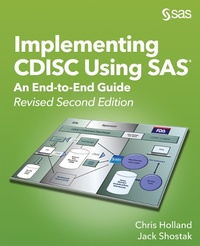
Implementing CDISC Using SAS
Description

Implementing CDISC Using SAS: An End-to-End Guide, Revised Second Edition, is an all-inclusive guide on how to implement and analyze the Study Data Tabulation Model (SDTM) and the Analysis Data Model (ADaM) data and prepare clinical trial data for regulatory submission. Updated to reflect the 2017 FDA mandate for adherence to CDISC standards, this new edition covers creating and using metadata, developing conversion specifications, implementing and validating SDTM and ADaM data, determining solutions for legacy data conversions, and preparing data for regulatory submission. The book covers products such as Base SAS, SAS Clinical Data Integration, and the SAS Clinical Standards Toolkit, as well as JMP Clinical. Topics included in this edition include an implementation of the Define-XML 2.0 standard, new SDTM domains, validation with Pinnacle 21 software, event narratives in JMP Clinical, STDM and ADAM metadata spreadsheets, and of course new versions of SAS and JMP software. The second edition was revised to add the latest C-Codes from the most recent release as well as update the make_define macro that accompanies this book in order to add the capability to handle C-Codes. The metadata spreadsheets were updated accordingly.
Any manager or user of clinical trial data in this day and age is likely to benefit from knowing how to either put data into a CDISC standard or analyzing and finding data once it is in a CDISC format. If you are one such person--a data manager, clinical and/or statistical programmer, biostatistician, or even a clinician--then this book is for you.
More details
Other editions
Additional editions
Persons
Content
- Intro
- Contents
- About This Book
- Background
- What's New in This Edition?
- Is This Book for You?
- Prerequisites
- Purpose
- Organization and Scope of This Book
- Software Used to Develop This Book's Content
- Data and Programs Used in This Book
- Author Pages
- Example Code and Data
- Additional Help
- Keep in Touch
- Contact the Author through SAS Press
- Purchase SAS Books
- Subscribe to the SAS Learning Report
- Publish with SAS
- Acknowledgments
- About These Authors
- Implementation Strategies
- The Case for Standards
- Table 1.1: FDA Documents and Events in Support of Data Standards
- Which Models to Use and Where
- Starting with the Clinical Data Acquisition Standards Harmonization (CDASH) Standard
- Implementation Plans and the Need for Governance
- SDTM Considerations
- ADaM Considerations
- Chapter Summary
- SDTM Metadata and Define.xml for Base SAS Implementation
- More Information
- See Also
- SDTM Metadata
- Table of Contents Metadata
- Table 2.1: Table of Contents Metadata
- Variable-Level Metadata
- Table 2.2: Variable-Level Metadata
- Codelist Metadata
- Table 2.3: Codelist Metadata
- Value-Level Metadata
- Table 2.4: Value-Level Metadata
- Where Clause Metadata
- Table 2.5: Where Clause Metadata
- Computational Method Metadata
- Table 2.6: Computational Method Metadata
- Comments Metadata
- Table 2.7: Comments Metadata
- External Links
- Table 2.8: External Links Metadata
- Building Define.xml
- Define File Header Metadata
- Table 2.9: Metadata File for Define.xml
- Define File Creation SAS Program
- Chapter Summary
- Implementing the CDISC SDTM with Base SAS
- More Information
- See Also
- Base SAS Macros and Tools for SDTM Conversions
- Table 3.1: Base SAS Programs for SDTM Conversions
- Creating an SDTM Codelist SAS Format Catalog
- Creating an Empty SDTM Domain Dataset
- Creating an SDTM --DTC Date Variable
- Creating an SDTM Study Day Variable
- Sorting the Final SDTM Domain Dataset
- Building SDTM Datasets
- Building the Special-Purpose DM and SUPPDM Domains
- Building the LB Findings Domain
- Building a Custom XP Findings Domain
- Building the AE Events Domain
- Building the EX Exposure Interventions Domain
- Building Trial Design Model (TDM) Domains
- Chapter Summary
- Implementing CDISC SDTM with the SAS Clinical Standards Toolkit and Base SAS
- More Information
- SAS Clinical Standards Toolkit Background
- Clinical Standards Setup for Study XYZ123
- Copy SDTM 3.2 Standard to XYZ123
- Edit Study XYZ123 Metadata
- Edit the XYZ123 SAS Clinical Standards Toolkit Control Files
- Register the XYZ123 Standard
- Building SDTM Datasets
- Base SAS Macros and Tools for SDTM Conversions
- Empty Dataset Creator via the SAS Clinical Standards Toolkit
- Domain Sorter via the SAS Clinical Standards Toolkit
- Building the Special-Purpose DM and SUPPDM Domains
- Building Define.xml
- Create the Study Level Metadata Dataset
- Create the Table and Column-Level Metadata Datasets
- Create the Value-Level Metadata Dataset
- Create the Codelists Metadata Dataset
- Create the Document Reference Metadata Dataset
- Create Define File Generation Programs
- Chapter Summary
- Implementing the CDISC SDTM with SAS Clinical Data Integration
- SAS Clinical Data Integration Introduction
- SAS Clinical Data Integration Metadata
- Classifications of SAS Clinical Data Integration Metadata
- CDISC-Published Metadata
- Company-Specific Metadata
- Setup of SAS Clinical Data Integration Metadata
- SAS Clinical Data Integration Study Setup
- Define the Clinical Study and Subfolders
- Register Source Datasets and Define Target SDTM Datasets
- Register Source Datasets
- Define Target SDTM Datasets
- Setting SAS Clinical Data Integration Defaults
- Creating SDTM Domains
- Creating the Special-Purpose DM and SUPPDM Domain
- Extract Transformation
- SQL Join Transformation
- Lookup Transformation
- Transpose Transformation
- Creating the AE (Adverse Events) Events Domain
- Subject Sequence Generator Transformation
- Creating the XP Pain Scale Customized Findings Domain
- Creating the EX Exposure Interventions Domain
- Creating the LB Laboratory Findings Domain
- Creating the Trial Design Model Domains
- Using Customized Code in SDTM Production
- Templating Your SDTM Conversion Jobs for Reuse
- Figure 5.1: General SAS Clinical Data Integration Job Flow to Create an SDTM File
- Using SAS Clinical Data Integration to Create Define.xml
- Chapter Summary
- ADaM Metadata and ADaM Define.xml
- More Information
- See Also
- Metadata Spreadsheets
- Variable Metadata in ADaM
- Analysis Parameter Value-Level Metadata
- Table 6.1: Selected Analysis Parameter Value-Level Metadata for ADEF
- Analysis Results Metadata
- Table 6.2: Description of Metadata Captured in the ANALYSIS_RESULTS Worksheet
- Building Define.xml
- Define.xml Navigation and Rendering
- Chapter Summary
- Implementing ADaM with Base SAS
- See Also
- ADaM Tools
- ISO 8601 Date and DateTime Conversions
- Log 7.1: Use of ISO 8601 Informats
- Merging in Supplemental Qualifiers
- Table 7.1: Supplemental Qualifiers to DM
- ADSL - The Subject-Level Dataset
- The ADaM Basic Data Structure (BDS)
- Table 7.2: Snippet of XP SDTM Data
- ADAE - Adverse Event Analysis Datasets
- ADTTE - The Time-to-Event Analysis Dataset
- Table 7.3: CNSR and EVNTDESC Values
- Chapter Summary
- CDISC Validation Using SAS
- SAS Clinical Standards Toolkit SDTM Validation
- SAS Clinical Standards Toolkit Setup
- Validation Control Data Set
- Study-Based Custom Codelist Format Catalog
- Reference and Source Data Set Metadata
- Properties Files
- SDTM Data Sets
- SAS Clinical Standards Toolkit SDTM Validation Program
- SAS Clinical Data Integration SDTM Validation
- SAS Clinical Standards Toolkit Define.xml Validation Program
- SAS Clinical Data Integration Define.xml Validation
- Chapter Summary
- CDISC Validation Using Pinnacle 21 Community
- Getting Started with Pinnacle 21 Community
- Running Pinnacle 21 Community (Graphical User Interface)
- Evaluating the Report
- Modifying the Configuration Files
- A Note about Controlled Terminology
- Running Pinnacle 21 Community (Command-Line Mode)
- Table 9.1: Selected Pinnacle 21 Community Command-Line Parameters
- ADaM Validation with Pinnacle 21 Community
- ADaM Traceability Checks with SAS
- Define.xml Validation with Pinnacle 21 Community
- Chapter Summary
- CDISC Data Review and Analysis
- Safety Evaluations with JMP Clinical
- Getting Started with JMP Clinical
- Safety Analyses
- Patient Profiles
- Event Narratives
- One PROC Away with ADaM Data Sets
- Transposing the Basic Data Structure for Data Review
- Progression Free Survival with Investigator and Central Assessment
- Chapter Summary
- Integrated Data and Regulatory Submissions
- See Also
- Regulatory Guidance
- Data Integration Challenges
- Data Integration Strategies
- Representing Subjects Who Appear in Multiple Studies in Subject-Level Data Sets
- Table 11.1: DM Data for a Double-Blind Study and Open-Label Extension Study
- Table 11.2: Integration Option 1(IADSL Data for a Double-Blind Study and Open-Label Extension Study (One Record per Subject per Study)
- Table 11.3: Integration Option 2(ADSL Data for a Double-Blind Study and Open-Label Extension Study Combined (One Record per Subject)
- Deciding Which Data to Integrate
- Coding Dictionary Issues
- Table 11.4: Historic Coding Variables Recommended by ADAE
- Summary of Data Integration Strategies
- Data Integration and Submission Tools
- Setting Variable Lengths Based on the Longest Observed Value
- Converting from Native SAS to Version 5.0 Transport Files
- Converting from Version 5.0 Transport Files to Native SAS
- Getting Submission Ready
- Chapter Summary
- Other Topics
- Standard for Exchange of Non-Clinical Data
- Dataset-XML
- BRIDG Model
- Protocol Representation Model
- FDA Janus Clinical Trials Repository
- CDISC Model Versioning
- Future CDISC Directions
- Chapter Summary
- Source Data Programs
- adverse Dataset
- demographics Dataset
- dosing Dataset
- laboratory Dataset
- pain scores Dataset
- SDTM Metadata
- Appendix B.1 - Define Header Metadata
- Appendix B.2 - Table of Contents Metadata
- Appendix B.3 - Variable-Level Metadata
- Appendix B.4 - Value-Level Metadata
- Appendix B.5 - Computational Method Metadata
- Appendix B.6 - Codelist Metadata
- Appendix B.7 - Where Clause Metadata
- Appendix B.8 - Comment Metadata
- Appendix B.9 - External Links Metadata
- ADaM Metadata
- Appendix C.1 - Define Header Metadata
- Appendix C.2 - Table of Contents Metadata
- Appendix C.3 - Variable-Level Metadata
- Appendix C.4 - Parameter-Level Metadata
- Appendix C.5 - Computational Method Metadata
- Appendix C.6 - Where Clause Metadata
- Appendix C.7 - Comments Metadata
- Appendix C.8 - Codelist Metadata
- Appendix C.9 - Analysis Results Metadata
- Appendix C.10 - External Links Metadata
- %run_p21v SAS macro
- %run_p21v SAS Macro
- Additional SAS Code Comments
- Index
- A
- B
- C
- D
- E
- F
- G
- H
- I
- J
- K
- L
- M
- N
- O
- P
- Q
- R
- S
- T
- U
- V
- W
- X
- Z
