

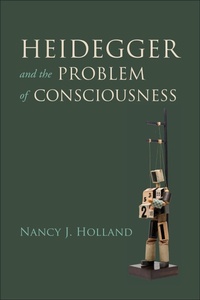
Heidegger and the Problem of Consciousness
Description

Nancy J. Holland turns to the thought of Martin Heidegger to help understand an age-old philosophical question: Is there a split between the body and the mind? Arguing against philosophical positions that define human consciousness as an overarching phenomenon or reduce it to the brain or physicality, Holland contends that consciousness is relational and it is this relationship that allows us to inhabit and negotiate in the world. Holland forwards a complex and nuanced reading of Heidegger as she focuses on consciousness, being, and what might constitute the animal or, more broadly, other-than-human world. Holland engages with the depth and breadth of Heidegger's work as she opens space for a discussion about the uniqueness of human consciousness.
More details
Other editions
Additional editions
Person
Nancy J. Holland is Professor Emerita of Philosophy at Hamline University. Her most recent books are Ontological Humility: Lord Voldemort and the Philosophers and The Madwoman's Reason: The Concept of the Appropriate in Ethical Thought.
Content
Introduction: Heidegger, Nature, and Consciousness
1. The Problem of Consciousness
2. The Earliest Vision
3. The Essence of Truth
4. The Later Heidegger
5. "Something Non-Material. . .But Also Not Unmaterial"
Conclusion: " [is] Not a Soul but the Unmediated Discovery of Being"
Epilogue: Charlemagne's Monogram
Endnotes
References
