

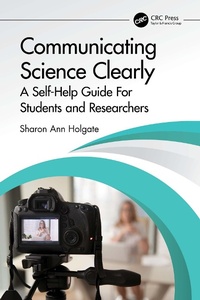
Communicating Science Clearly
A Self-Help Guide For Students and Researchers
1st Edition
Published on 29. November 2023
162 pages
978-1-000-99068-3 (ISBN)
Description

This unique self-help guide equips undergraduates, postgraduate students, and early career researchers within the sciences with transferrable communication skills that they can adapt and refer back to as they progress through their careers.
It provides practical guidance on how to best communicate science in a range of different settings. This book facilitates clear and concise communication in both academic scenarios and the workplace. It covers settings ranging from job interviews, through conference presentations, to explaining your research to the general public.
It is illustrated with first-hand experiences, top tips, and "dos and don'ts" to demonstrate best practices. It will also be a valuable guide for established academics who would like a refresher or a guide to new avenues of science communication, such as podcasts.
Key Features:
Written by an award-winning professional science journalist and broadcaster with 25 years' experience, including writing for national newspapers, devising and presenting programmes for BBC Radio 4, and being interviewed on radio, TV, video, and podcasts
Covers science communication in a broad range of settings including peer-to-peer, to your manager, at job interviews, and during media appearances
Includes advice from a range of experts who communicate professionally, including a radio producer, a TV presenter, actors and entertainers, and scientists
Additional video material to accompany this book can be found here: https://www.youtube.com/playlist?list=PLLUWyRwmgFlW7_NrNupeuiJ86OxIWHZ6I.
It provides practical guidance on how to best communicate science in a range of different settings. This book facilitates clear and concise communication in both academic scenarios and the workplace. It covers settings ranging from job interviews, through conference presentations, to explaining your research to the general public.
It is illustrated with first-hand experiences, top tips, and "dos and don'ts" to demonstrate best practices. It will also be a valuable guide for established academics who would like a refresher or a guide to new avenues of science communication, such as podcasts.
Key Features:
Written by an award-winning professional science journalist and broadcaster with 25 years' experience, including writing for national newspapers, devising and presenting programmes for BBC Radio 4, and being interviewed on radio, TV, video, and podcasts
Covers science communication in a broad range of settings including peer-to-peer, to your manager, at job interviews, and during media appearances
Includes advice from a range of experts who communicate professionally, including a radio producer, a TV presenter, actors and entertainers, and scientists
Additional video material to accompany this book can be found here: https://www.youtube.com/playlist?list=PLLUWyRwmgFlW7_NrNupeuiJ86OxIWHZ6I.
Reviews / Votes
Science communication is an integral part of any scientist's career. Sharon Ann Holgate provides a concise, clear foundation for science students and researchers who want to develop their communication skills. Based on years of practical experience as a science writer and broadcaster, Holgate provides tips for a wide range of communication skills needed in a modern scientific career, including consideration of audience and keeping explanations concise and on message. Holgate notes that "by the summer of 2020, most of us had experienced a sea change in how we communicated," and provides guidance about using remote technologies. Practical sections ranging from conference presentations to writing and broadcasting online are relevant for those who use diverse methods for communicating about their science. With massive and rapid changes in technologies, media and work practices, there is always room for reflexivity about communication and practice to improve skills.- Reviewed by Nancy Longnecker; Professor of Science Communication; University of Otago, New Zealand
In an era of widespread misinformation and troubling scepticism about topics such as vaccines and climate change, the need to be able to communicate about science to the public and the media has never been greater [...] And yet science communication is still rarely covered in degree programmes, leaving otherwise well-qualified scientists at a loss to know how to safely and effectively enter the potential minefield of public engagement and media work.
This is a book that I would thoroughly recommend for scientists at any career stage who want to communicate in a more impactful and memorable way or simply want to feel better prepared and less exposed when it comes to the increasingly important work of public engagement in science.'
- Dr. Stephen Keevil, Professor of Medical Physics at King's College London and Head of Medical Physics at Guy's and St Thomas' NHS Foundation Trust, February 2025.
More details
Edition
1. Auflage
Language
English
Place of publication
London
United Kingdom
Publishing group
Taylor & Francis Ltd
Target group
College/higher education
Product notice
Reflowable
Illustrations
15 Line drawings, black and white; 42 Halftones, black and white; 57 Illustrations, black and white
ISBN-13
978-1-000-99068-3 (9781000990683)
Copyright in bibliographic data and cover images is held by Nielsen Book Services Limited or by the publishers or by their respective licensors: all rights reserved.
Schweitzer Classification
Other editions
Additional editions
Book
11/2023
1st Edition
CRC Press
€139.50
Shipment within 10-20 days
Book
11/2023
1st Edition
CRC Press
€59.70
Shipment within 10-20 days
Person
Sharon Ann Holgate is a freelance science writer and broadcaster. She has presented on BBC Radio 4 and the BBC World Service, and presented video podcasts for medical research charity the Myrovlytis Trust. She earned a D.Phil in physics from the University of Sussex, where she was a Visiting Fellow in Physics and Astronomy for nine years. Her articles have appeared in Science, Science Careers, New Scientist, The Times Higher Education Supplement, The Times Literary Supplement, Flipside, E&T, Focus, Physics World, Interactions, Materials World, Modern Astronomer, and Astronomy Now. She was also shortlisted for the radio programme category of the Association of British Science Writers' Awards in 2005, and for the Aventis Prizes for Science Books Junior Prize in 2003. Dr. Holgate was the recipient of the Institute of Physics 2022 William Thomson, Lord Kelvin Medal and Prize for communicating science to a wide variety of audiences and for positive representations of scientists from non-traditional backgrounds. She has also received the Institute of Physics Young Professional Physicist of the Year Award and a Merit Award in the Daily Telegraph Young Science Writer of the Year competition. She is the author of the undergraduate textbook Understanding Solid State Physics, which is currently in its second edition and used as a core text in universities around the world.
Content
Preface. Author. 1 Introduction. 2 Keeping It Simple and on Message. 3 Tailoring to Your Target Audience. 4 Personal Presentation. 5 Using Remote Technologies. 6 Preparing for Media Interviews, Talks, and Poster Sessions. 7 Giving Talks. 8 Radio, TV, and Online Broadcasting. 9 Newspapers, Magazines, and Books. 10 Social Media and Other Online Writing. 11 Communicating with Individuals and Small Groups. 12 Job and University Interviews. 13 Troubleshooting. Further Reading. Index.
