

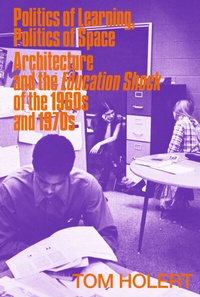
Politics of Learning, Politics of Space
Description

How the relationships between education and outer space have developed historically is exemplified in an incisive way by the decades that followed the "Sputnik shock" of 1957. The wake-up call that resulted from the Soviet space program set the global landscape of learning in motion. New schools and universities came into being against the backdrop of the reform euphoria and mood of catastrophe. At the same time, traditional pedagogical concepts were severely called into question-including the call to do away with institutions of education. What is shown in the architectures of learning is not only a politics of space, but also the educational shock that intensively shook up the global societies of the 1960s and 1970s, while they were gradually being transformed into knowledge societies.
More details
Other editions
Additional editions
Person
Tom Holert, Kunsthistoriker, Kurator und Künstler, Berlin.
Content
- Intro
- Contents
- Preface
- Open Plan and Limited Access: The Embattled Classrooms of the 1960s and 1970s
- School's In/Out: OSZ Wedding, Berlin, or Learning from a Resilient Learning Environment
- Educationalize and Fail: The 1967 Rice Design Fete and the Blind Spots of Transgressive Planning
- Spaces of the Learning Self: Interiority and Instructional Design, ca. 1969
