

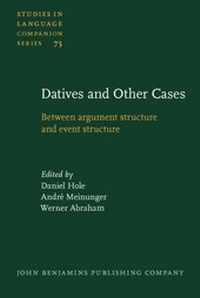
Datives and Other Cases
Between argument structure and event structure
1st Edition
Published on 19. April 2006
VIII, 385 pages
978-90-272-9360-2 (ISBN)
Description

This volume provides a state-of-the-art account of research into datives and other morphological cases. The contributors, among them leading scholars in the field, present fresh insights into traditional issues such as the dichotomy between lexical and structural case, and open up fascinating new areas of research. A recurrent feature of the majority of contributions is their combined syntax-semantics perspective. Germanic varieties, Serbian, Albanian and other Balkan languages alongside Chinese, Japanese, Tagalog are discussed from various theoretical angles such as mainstream generativism, lexical-functional grammar, and functional typology. Despite the broad range of facts spanning the distance between acquisition data and dialectology, the papers are connected by a renewed interest in form-function correspondencies. This volume will be welcomed by theoretical linguists and typologists with an interest in argument and event structure, linguists studying the case systems of individual languages and researchers in search for up-to-date discussion of Germanic datives.
More details
Other editions
Additional editions
Daniel Hole | Andre Meinunger | Werner Abraham
Datives and Other Cases
Between argument structure and event structure
Book
04/2006
John Benjamins Publishing Co
€137.80
Shipment within 10-15 days
Persons
Content
- Datives and Other Cases
- Editorial Page
- Title page
- LCC data
- Table of contents
- Preface
- Introduction
- Introduction
- 1. Cases: Modern deep problems vs. older surface issues
- 1.1. Case, as a typological and traditional grammatical concept
- 1.2. Explanations for the existence of two dative positions
- 1.3. Inherent vs. structural
- 2. Case and valence-induced case combinations
- 2.1. Dative varieties
- 2.2. Regular vs. exceptional patterns in German
- 2.3. Abstract vs. overt/morphological Case
- 2.4. Intensional varieties of the German Dative laid bare: The German Dative height8pt depth3pt width0pt in cross-Germanic comparison
- 2.5. Methodological conclusions: Parsing distinctions
- 3. Case governed by V-incorporated P
- 4. Dative as recipient argument and scalar interpretations
- 5. Dative(s): Reflexivity and reciprocity
- 6. Raised possessors as ergatives in non-ergative languages: The case height8pt depth3pt width0pt of Modern German
- 7. Paradigmatic and syntagmatic dative relations. A new chapter height8pt depth3pt width0pt in case grammar
- 8. The dative as adjective governed: Russian vs. German
- 9. Concluding words: How do semantic roles and argumenthood interact with the syntactic functions of subject and object? Functions of the `dative' other than objecthood?
- Notes
- References
- Focus on Germanic
- German inherent datives and argument structure
- 1. Introduction
- 2. Towards a structural analysis
- 2.1. Structural considerations
- 2.2. Semantic evidence for an argument-structural analysis
- 2.3. Syntactic evidence
- 2.4. Inherent accusatives
- 3. Against a case-based account
- 3.1. Separating movement from case
- 3.2. How are German and Icelandic really different?
- 4. Conclusion
- Notes
- References
- Remarks on the projection of dative arguments in German
- 1. Introduction
- 2. Difficulties with focus projection and a diagnostic for basic word order
- 3. The strict word order hypothesis
- 4. Some similarities with experiencer verbs
- 5. The dat & acc & dat / pp asymmetry
- 6. Low datives are pps
- 7. Some problems and speculations
- 8. Summary
- Notes
- References
- Receiving and perceiving datives (cipients)
- 1. Introduction
- 2. Shifting, raising, doubling
- 2.1. Dative shift
- 2.2. Possessor raising
- 2.3. Applicative head analyses
- 2.4. The location argument
- 2.5. DOCs minus agentive structure are DECs
- 3. Location doubling and whole-part agreement
- 3.1. More on the cipient-PP location relation
- 3.2. Two indices and cipient anchors
- 3.3. Blocking, repetition and outlook
- Notes
- References
- The datives that aren't born equal
- 1. Positions for dative objects of ditransitives
- 1.1. High vs. low datives
- 1.2. Explanations for the existence of two dative positions
- 2. Differences in conceptual structure
- 2.1. Forcing particular interpretations
- 2.2. Zuführen `deliver' and `supply'
- 2.3. Some non-alternating verbs: Aussetzen `expose' and unterziehen `subject'
- 2.4. Distribution of kriegen-passive with respect to interpretation
- 3. Lexical mapping from conceptual structure to grammatical functions
- 3.1. The Dative Alternation and secondary object in English
- 3.2. Lexical Mapping for the German data
- 3.3. Word order: Why two dative positions?
- 4. The kriegen-passive revisited
- 4.1. Norwegian få and predicate composition
- 4.2. Kriegen et al. and predicate composition
- 5. Concluding remarks
- Notes
- References
- The interpretation of German datives and English have
- 1. Introduction
- 2. Syntactic assumptions
- 3. The HAVE relation
- 4. Geben `give'
- 5. Pertinence (possessor) and ficiary (beneficiary/maleficiary) datives
- 5.1. Pertinence and ficiary datives as event-related and affected
- 5.2. Pertinence and ficiary datives as HAVE subjects
- 6. Privative datives
- 7. Datives in various recipient and possessive constructions
- 7.1. Embedded VdatP
- 7.2. Recipient constructions with send, sell etc. as resultative constructions
- 7.3. Recipients co-occurring with directional PP complements
- 8. Datives with verb particles and locational HAVE
- 9. Unintentional causer readings of datives with unaccusatives
- 10. Other datives not analysed here
- 10.1. Probable candidates for a HAVE analysis
- 10.2. Estimative and ethic datives
- 10.3. Low datives
- 11. Conclusions and problems
- Notes
- References
- Dative and indirect object in German dialects
- 1. Introduction
- 1.1. Accessibility Hierarchy and Case Hierarchy
- 1.2. Case
- 1.3. Dative case in German dialects
- 1.4. The data
- 2. Attested relative clause patterns
- 2.1. [+case] strategy in direct object relative clauses
- 2.2. [+case] strategy alternates with [-case] strategy in direct object height8pt depth3pt width0pt relative clauses
- 2.3. [-case] strategy in direct object relative clauses
- 3. Case matching
- 3.1. Case matching in free relative clause formation in Standard German
- 3.2. Case matching in relative clause formation in German dialects
- 4. Summary
- 5. Conclusion
- Notes
- References
- Indirect objects and dative case in monolingual German and bilingual German/Romance language acquisition
- 1. Introduction
- 2. The target system and the acquisition of the dative in German
- 2.1. The target system
- 2.2. The acquisition of Dative: Literature overview
- 3. Bilingual first language acquisition
- 4. Dative case errors: An analysis of longitudinal data
- 4.1. Longitudinal analysis of the use of the dative case
- 4.2. The use of the dative case and correct reproductions of indirect height8pt depth3pt width0pt object by phases
- 5. Discussion and conclusion
- Appendix: Tables indicating absolute numbers of dative case errors (Figures 1-5)
- Notes
- References
- Beyond Germanic
- Unaccusatives with dative causers and experiencers
- 1. Introduction
- 2. Unaccusatives with dative causers and experiencers
- 2.1. The core data: Involuntary states and unintended causations
- 2.2. The distribution of the involuntary state and unintended causation reading
- 3. Other readings of the dative unaccusative construction: height8pt depth3pt width0pt Ambiguity or vagueness?
- 4. Previous analyses
- 4.1. Hubbard (1985)
- 4.2. Kallulli (1999a, b)
- 4.3. Rivero (2003, 2004), Rivero and Milojevic-Sheppard (2003)
- 4.4. Marusic and Zaucer (2004a, 2004b)
- 5. The syntactic visibility of intentionality
- 5.1. A simple event ontology and its syntactic projection
- 5.2. Predicate structure
- 5.3. Defining non-active morphology: Deriving the various constructions height8pt depth3pt width0pt (and their readings)
- 6. Conclusion and open questions
- Notes
- References
- Putting things into perspective
- 1. Introduction
- 2. Syntactic properties
- 2.1. Overview
- 2.2. Is the dative DP a ``quirky'' subject?
- 2.3. The structure of [dative DP + AP]
- 2.4. Pro in SpecDegP
- 3. Interpreting the dative
- 3.1. The semantics of adjectives
- 3.2. The dative DP with adjectives
- 3.3. The dative with comparatives
- 4. Conclusions
- Notes
- References
- Widening the perspective
- 1. General content of the paper
- 1.1. Problems (i) and (ii) and the language data to be analyzed
- 1.2. Linguistic theories in the light of problems (i) and (ii)
- 2. Japanese
- 3. Chinese
- 4. Tagalog
- 5. Conclusion
- Notes
- List of abbreviations
- References
- Index
- The series Studies in Language Companion Series
