

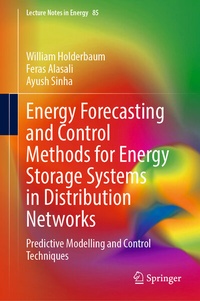
Energy Forecasting and Control Methods for Energy Storage Systems in Distribution Networks
Description

This book describes the stochastic and predictive control modelling of electrical systems that can meet the challenge of forecasting energy requirements under volatile conditions.
The global electrical grid is expected to face significant energy and environmental challenges such as greenhouse emissions and rising energy consumption due to the electrification of heating and transport. Today, the distribution network includes energy sources with volatile demand behaviour, and intermittent renewable generation. This has made it increasingly important to understand low voltage demand behaviour and requirements for optimal energy management systems to increase energy savings, reduce peak loads, and reduce gas emissions.
Electrical load forecasting is a key tool for understanding and anticipating the highly stochastic behaviour of electricity demand, and for developing optimal energy management systems. Load forecasts, especially of the probabilistic variety, can support moreinformed planning and management decisions, which will be essential for future low carbon distribution networks. For storage devices, forecasts can optimise the appropriate state of control for the battery. There are limited books on load forecasts for low voltage distribution networks and even fewer demonstrations of how such forecasts can be integrated into the control of storage.
This book presents material in load forecasting, control algorithms, and energy saving and provides practical guidance for practitioners using two real life examples: residential networks and cranes at a port terminal.
More details
Other editions
Additional editions
Persons
Mr. Ayush Sinha is working as Research Associate with research interest as to apply and optimize machine learning algorithms on demand response optimization and cyber security of critical infrastructure while pursuing PhD at Indian Institute of Information technology Allahabad, India. He has 4 years of research experience in the C3i HUB IIT Kanpur sponsored project(Risk Averse Resilience Framework for Critical Infrastructure Security), and in the Indo-Norway Project(CPSEC) in the field of "Machine Learning Approach for Cyber Security"- (under joint collaboration of IIT Kanpur, IIIT Allahabad and Norwegian University of Science& Technology, Gjowik-Norway). He received his graduation in Mathematics(BHU, India) and postgraduation in Computer Application(MNNIT Allahabad, India) and in Software Systems(BITS Pilani, India). After postgraduation, he worked 9 years for multinationals like Tata Consultancy Services(India) and Ciena India Pvt. Ltd. (Indian and Canada) as a senior Java developer in the field of Telecommunications, Layer zero control plane for optical fiber and Banking/Finance.
Content
Introduction.- Basic tools.- Short term load forecasting.- Control strategies in low voltage network for energy saving.- Optimal control with load forecasting.- Case study: Energy saving based on optimal control and load forecasts.- Conclusion.
