

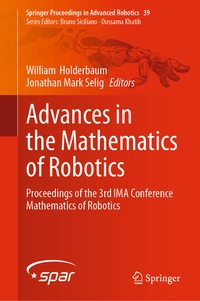
Advances in the Mathematics of Robotics
Description

This book presents the proceedings of the Third IMA Conference on Mathematics of Robotics, held in Manchester in September 2025. It brings together a diverse collection of contributions that reflect the increasing role of mathematics in addressing fundamental problems in robotics.
This book covers a wide range of methods including algebraic geometry, control theory, numerical optimisation, and topological data analysis, applied to topics such as kinematics, motion planning, soft robotics, and multi agent systems. The breadth of contributions, both in subject matter and in international participation, highlights the growing global community at the interface of mathematics and robotics.
Alongside rigorously reviewed research papers, this book also features keynote lectures addressing themes such as uncertainty quantification and geometric approaches to robotic manipulation. Together, these works provide a valuable reference for mathematicians, engineers, and researchers seeking to advance the theoretical foundations and practical capabilities of robotics.
More details
Other editions
Additional editions
Content
1.Robots for Nuclear Decommissioning.- 2.From Maps to Mechanisms.- 3.Origami Design for Continously Foldable Uniaxial Bases.- 4.Model-based and learning approaches to cloth manipulation by robots.- 5.Kinematic synthesis over curves using cellular decompositions and Chebyshev interpolants.- 6.On flexes associated with higher-order fl exible bar-joint frameworks.- 7.Rigid-body motions characterized via the Sannia frame on ruled surfaces.- 8.Inverse kinematic solution for generic 3R positional robots using Conformal Geometric Algebra.- 9.Geometric analysis of generic 3R robots, and necessary and suffi cient conditions for a class of orthogonal robots to have four IKS.- 10.A Constrained Saddle Search Approach for Constructing Singular and Flexible Bar Frameworks.- 11.Bifurcations and Equivariant Morse Theory.- 12.Singly-periodic pointed pseudotriangulations have an expansive motion.- 13.Reorientating a linked three sphere swimmer to a target.- 14.Analysis of a Cuspidal 6R Robot.- 15.A cubic product of exponentials (POE) spline cannot exactly reconstruct a cubic curve on SE(3).- 16.A library of open chain linkage dynamics.- 17.Sixth-order singularities of the 3RR planar pentad mechanism.- 18.Distortion Bounds of Subdivision Models for SO(3).
