

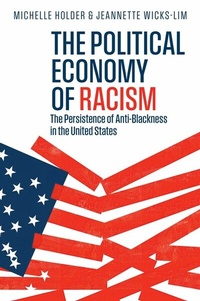
The Political Economy of Racism
Description

Why does racial inequality in America persist? In this important textbook, Michelle Holder and Jeannette Wicks-Lim answer this question by introducing readers to the innovative field of stratification economics. Stratification economics offers an antidote to conventional economics' hyper-focus on individuals and disregard for how politics shapes the economy. It spotlights how groups - such as racial groups - compete to gain favorable positions in society through political and economic domination. The book fuses stratification economics with intersectional theory to illuminate how gender and ethnicity intertwine with racial oppression. Holder and Wicks-Lim argue that anti-Black racism developed and persists because it protects the interests of a politically dominant social group: White Americans. This argument is demonstrated across multiple arenas: education, employment, wealth, and the criminal legal system. Policy intervention - through government action spurred by social movements - is necessary for achieving racial equity.
More details
Other editions
Additional editions
Persons
Jeannette Wicks-Lim is Research Professor at the Political Economy Research Institute, University of Massachusetts Amherst.
Content
List of Figures and Tables
Part One: How We Use Stratification Economics to Analyze Anti-Blackness in the United States
1 Introduction
2 The Construction of Race and the Origins of Racism in the United States
3 Afro-Latinxs and Anti-Blackness
4 An Intersectional Approach to Stratification Economics
Part Two: Demonstrating How Anti-Blackness Stratifies the U.S. Economy
Primer to Part Two
5 Education: Unequal Access, Unequal Outcomes
6 Unemployment, Occupational Crowding, Wage Inequality And Anti-Blackness in the Labor Market
7 Wealth and Anti-Blackness: The Case of Black Women
8 The Criminal Legal System: Hardening the Racial Divide
9 Conclusion
Notes
References
Index
Acknowledgments
This book is going into production a few months after Donald Trump's inauguration as the 47th president of the United States. In this short time, Trump's second term has hurled the United States into a frightful and repressive era.1 One example particularly relevant for our book is his administration's determination to expunge from educational institutions work engaged in studying and/or addressing the problem of disparities between privileged and marginalized social groups, including racial groups.2 The president's efforts hit at both people employed in Diversity, Equity, and Inclusion (DEI) programs and what his administration pejoratively calls "woke ideology." DEI programs are the institutional policies - such as in schools, businesses, and government agencies - that proliferated in response to the Black Lives Matter movement.3 These programs are meant to go beyond increasing the "diversity" of perspectives operating within an institution by adding two additional priorities: achieving a measure of justice, or equity, for marginalized social groups that have experienced a long history of inequity, as well as fostering a climate of inclusion as a remedy to a long history of exclusion. Under the Trump administration, the mere mention of even one of these three words as part of any federal program risks the program's excision.4 "Woke ideology" appears to refer to any analysis or discussion of racism, in particular.
In this environment, the educational institutions that we have been anticipating would be the primary forums through which we could share our book are vulnerable to the Trump administration's censorship. Consequently, we suspect that these institutions may not be willing and/or able to offer our book in their classrooms. Indeed, just about all higher education institutions appear vulnerable to the pressure to suppress any discussion of racism on their campuses given the acquiescence to Trump administration demands by super-endowed private institutions such as Columbia University, as well as elite public institutions such as University of Michigan.5 And the Trump administration's attack on any critical analysis of racism and DEI efforts is happening everywhere: in education,6 employment,7 government,8 public health,9 the arts,10 scientific research11 (including in economics12), and more.13 The tentacles of influence linked to federal authority and funds that reached across the country to promote racial equity in the wake of the 1960s Civil Rights Movement are now twisting around, and squeezing out, any discussion of diversity, equity, or inclusion.
We believe that this political conjuncture makes our book even more important to publish. This is for two basic reasons. First, our book documents the truth about racism and the racial hierarchy that operates in the United States, built primarily on a foundation of anti-Blackness. Presenting the facts of this truth is our way of doing, as W. E. B. Du Bois was wont to do: to "look America squarely in the face" and say, "This country of ours, despite all its better souls have done and dreamed, is yet a shameful land."14 Second, this book is our attempt to fulfill the marching orders of the late, great, economist Rhonda Williams. Williams' directive - shared by Nina Banks in her 2021 National Economics Association (NEA) presidential address - was that "We have to publish to leave footprints. We have to publish so that others will have something to build on." Fellow economist Patrick Mason said of Williams' charge, "for Rhonda, research and journal publications weren't a selfish/careerist activity. It was her contribution to the struggle; we are all part of a collective enterprise."15 We are publishing this book to leave footprints, so that anyone interested in our collective enterprise to eradicate racial oppression can build on our efforts. This propels us with excitement to get this book out. We want to share our book in spite of, and because of, the likely censorship that our type of scholarship will face in the coming years.
We are grateful for our network of colleagues in the NEA which buoys, motivates, and informs our work - the above is just one example of this. Along with Patrick, Nina, and Rhonda, we want to specifically thank William Darity Jr., Samuel Myers Jr., and Rhonda Sharpe, along with Lisa Saunders and William Spriggs, both of whom we lost while writing this book. We also want to put a spotlight on how we have benefitted from the numerous -and ongoing - conversations started at the annual Freedom and Justice summer conferences that the NEA co-sponsors along with the Association for Economic Research of Indigenous Peoples and the American Society of Hispanic Economists.
We would like to thank the University of Massachusetts School for Behavior and Social Sciences and the Political Economy Research Institute (PERI) of the University of Massachusetts for the multiple ways they supported the development of this book. These supports include providing Jeannette with the time, space, and resources to work on this book, as well as funding for our research assistant, UMass Economics doctoral candidate Daniella Medina. Daniella provided us with truly outstanding research, editorial, technical, and moral support. They contributed to our book in both small and large ways, in particular by authoring the textboxes that appear in each of the book chapters, excepting the conclusion. We'd also like to thank the City University of New York John Jay College Office for the Advancement of Research, as well as John Podesta and the Washington Center for Equitable Growth, for research and fellowship funding for Michelle which allowed her the time and space to write portions of this book.
We want to also thank Polity editor George Owers, whose enthusiasm for our book proposal gave us great encouragement; Polity editors Ellen MacDonald, Ian Malcolm, Evie Deavall, and Leigh Mueller, who treated us with generous amounts of both patience and guidance. We thank the anonymous reviewers of our book proposal and manuscript draft, as well as our colleague and friend Patrick Mason who gave us thoughtful feedback on our draft even while he was serving as the chair of the Economics Department at the University of Massachusetts Amherst. With the support of these reviewers, we were able to improve the quality of our book.
Michelle would like to thank, first and foremost, her (late) mother Daphne, her role model and chief cheerleader. Michelle would also like to thank Jeannette for inviting her to participate in this important project, as well as for graciously accommodating Michelle's scheduling needs throughout the years this book was written. Michelle would also like to thank daughters Dream and Damaris for their inspiration and patience as mom spent many hours writing; brothers Bert and Mike; niece and nephews Imani, Miles, and Ian; sister-in-law Nilda; cousins Yvonne, Desiree, and Gordon; godson Khaya Adams; and friends Adrian Techeira, Robert Jones Jr., Agnes Callamard, Julia Landau, Tony Medina, Helen Yosef Hailu, Joan Williams, Regina Eaton, Bobo Diallo, Rose Golden, Amy Adamczyk, Darrick Hamilton, Teresa Ghilarducci, Kate Bahn, Nina Banks, Stephanie Seguino, Jessica Gordon Nembhard, Alan Aja, Daniele Tavani, Rakeen Mabud, and Livia Summers - who lovingly cared for Dream and Damaris whenever needed; colleagues Elissa Braunstein, Heidi Hartmann, Jay Hamilton, Rita Taveras, Ian Seda, Daniel Stageman, Lygia Sabbag Fares, and Gail Garfield. Finally, Michelle thanks John Jay College, City University of New York, for being her intellectual and professional home for the last 11 years, as well as President Karol Mason, Provost Allison Pease, Associate Provost Anthony Carpi, and Interim Dean of Faculty Angela Crossman.
Jeannette would like to personally thank Michelle for joining her on this book project. Michelle's knack for open communication, generous-hearted-yet-disciplined thinking, and wealth of knowledge made the project truly rewarding. Jeannette is ever indebted to her family - her family of origin and the family she created with her partner Ali - whose love and support made it possible for her to work on this book. Her family includes, along with partner Ali, her parents, Byung H. and Choon H. Lim, big sister Mee Mee (and partner Matt) and big brother David (and partner Rebecca), son Mason, daughter Summit, and in-laws Lee and Roy. Last, but not least, Jeannette thanks her long-time colleagues at PERI and at the University of Massachusetts Economics Department for their professional support and warm camaraderie. These include - in addition to the aforementioned Patrick Mason and Lisa Saunders - Peter Arno, Michael Ash, Lee Badgett, Shouvik Chakraborty, Nicole Dunham, Gerald Epstein, Judy Fogg, Mwangi wa Githinji, Léonce Ndikumana, Robert Pollin, and Kim Weinstein.
Notes
- 1 C. Savage (2025), "Congress Wrote a Deportation Law to Be Used 'Sparingly.' Trump Has Other Ideas," New York Times, April 1, available at: www.nytimes.com/2025/04/01/us/trump-deportations-students-campus-protests.html; M. Matza (2025), "US Judge Scolds Trump Officials for Failing to Return Man Deported in Error," BBC, April 6, available at: www.bbc.com/news/articles/cn4jz3v401yo; T. Bedford...
