

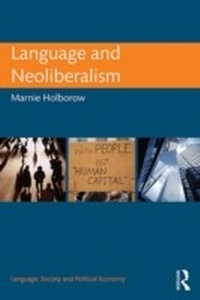
Language and Neoliberalism
1st Edition
Published on 20. February 2015
160 pages
978-1-317-51217-2 (ISBN)
Description

Language and Neoliberalism examines the ways in which neoliberalism, or the ideology of market rule, finds expression in language. In this groundbreaking original study, Holborow shows at once the misleading character of ideological meaning and the underlying social reality from which that meaning emerges.
In universities, it is now the norm to use terms like entrepreneurial and business partnerships. How have these terms become a core component of education and gained such force? Markets have become, metaphorically, a power in their own right. They now tell governments how to act and warn them against too much public spending. Post-crash, the capitalist market continues to be crisis-prone, and in that context the neoliberal ideology remains contested.
Free of jargon and assuming no specialist knowledge, this book will strike a chord internationally by showing how neoliberal ideology has, literally, gone global in language. Drawing on Volosinov and Bakhtin, Williams and Gramsci, and introducing concepts from Marxist political economy, Language and Neoliberalism is essential reading for all interested in the intersection of linguistics/applied linguistics and politics.
In universities, it is now the norm to use terms like entrepreneurial and business partnerships. How have these terms become a core component of education and gained such force? Markets have become, metaphorically, a power in their own right. They now tell governments how to act and warn them against too much public spending. Post-crash, the capitalist market continues to be crisis-prone, and in that context the neoliberal ideology remains contested.
Free of jargon and assuming no specialist knowledge, this book will strike a chord internationally by showing how neoliberal ideology has, literally, gone global in language. Drawing on Volosinov and Bakhtin, Williams and Gramsci, and introducing concepts from Marxist political economy, Language and Neoliberalism is essential reading for all interested in the intersection of linguistics/applied linguistics and politics.
Reviews / Votes
'An acute, imaginative piece of discourse analysis which reveals in tenacious detail just how deeply our language has been contaminated by the dehumanising idiom of the corporations' Terry Eagleton, University of Lancaster, UK'Holborow raises the bar for studies of language and political economy. She applies subtle Marxist analyses to how keywords linked to markets and entrepreneurialism are shaping an ever-increasing number of spheres and activities. She provocatively asks when, how and if metaphors of market and commodity-including uses by critical scholars-challenge neoliberal ideologies. This book is a crucial read for applied linguists, sociolinguists, linguistic anthropologists, and anyone interested in the role of language in ideologies that justify or obscure or try to make commonsensical exploitative economic relations.' Bonnie McElhinny, University of Toronto, Canada
'...the book is a notable contribution to the study of neoliberalism as a political as well as an economic project, and its emphatic distinction 'between the ideological representation of the world and ... the real experience of class conflict' (130) constitutes, amongst other forms of praxis, a crucial dimension of 'the much needed challenge to neoliberalism' (131) - a challenge that many of our more 'fashionable' theories are unable to present.' Liane Tanguay (University of Houston-Victoria) Key Words
More details
Series
Language
English
Place of publication
London
United Kingdom
Publishing group
Taylor & Francis Ltd
Target group
College/higher education
File size
2,22 MB
ISBN-13
978-1-317-51217-2 (9781317512172)
Copyright in bibliographic data and cover images is held by Nielsen Book Services Limited or by the publishers or by their respective licensors: all rights reserved.
Schweitzer Classification
Other editions
Additional editions
Marnie Holborow
Language and Neoliberalism
Book
03/2015
1st Edition
Routledge
€76.30
Shipment within 15-20 days
Marnie Holborow
Language and Neoliberalism
Book
02/2015
1st Edition
Routledge
€253.00
Shipment within 15-20 days
Person
Marnie Holborow is a lecturer in the School of Applied Language and Intercultural Studies in Dublin City University, Ireland. She is a co-author of Neoliberalism and Applied Linguistics and has written widely on the presence of neoliberal ideology in language.
Content
Chapter 1. Introduction: Language and Neoliberalism: Issues and
Framework
Chapter 2. Neoliberalism and Language as a Commodity
Chapter 3. Markets, Metaphors and Neoliberal Ideology
Chapter 4. Language and the Market Metaphor
Chapter 5. The Neoliberal Invention of Entrepreneur
Chapter 6. Austerity, Entrepreneurship and the Neoliberal
University
Chapter 7. Conclusion: Implications for Understanding Ideology in
Language
Framework
Chapter 2. Neoliberalism and Language as a Commodity
Chapter 3. Markets, Metaphors and Neoliberal Ideology
Chapter 4. Language and the Market Metaphor
Chapter 5. The Neoliberal Invention of Entrepreneur
Chapter 6. Austerity, Entrepreneurship and the Neoliberal
University
Chapter 7. Conclusion: Implications for Understanding Ideology in
Language
