

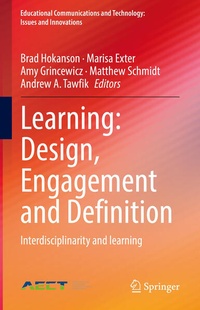
Learning: Design, Engagement and Definition
Description

This book examines the topic of learning design from a human, interactive, and collaborative perspective. A variety of pedagogic and instructional modalities are thoroughly investigated as methodologies for creating functional and effective designs for students. The book is appropriate for all levels of teaching and learning, but special attention is paid to the special requirement of higher education, graduate education and post-graduate classrooms.
Within the research chapters are embedded numerous examples, case studies, and implementation guides. The book is a scholarly yet practical guide to learning design and everyone from educational researchers in all areas of educational technology to instructional designers and instructional technologists will find it useful and inspiring at once.
More details
Other editions
Additional editions
Persons
Brad Hokanson is a professor in Design at the University of Minnesota. He has a diverse academic record, including degrees in art, architecture, urban design, and received his Ph.D. in Instructional Technology. He teaches in the area of creative problem solving and has published research in the fields of creativity and educational technology. His most recent book on the development of creativity is Developing Creative Thinking in Learners. He also is currently the Mertie Buckman Professor of Design Education. He won his college's awards for outstanding teaching in 2002 and 2008.
He has recently completed research on the relationship between creativity and achievement in school children, comparing measured creativity with standardized achievement scores. He is now running his fourth massive online course on creativity for the University of Minnesota with an enrollment of over 201,000. Previous courses each enrolled over 52,000 learners.
He served asPresident of the Association of Educational Communication and Technology in 2017 and won the J. Michael Spector Award for exemplary service to AECT, 2020.
