

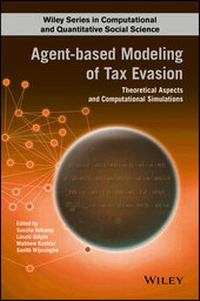
Agent-based Modeling of Tax Evasion
Description

The only single-source guide to understanding, using, adapting, and designing state-of-the-art agent-based modelling of tax evasion
A computational method for simulating the behavior of individuals or groups and their effects on an entire system, agent-based modeling has proven itself to be a powerful new tool for detecting tax fraud. While interdisciplinary groups and individuals working in the tax domain have published numerous articles in diverse peer-reviewed journals and have presented their findings at international conferences, until Agent-based Modelling of Tax Evasion there was no authoritative, single-source guide to state-of-the-art agent-based tax evasion modeling techniques and technologies.
Featuring contributions from distinguished experts in the field from around the globe, Agent-Based Modelling of Tax Evasion provides in-depth coverage of an array of field tested agent-based tax evasion models. Models are presented in a unified format so as to enable readers to systematically work their way through the various modeling alternatives available to them. Three main components of each agent-based model are explored in accordance with the Overview, Design Concepts, and Details (ODD) protocol, each section of which contains several sub elements that help to illustrate the model clearly and that assist readers in replicating the modeling results described.
- Presents models in a unified and structured manner to provide a point of reference for readers interested in agent-based modelling of tax evasion
- Explores the theoretical aspects and diversity of agent-based modeling through the example of tax evasion
- Provides an overview of the characteristics of more than thirty agent-based tax evasion frameworks
- Functions as a solid foundation for lectures and seminars on agent-based modelling of tax evasion
The only comprehensive treatment of agent-based tax evasion models and their applications, this book is an indispensable working resource for practitioners and tax evasion modelers both in the agent-based computational domain and using other methodologies. It is also an excellent pedagogical resource for teaching tax evasion modeling and/or agent-based modeling generally.
More details
Other editions
Additional editions
Persons
Sascha Hokamp, PhD is a member of the Research Unit for Sustainability and Global Change (FNU) and of the Center for Earth System Research and Sustainability (CEN), Universität Hamburg. His research topics include illicit activities (tax evasion and doping in elite sports) and the shadow economy.
László Gulyás, PhD is Assistant Professor at Eötvös Loránd University, Budapest. He is a former Head of Division at AITIA International, Inc. He has been doing research on agent-based modeling and multi-agent systems since 1996.
Matthew Koehler, PhD is the Applied Complexity Sciences Area Lead for US Treasury/Internal Revenue Service, US Commerce, and Social Security Administration Program Division at The MITRE Corporation.
Sanith Wijesinghe, PhD is Chief Engineer of the Model Based Analytics department at The MITRE Corporation.
Content
Notes on Contributors xiii
Foreword xxi
Preface xxvii
Part I Introduction
1 Agent-Based Modeling and Tax Evasion: Theory and Application 3 Sascha Hokamp, László Gulyás, Matthew Koehler and H. Sanith Wijesinghe
1.1 Introduction 3
1.2 Tax Evasion, Tax Avoidance and Tax Noncompliance 4
1.3 Standard Theories of Tax Evasion 5
1.4 Agent-Based Models 10
1.5 Standard Protocols to Describe Agent-Based Models 11
1.5.1 The Overview, Design Concepts, Details, and Decision-Making Protocol 13
1.5.2 Concluding Remarks on the ODD+D Protocol 17
1.6 Literature Review of Agent-Based Tax Evasion Models 18
1.6.1 Public Goods, Governmental Tasks and Back Auditing 22
1.6.2 Replication, Docking, and Calibration Studies 25
1.6.3 Concluding Remarks on Agent-Based Tax Evasion Models 26
1.7 Outlook: The Structure and Presentation of the Book 27
1.7.1 Part I Introduction 28
1.7.2 Part II Agent-Based Tax Evasion Models 28
References 31
2 How Should One Study Clandestine Activities: Crimes, Tax Fraud, and Other "Dark" Economic Behavior? 37 Aloys L. Prinz
2.1 Introduction 37
2.2 Why Study Clandestine Behavior At All? 38
2.3 Tools for Studying Clandestine Activities 40
2.4 Networks and the Complexity of Clandestine Interactions 42
2.5 Layers of Analysis 45
2.6 Research Tools and Clandestine Activities 48
2.7 Conclusion 55
Acknowledgment 56
References 56
3 Taxpayer's Behavior: From the Laboratory to Agent-Based Simulations 59 Luigi Mittone and Viola L. Saredi
3.1 Tax Compliance: Theory and Evidence 59
3.2 Research on Tax Compliance: A Methodological Analysis 62
3.3 From Human-Subject to Computational-Agent Experiments 68
3.4 An Agent-Based Approach to Taxpayers' Behavior 73
3.4.1 The Macroeconomic Approach 74
3.4.2 The Microeconomic Approach 77
3.4.3 Micro-Level Dynamics for Macro-Level Interactions among Behavioral Types 80
3.5 Conclusions 83
References 84
Part II Agent-Based Tax Evasion Models
4 Using Agent-Based Modeling to Analyze Tax Compliance and Auditing 91 Nigar Hashimzade and Gareth Myles
4.1 Introduction 91
4.2 Agent-Based Model for Tax Compliance and Audit Research 93
4.2.1 Overview 93
4.2.2 Design Concepts 94
4.2.3 Details 98
4.3 Modeling Individual Compliance 98
4.3.1 Expected Utility 98
4.3.2 Behavioral Models 101
4.3.3 Psychic Costs and Social Customs 102
4.4 Risk-Taking and Income Distribution 106
4.5 Attitudes, Beliefs, and Network Effects 111
4.5.1 Networks and Meetings 113
4.5.2 Formation of Beliefs 113
4.6 Equilibrium with Random and Targeted Audits 115
4.7 Conclusions 119
Acknowledgments 122
References 122
Appendix 4A 123
5 SIMULFIS: A Simulation Tool to Explore Tax Compliance Behavior 125 Toni Llacer, Francisco J. Miguel Quesada, José A. Noguera and Eduardo Tapia Tejada
5.1 Introduction 125
5.2 Model Description 126
5.2.1 Purpose 127
5.2.2 Entities, State Variables, and Scales 127
5.2.3 Process Overview and Scheduling 131
5.2.4 Theoretical and Empirical Background 131
5.2.5 Individual Decision Making 132
5.2.6 Learning 135
5.2.7 Individual Sensing 136
5.2.8 Individual Prediction 136
5.2.9 Interaction 137
5.2.10 Collectives 137
5.2.11 Heterogeneity 138
5.2.12 Stochasticity 138
5.2.13 Observation 139
5.2.14 Implementation Details 140
5.2.15 Initialization 140
5.2.16 Input Data 141
5.2.17 Submodels 141
5.3 Some Experimental Results and Conclusions 145
Acknowledgments 148
References 148
6 TAXSIM: A Generative Model to Study the Emerging Levels of Tax Compliance in a Single Market Sector 153 László Gulyás, Tamás Máhr and István J. Tóth
6.1 Introduction 153
6.2 Model Description 155
6.2.1 Overview 155
6.2.2 Design Concepts 165
6.2.3 Observation and Emergence 172
6.2.4 Details 173
6.3 Results 175
6.3.1 Scenarios 175
6.3.2 Sensitivity Analysis 182
6.3.3 Adaptive Audit Strategy 190
6.3.4 Minimum Wage Policies 192
6.4 Conclusions 194
Acknowledgments 196
References 196
7 Development and Calibration of a Large-Scale Agent-Based Model of Individual Tax Reporting Compliance 199 Kim M. Bloomquist
7.1 Introduction 199
7.1.1 Taxpayer Dataset 201
7.1.2 Agents 202
7.1.3 Tax Agency 204
7.1.4 Taxpayer Reporting Behavior 207
7.1.5 Filer Behavioral Response to Tax Audit 209
7.1.6 Model Execution 210
7.2 Model Validation and Calibration 211
7.3 Hypothetical Simulation: Size of the "Gig" Economy and Taxpayer Compliance 214
7.4 Conclusion and Future Research 216
Acknowledgments 216
References 217
Appendix 7A: Overview, Design Concepts, and Details (ODD) 218
7a.1 Purpose 218
7a.2 Entities, State Variables, and Scales 218
7a.3 Process Overview and Scheduling 219
7a.4 Design Concepts 219
7a.4.1 Basic Principles 219
7a.4.2 Emergence 220
7a.4.3 Adaptation 220
7a.4.4 Objectives 220
7a.4.5 Learning 220
7a.4.6 Prediction 221
7a.4.7 Sensing 221
7a.4.8 Interaction 221
7a.4.9 Stochasticity 221
7A.4.10 Collectives 222
7A.4.11 Observation 222
7a.5 Initialization 223
7a.6 Input Data 223
7a.7 Submodels 224
8 Investigating the Effects of Network Structures in Massive Agent-Based Models of Tax Evasion 225 Matthew Koehler, Shaun Michel, David Slater, Christine Harvey, Amanda Andrei and Kevin Comer
8.1 Introduction 225
8.2 Networks and Scale 226
8.3 The Model 230
8.3.1 Overview 230
8.3.2 Design Concepts 232
8.3.3 Details 237
8.4 The Experiment 241
8.5 Results 241
8.5.1 Impact of Scale 243 8.5.2 Distributing the Model on a Cluster Computer 246
8.6 Conclusion 251
References 251
9 Agent-Based Simulations of Tax Evasion: Dynamics by Lapse of Time, Social Norms, Age Heterogeneity, Subjective Audit Probability, Public Goods Provision, and Pareto-Optimality 255 Sascha Hokamp and Andrés M. Cuervo Díaz
9.1 Introduction 255
9.2 The Agent-Based Tax Evasion Model 257
9.2.1 Overview of the Model 257
9.2.2 Design Concepts 264
9.2.3 Details 268
9.3 Scenarios, Simulation Results, and Discussion 269
9.3.1 Age Heterogeneity and Social Norm Updating 269
9.3.2 Public Goods Provision and Pareto-optimality 274
9.3.3 The Allingham-and-Sandmo Approach Reconsidered 277
9.3.4 Calibration and Sensitivity Analysis 281
9.4 Conclusions and Outlook 284
Acknowledgments 285
References 285
Appendix 9A 287
10 Modeling the Co-evolution of Tax Shelters and Audit Priorities 289 Jacob Rosen, Geoffrey Warner, Erik Hemberg, H. Sanith Wijesinghe and Una-May O'Reilly
10.1 Introduction 289
10.2 Overview 291
10.3 Design Concepts 293
10.3.1 Simulation 294
10.3.2 Optimization 297
10.4 Details 299
10.4.1 IBOB 299
10.4.2 Grammar 302
10.4.3 Parameters 304
10.5 Experiments 305
10.5.1 Experiment LimitedAudit: Audit Observables That Do Not Detect IBOB 305
10.5.2 Experiment EffectiveAudit: Audit Observables That Can Detect IBOB 308
10.5.3 Experiment CoEvolution: Sustained Oscillatory Dynamics Of Fitness Values 308
10.6 Discussion 311
References 314
11 From Spins to Agents: An Econophysics Approach to Tax Evasion 315 Götz Seibold
11.1 Introduction 315
11.2 The Ising Model 316
11.2.1 Purpose 316
11.2.2 Entities, State Variables, and Scales 316
11.2.3 Process Overview and Scheduling 318
11.3 Application to Tax Evasion 320
11.4 Heterogeneous Agents 324
11.5 Relation to Binary Choice Model 330
11.6 Summary and Outlook 333
References 334
Index 337
Notes on Contributors
Amanda Andrei is a social scientist and senior artificial intelligence engineer at The MITRE Corporation specializing in social analytics, development of innovative processes and spaces, and application of mixed methods to sociotechnical problems. She received her BA in Anthropology from the College of William & Mary, her Certificate in Computational Social Science from George Mason University, and her MA in Communication, Culture, and Technology from Georgetown University.
Kim M. Bloomquist is an operations research analyst with the U.S. Internal Revenue Service's Taxpayer Advocate Service. He has authored and coauthored numerous papers and book chapters on the economics of taxpayer compliance and agent-based modeling. His research has been cited in Congressional testimony, the Washington Post, Tax Notes, and Tax Notes International. He has received several awards for his research on tax compliance including the Organization for Economic Cooperation and Development's (OECD) Jan Francke Tax Research Award, the Cedric Sandford medal for the best paper at the seventh International Conference on Tax Administration in Sydney, Australia, and the IRS Research Community Award for Research Technical Expertise. Kim received his PhD (Computational Social Science) from George Mason University, Fairfax, Virginia in 2012.
Kevin Comer is a Modeling and Simulation Engineer at the MITRE Corporation, specializing in agent-based modeling design, development and validation. His primary focus is in simulating the dynamics of the individual health insurance market. He also works on modeling processes in cybersecurity and homeland security. He received his B.S. in Systems Engineering and Economics from the University of Virginia, his M.S. in Operations Research from George Mason University Volgenau School of Engineering, and his Ph.D. in Computational Social Science from George Mason University's Department of Computational Social Science. His email address is ktcomer@mitre.org.
Andrés M. Cuervo Díaz completed his BSc in Physics from Universidad de los Andes, Bogota, Colombia, in 2014 in the field of quantum optics and is a master's student in the study program "Integrated Climate System Sciences" at the Cluster of Excellence (DFG EXC 177 CliSAP), participating in the research group Climate Change and Security (CLISEC). He is mainly interested in agent-based and integrated assessment modeling for the evaluation of policies' performance and possible strategies to enhance environmental protection and climate change action.
László Gulyás holds a PhD in Computer Science from Eötvös Loránd University, Hungary. He is an assistant professor at Eötvös Loránd University, Budapest, and held the position of head of division at AITIA International, Inc. He has been doing research on agent-based modeling and multiagent systems since 1996. He has been involved in teaching both graduate and undergraduate level courses in agent-based modeling and simulation at Harvard University, at the Central European University and at the Eötvös Loránd University, Hungary. He has authored several book chapters and journal articles. In particular, László has published on agent-based modeling of tax evasion since 2009.
Nigar Hashimzade obtained her PhD in Economics from Cornell University in 2003. Prior to her current position at Durham she has worked at the University of Exeter and the University of Reading. Her research interests are in applied microeconomic theory and in quantitative methods. Since 2012, she has been involved in research on the behavioral approach to tax evasion funded jointly by the ESRC, HMRC, and HMT. Among other projects, she works on developing behavioral models of tax compliance decisions in social networks and on building agent-based models that can be used to assess and compare tax enforcement policies in a complex environment. Nigar has published in leading international academic journals and contributed to a number of monographs, for some of which she has also been a coeditor. Her previous career was in theoretical physics.
Christine Harvey is a high-performance and analytic computing engineer at The MITRE Corporation in Washington, D.C. She specializes in data analysis and high-performance computing in simulations. In addition, her research interests include agent-based modeling and big data analysis, particularly in the field of Healthcare. She completed her masters in Computational Science from Stockton University in 2013 and is expected to finish her PhD in Computational Science and Informatics at George Mason University in 2018.
Erik Hemberg is a postdoctoral researcher in the ALFA group in CSAIL at the Massachusetts Institute of Technology. He performs research regarding scaleable machine learning. He is currently involved in research regarding tax evasion and physiological time series prediction. He received his PhD in Computer Science from the University College Dublin, Ireland. At ICAIL 2015 he co-authored the Peter Jackson Best Innovative Application paper.
Sascha Hokamp obtained his PhD in Public Economics from the Brandenburg University of Technology Cottbus, Germany, in 2013. He was awarded a stipend from the Deutsche Bundesbank via the "Verein für Socialpolitik" in 2011 and 2012. He is involved in organizing the biannual "Shadow Economy" conference series, founded at the Westfälische Wilhelms-Universität Münster, Germany, in 2009. He served in 2015 as a guest editor in Economics of Governance on "The Shadow Economy, Tax Evasion, and Governance." Sascha is a member of the Research Unit for Sustainability and Global Change (FNU) and of the Center for Earth System Research and Sustainability (CEN), Universität Hamburg, Germany, and he is participating researcher at the Cluster of Excellence "Integrated Climate System Analysis and Prediction" (DFG EXC 177 CliSAP), on the project "Societal Use of Climate Information." His research topics are integrated assessment modeling of climate change, agent-based modeling of environmental challenges, and climate policy as well as illicit activities (tax evasion and doping in elite-sports) and the shadow economy.
Matthew Koehler is the Applied Complexity Sciences Area Lead for the U.S. Treasury/Internal Revenue Service, U.S. Commerce, and Social Security Administration Program Division at The MITRE Corporation. He has concentrated on decision support using agent-based models and simulations, and the analysis and visualization of large datasets coming from complex systems. He received his AB in Anthropology from Kenyon College, his MPA from Indiana University's School of Public and Environmental Affairs, his JD from George Washington University's Law School, and his PhD in Computational Social Science from George Mason University's Krasnow Institute for Advanced Study, Department of Computational Social Science.
Toni Llacer holds a PhD in Sociology from the Universitat Autónoma de Barcelona (UAB), Spain. His research field is the interdisciplinary study of tax evasion. He obtained a bachelor's degree in Economics from Universitat Pompeu Fabra, a bachelor's degree in Philosophy from Universitat de Barcelona (Academic Excellence Award), and a master of science in Applied Social Research from UAB.
Tamás Máhr has a PhD in Computer Sciences from the Delft University of Technology, The Netherlands, and project manager of the simulation group of AITIA International Inc. He has been the senior software architect of the CRISIS project on agent-based modeling of the macro-financial system, responsible for the CRISIS Game Architecture, as well as for the CRISIS Integrated Simulator. His past research involved agent-based transportation planning and robustness of multiagent logistical planning, but he also published on auction algorithms, which are commonly used mechanisms in multiagent systems. Before the PhD track, Tamás got his MSc from the Budapest University of Technology and Economics, Hungary.
Shaun Michel is a computational sociologist in The MITRE Corporation's Department of Artificial Intelligence and Cognitive Science, specializing in simulation modeling, social behavior, and globalization. He began working on a PhD in Sociology at George Mason University in 2012 and he holds a master's degree in Sociology from East Tennessee State University.
Francisco J. Miguel Quesada is an associate professor at the Universitat Autónoma de Barcelona (UAB) teaching Methodology for the Social Sciences, Sociology of Consumption, and Applied Statistics for Marketing Analysis. He holds a PhD in Sociology from the UAB and a university specialist degree in Sociology of Consumption from the Universidad Complutense de Madrid. He has conducted research in sociology of consumption, social indicators, and school-to-work transitions. At present, he mainly works in the domain of computational sociology as GSADI group member. As Head of the "Laboratory for Socio-Historical Dynamics Simulation" (LSDS), he has been involved in several projects on the use of agent-based social simulation for modeling social networks dynamics and evolution of social behavior.
Luigi Mittone is a full professor of Economics at the University of Trento, Italy. At the University of Trento he is the Director of the Doctoral School of Social Sciences, Director of the Cognitive and Experimental Economics Laboratory, and coordinator of the International...
