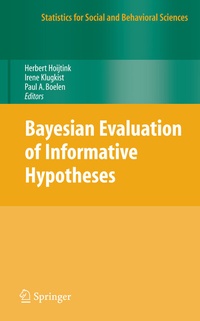
Bayesian Evaluation of Informative Hypotheses
Description

Reviews / Votes
From the reviews:
"While this book is a collection of papers, the editors have done a great service to the reader by choosing three substantial psychology research studies that are used as examples throughout the book. The continuity of examples provides easy comparison among the methods and makes subsequent developments easier to follow. The book identifies open questions.and provides alternative methodologies with discussion. Each chapter provides a comprehensive bibliography, which makes this book an excellent reference. Statisticians and quantitative social scientists who are interested in a broad introduction and review of Bayesian methods for informative hypotheses, including several chapters of detailed statistical development, will find this book valuable." (Journal of the American Statistical Association, Mar. 2010, Vol. 105, No.489)
".Bayesian evaluation for informative hypotheses was first proposed by Hoijtink (2001). The present book collects the recent developments in the area. since then. The content.is the result of written contributions from the workshop in Utrecht in June 2007. .The book is well written . software accompanying the main topics... are available on the website. .This book is motivated largely by a number of examples in psychological and social science, resulting in the particular interest to the researchers in these fields. However researchers in other disciplines such as public health and biomedical science may find this book useful since similar questions of informative hypotheses are encountered frequently in those fields as well. The book succeeds in its aims and is undoubtedly a valuable resource for the public. I would recommend the book to psychologists and scientists in the aforementioned areas who wish to do more complicated analyses. I would also recommend this book to biostatisticians and statisticians who are keen to expand their horizons orwant to attain some inspiration. ." (Biometrics 65, 1308-1309, December 2009)
"This book has been very imaginatively planned and anchored around analysis of challenging problems of (Clinical) Psychology. Not only the analyses but the design of experiments and the variables measured are very interesting. ... This is an excellent book for psychologists and Bayesian statisticians. Strongly recommended for both categories of readers." (International Statistical Review 2009, 77, 2)
"The methods developed here are applicable in areas other than ANOVA, such as ANCOVA, latent class models, and contingency tables. . For those who find ANOVA troubling . and are not so devoted to frequentist approaches as to be troubled by the use of priors (informative or not), this book provides a way forward. If you fall into this class of readers, I highly recommend that you read this book and, when appropriate, consider using the methods described therein in your own work." (Lawrence Barker, Technometrics, Vol. 52 (3), August, 2010)
More details
Other editions
Additional editions