

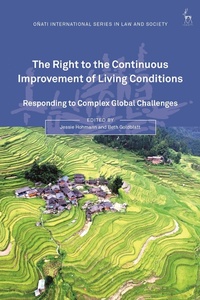
The Right to the Continuous Improvement of Living Conditions
Responding to Complex Global Challenges
1st Edition
Published on 21. October 2021
288 pages
978-1-5099-4784-3 (ISBN)
Description

What does the right to the continuous improvement of living conditions in Article 11(1) of the International Covenant on Economic, Social and Cultural Rights really mean and how can it contribute to social change? The book explores how this underdeveloped right can have valuable application in response to global problems of poverty, inequality and climate destruction, through an in-depth consideration of its meaning.
The book seeks to interpret and give meaning to the right as a legal standard, giving it practical value for those whose living conditions are inadequate. It locates the right within broader philosophical and political debates, whilst also assessing the challenges to its realisation. It also explores how the right relates to human rights more generally and considers its application to issues of gender, care and the rights of Indigenous peoples. The contributors deeply probe the meaning of 'living conditions', suggesting that these encompass more than the basic rights to housing, water, food, and clothing. The chapters provide a range of doctrinal, historical and philosophical engagements through grounded analysis and imaginative interpretation.
With a foreword by Sandra Liebenberg (former Member of the UN Committee on Economic, Social and Cultural Rights), the book includes chapters from renowned and emerging scholars working across disciplines from around the world.
The book seeks to interpret and give meaning to the right as a legal standard, giving it practical value for those whose living conditions are inadequate. It locates the right within broader philosophical and political debates, whilst also assessing the challenges to its realisation. It also explores how the right relates to human rights more generally and considers its application to issues of gender, care and the rights of Indigenous peoples. The contributors deeply probe the meaning of 'living conditions', suggesting that these encompass more than the basic rights to housing, water, food, and clothing. The chapters provide a range of doctrinal, historical and philosophical engagements through grounded analysis and imaginative interpretation.
With a foreword by Sandra Liebenberg (former Member of the UN Committee on Economic, Social and Cultural Rights), the book includes chapters from renowned and emerging scholars working across disciplines from around the world.
More details
Series
Edition
1. Auflage
Language
English
Place of publication
London
United Kingdom
Publishing group
Bloomsbury Publishing PLC
Target group
College/higher education
ISBN-13
978-1-5099-4784-3 (9781509947843)
Copyright in bibliographic data and cover images is held by Nielsen Book Services Limited or by the publishers or by their respective licensors: all rights reserved.
Schweitzer Classification
Other editions
Additional editions
Jessie Hohmann | Beth Goldblatt
The Right to the Continuous Improvement of Living Conditions
Responding to Complex Global Challenges
Book
05/2023
Hart Publishing
€73.31
Shipment within 15-20 days
Jessie Hohmann | Beth Goldblatt
The Right to the Continuous Improvement of Living Conditions
Responding to Complex Global Challenges
Book
11/2021
Hart Publishing
€133.92
Shipment within 15-20 days
Persons
Jessie Hohmann is Associate Professor and Beth Goldblatt is Professor, both in the Faculty of Law at the University of Technology Sydney, Australia.
Content
Foreword
Sandra Liebenberg (Stellenbosch University, South Africa)
1. Introduction: Situating the Right to Continuous Improvement of Living Conditions and Considering its Interpretations and Applications
Jessie Hohmann (University of Technology Sydney, Australia) and Beth Goldblatt (University of Technology Sydney, Australia)
2. Sources for A Nascent Interpretation of the Right to the Continuous Improvement of Living Conditions: The Travaux Préparatoires and the Work of the CESCR
Jessie Hohmann (University of Technology Sydney, Australia)
3. Cooperating to Continuously Improve
Meghan Campbell (University of Birmingham, UK)
4. The Right to the Continuous Improvement of Living Conditions as a Response to Poverty
Luke D Graham (Coventry University, UK)
5. Is Financial Inclusion a Proxy for Continuously Improving Living Conditions?
Juan Pablo Bohoslavsky (Universidad Nacional de Río Negro, Argentina) and Francisco Cantamutto (National University of the South, Argentina)
6. The Right to the Continuous Improvement of Living Conditions and Progressive Realisation: The Case of the Right to Social Security in Canada
Lucie Lamarche (Université du Québec à Montréal, Canada)
7. Understanding Forgotten Rights
Naomi Lott (University of Nottingham, UK)
8. The Right to the Continuous Improvement of Living Conditions and Human Rights of Future Generations - A Circle Impossible to Square?
Sigrun I Skogly (Lancaster University, UK)
9. New Synergies and Possibilities in the Inter-American Court of Human Rights: From Dignified Life to the Right to the Continuous Improvement of Living Conditions
Isaac de Paz González (Autonomous University of Baja California, Mexico)
10. (Dis)Continuous Improvement: Canada, Indigenous Peoples, Lobster and Child Welfare
Jeffery Hewitt (York University, Canada)
11. The Work of Living - Social Reproduction and the Right to the Continuous Improvement of Living Conditions
Beth Goldblatt (University of Technology Sydney, Australia)
12. Measure for Measure: The Challenges of Measuring Continuous Improvement and Lessons from the Sustainable Development Goals
Sandra Fredman (University of Oxford, UK)
13. Entangled Rights and Reproductive Temporality: Legal Form, Continuous Improvement of Living Conditions, and Social Reproduction
Ruth Fletcher (Queen Mary University of London, UK)
Sandra Liebenberg (Stellenbosch University, South Africa)
1. Introduction: Situating the Right to Continuous Improvement of Living Conditions and Considering its Interpretations and Applications
Jessie Hohmann (University of Technology Sydney, Australia) and Beth Goldblatt (University of Technology Sydney, Australia)
2. Sources for A Nascent Interpretation of the Right to the Continuous Improvement of Living Conditions: The Travaux Préparatoires and the Work of the CESCR
Jessie Hohmann (University of Technology Sydney, Australia)
3. Cooperating to Continuously Improve
Meghan Campbell (University of Birmingham, UK)
4. The Right to the Continuous Improvement of Living Conditions as a Response to Poverty
Luke D Graham (Coventry University, UK)
5. Is Financial Inclusion a Proxy for Continuously Improving Living Conditions?
Juan Pablo Bohoslavsky (Universidad Nacional de Río Negro, Argentina) and Francisco Cantamutto (National University of the South, Argentina)
6. The Right to the Continuous Improvement of Living Conditions and Progressive Realisation: The Case of the Right to Social Security in Canada
Lucie Lamarche (Université du Québec à Montréal, Canada)
7. Understanding Forgotten Rights
Naomi Lott (University of Nottingham, UK)
8. The Right to the Continuous Improvement of Living Conditions and Human Rights of Future Generations - A Circle Impossible to Square?
Sigrun I Skogly (Lancaster University, UK)
9. New Synergies and Possibilities in the Inter-American Court of Human Rights: From Dignified Life to the Right to the Continuous Improvement of Living Conditions
Isaac de Paz González (Autonomous University of Baja California, Mexico)
10. (Dis)Continuous Improvement: Canada, Indigenous Peoples, Lobster and Child Welfare
Jeffery Hewitt (York University, Canada)
11. The Work of Living - Social Reproduction and the Right to the Continuous Improvement of Living Conditions
Beth Goldblatt (University of Technology Sydney, Australia)
12. Measure for Measure: The Challenges of Measuring Continuous Improvement and Lessons from the Sustainable Development Goals
Sandra Fredman (University of Oxford, UK)
13. Entangled Rights and Reproductive Temporality: Legal Form, Continuous Improvement of Living Conditions, and Social Reproduction
Ruth Fletcher (Queen Mary University of London, UK)
