

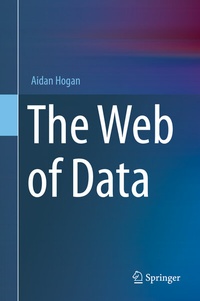
The Web of Data
Description

This book's main goals are to bring together in a concise way all the methodologies, standards and recommendations related to Data, Queries, Links, Semantics, Validation and other issues concerning machine-readable data on the Web, to describe them in detail, to provide examples of their use, and to discuss how they contribute to - and how they have been used thus far on - the "Web of Data". As the content of the Web becomes increasingly machine readable, increasingly complex tasks can be automated, yielding more and more powerful Web applications that are capable of discovering, cross-referencing, filtering, and organizing data from numerous websites in a matter of seconds.
The book is divided into nine chapters, the first of which introduces the topic by discussing the shortcomings of the current Web and illustrating the need for a Web of Data. Next, "Web of Data" provides an overview of the fundamental concepts involved, and discusses some current use-cases on the Web wheresuch concepts are already being employed. "Resource Description Framework (RDF)" describes the graph-structured data model proposed by the Semantic Web community as a common data model for the Web. The chapter on "RDF Schema (RDFS) and Semantics" presents a lightweight ontology language used to define an initial semantics for terms used in RDF graphs. In turn, the chapter "Web Ontology Language (OWL)" elaborates on a more expressive ontology language built upon RDFS that offers much more powerful ontological features. In "SPARQL Query Language" a language for querying and updating RDF graphs is described, with examples of the features it supports, supplemented by a detailed definition of its semantics. "Shape Constraints and Expressions (SHACL/ShEx)" introduces two languages for describing the expected structure of - and expressing constraints on - RDF graphs for the purposes of validation. "Linked Data" discusses the principles and best practices proposed by the Linked Data communityfor publishing interlinked (RDF) data on the Web, and how these techniques have been adopted. The final chapter highlights open problems and rounds out the coverage with a more general discussion on the future of the Web of Data.
The book is intended for students, researchers and advanced practitioners interested in learning more about the Web of Data, and about closely related topics such as the Semantic Web, Knowledge Graphs, Linked Data, Graph Databases, Ontologies, etc. Offering a range of accessible examples and exercises, it can be used as a textbook for students and other newcomers to the field. It can also serve as a reference handbook for researchers and developers, as it offers up-to-date details on key standards (RDF, RDFS, OWL, SPARQL, SHACL, ShEx, RDB2RDF, LDP), along with formal definitions and references to further literature. The associated website webofdatabook.org offers a wealth of complementary material, including solutions to the exercises, slides for classes, raw data for examples, and a section for comments and questions.
More details
Other editions
Additional editions
Person
Content
1. Introduction.- 2. Web of Data.- 3. Resource Description Framework.- 4. RDF Schema and Semantics.- 5. Web Ontology Language.- 6. SPARQL Query Language.- 7. Shape Constraints and Expressions.- 8. Linked Data.- 9. Conclusions.
