

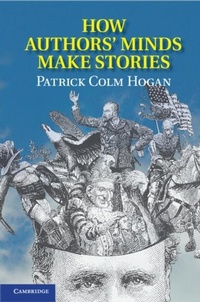
How Authors' Minds Make Stories
Published on 23. January 2013
978-1-107-30300-3 (ISBN)
Description

This book explores how the creations of great authors result from the same operations as our everyday counterfactual and hypothetical imaginations, which cognitive scientists refer to as 'simulations'. Drawing on detailed literary analyses as well as recent research in neuroscience and related fields, Patrick Colm Hogan develops a rigorous theory of the principles governing simulation that goes beyond any existing framework. He examines the functions and mechanisms of narrative imagination, with particular attention to the role of theory of mind, and relates this analysis to narrative universals. In the course of this theoretical discussion, Hogan explores works by Austen, Faulkner, Shakespeare, Racine, Brecht, Kafka and Calvino. He pays particular attention to the principles and parameters defining an author's narrative idiolect, examining the cognitive and emotional continuities that span an individual author's body of work.
Reviews / Votes
"From his groundbreaking work on how the mind's stories resonate with themes that occur all around the world, Patrick Hogan takes on the question of how minds make stories. His answer is that it is by the same sort of imagination that we humans use to know each other. Hogan ranges cogently through examples from William Shakespeare's Hamlet and Jane Austen's Emma to Franz Kafka's Metamorphosis. He ends with an afterword, inspired by Italo Calvino, of a kind you won't find in any other academic book. Marvelous."- Keith Oatley, University of Toronto "Patrick Hogan's provocative discussion of the role of simulation in literary composition demystifies literary narration by relating it to familiar mechanisms of reasoning and simulation. More important, he makes explicit cognitivist attempts at explanation so that we can try to evaluate how far cognitive approaches to narrative just provide an alternative vocabulary, and how far they offer additional explanatory power. As Hogan models the processes that underlie the creation of literary works, he outlines of a valuable program for poetics."
- Jonathan Culler, Cornell University< "...This engaging and thoughtful written account, [however], goes beyond traditional approaches of literary criticism.... Drawing on recent work in neurophysiology, primed memories, childhood experiences, and theories of mind, Hogan makes a significant contribution to both cognitive and literary studies.... sheds light on the uniquely human mental faculty of authors to entertain counterfactual situations and render them in well-crafted, descriptively precise word.... Highly recommended..."
--R.M. Davis, emeritus, Albion College, CHOICE
More details
Language
English
Place of publication
Cambridge
United Kingdom
Target group
Professional and scholarly
File size
3,09 MB
ISBN-13
978-1-107-30300-3 (9781107303003)
Copyright in bibliographic data and cover images is held by Nielsen Book Services Limited or by the publishers or by their respective licensors: all rights reserved.
Schweitzer Classification
Other editions
Additional editions
Patrick Colm Hogan
How Authors' Minds Make Stories
Book
12/2014
Cambridge University Press
€48.90
Shipment within 15-20 days
Patrick Colm Hogan
How Authors' Minds Make Stories
Book
01/2013
Cambridge University Press
€140.60
Shipment within 15-20 days
Person
Patrick Colm Hogan is a professor in the Department of English and of the programs in Cognitive Science, Comparative Literature and Comparative Studies, and India Studies at the University of Connecticut. He is the author of fifteen books, including The Mind and its Stories and What Literature Teaches Us about Emotion, and the editor of The Cambridge Encyclopedia of the Language Sciences.
Content
Introduction: from the universal to the particular; 1. Simulation: imagining fictional worlds in Faulkner and Austen; 2. Story development, literary evaluation, and the place of character; 3. A narrative idiolect: Shakespeare's heroic stories; 4. Principles and parameters of storytelling: the trajectory of Racine's romantic tragedies; 5. Argument and metaphor in Brecht and Kafka; 6. Emplotment: selection, organization, and construal in Hamlet; Afterword: if on a winter's night a narrator ....
