

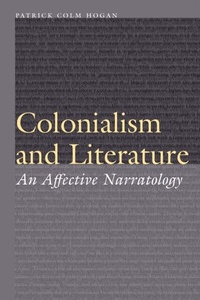
Colonialism and Literature
An Affective Narratology
1st Edition
Published on 1. January 2025
308 pages
978-1-4962-4169-6 (ISBN)
Description

In earlier work Patrick Colm Hogan argued that a few story genres-heroic, romantic, sacrificial, and others-recur prominently across separate literary traditions. These structures recur because they derive from important emotion-motivation systems governing human social interaction, such as group pride and shame.
In Colonialism and Literature Hogan extends this work to argue that these genres play a prominent role in the fashioning of postcolonization literature-literature encompassing both the colonial and postcolonial periods. Crucially, colonizers and colonized people commonly understand and explain their situation in terms of these narrative structures. In other words, the stories we tell to some degree simply reflect the facts. But we also tend to interpret our condition in terms of genre, with the genre guiding us about what to record and how to evaluate it. Hogan explores these consequential processes in theoretical and literary analysis, presenting extended, culturally and historically specified interpretations of works by PAdraic Pearse (Ireland), Ngugi wa Thiong'o (Kenya), Yasujiro Ozu (Japan), J. M. Coetzee (South Africa), Margaret Atwood (Canada), Rabindranath Tagore (India), Abderrahmane Sissako (Mali), and Dinabandhu Mitra (India).
In Colonialism and Literature Hogan extends this work to argue that these genres play a prominent role in the fashioning of postcolonization literature-literature encompassing both the colonial and postcolonial periods. Crucially, colonizers and colonized people commonly understand and explain their situation in terms of these narrative structures. In other words, the stories we tell to some degree simply reflect the facts. But we also tend to interpret our condition in terms of genre, with the genre guiding us about what to record and how to evaluate it. Hogan explores these consequential processes in theoretical and literary analysis, presenting extended, culturally and historically specified interpretations of works by PAdraic Pearse (Ireland), Ngugi wa Thiong'o (Kenya), Yasujiro Ozu (Japan), J. M. Coetzee (South Africa), Margaret Atwood (Canada), Rabindranath Tagore (India), Abderrahmane Sissako (Mali), and Dinabandhu Mitra (India).
Reviews / Votes
"With characteristic erudition and lucidity, Hogan examines how emotions often produced by postcolonial conditions serve as engines that drive certain kinds of prototype stories found across cultures. Hogan's work is exemplary affective narratology and will generate much future research."-Sue J. Kim, author of On Anger: Race, Cognition, Narrative "Hogan writes in a remarkably accessible way and develops arguments through easy-to-follow examples. He has quite a gift for distilling often highly specialized research into terms where its relevance to nonspecialists can readily be discerned. He also deftly interconnects multiple lines of interdisciplinary scholarship. Mastery of subject, accessibility, and sensible argument are admirably merged. It is hard to imagine anyone working in any of the three primary fields engaged here who would not enjoy and benefit from this work."-Donald R. Wehrs, author of Ethical Sense and Literary Significance: Deep Sociality and the Cultural Agency of Imaginative DiscourseMore details
Series
Language
English
Place of publication
Lincoln
United States
Target group
Professional and scholarly
Illustrations
19 illustrations, 1 chart, index
ISBN-13
978-1-4962-4169-6 (9781496241696)
Copyright in bibliographic data and cover images is held by Nielsen Book Services Limited or by the publishers or by their respective licensors: all rights reserved.
Schweitzer Classification
Other editions
Additional editions
Book
01/2025
University of Nebraska Press
€84.38
Shipment within 15-20 days
Person
Patrick Colm Hogan is Board of Trustees Distinguished Professor Emeritus, Department of English, Program in Comparative Literature and Cultural Studies, and Program in Cognitive Science, at the University of Connecticut. He is the author of more than twenty-five books, including Affective Narratology: The Emotional Structure of Stories (Nebraska, 2011) and Imagining Kashmir: Emplotment and Colonialism (Nebraska, 2016).
Content
List of Illustrations
Introduction: Imperialism and Its Stories
1. Colonialism, Emotions, and Narrative: Theoretical Principles
2. Idealized Sacrifice: PAdraic Pearse, Attachment Love, and the 1916 Easter Uprising
3. Ambivalent Sacrifice and Allegorical Love: Shame and Desire in Ngugi wa Thiong'o's A Grain of Wheat
4. Family Separation and Reunion: Attachment and Mirth in Yasujiro Ozu's Early Summer
5. Disfigured Heroism and the Possibility of Romance: War and Love in J. M. Coetzee's Waiting for the Barbarians
6. Allegory and the Heroic Epilogue: Guilt and Disfigured Genres in Margaret Atwood's Surfacing
7. Minor Genres: Revenge in Rabindranath Tagore's "Punishment," Crime in Abderrahmane Sissako's Bamako, and Seduction in Dinabandhu Mitra's The Indigo Planting Mirror
8. Afterword: A Note on the Psychology of Stories and the Psychology of Colonialism
Source Acknowledgments
Notes
Bibliography
Index
Introduction: Imperialism and Its Stories
1. Colonialism, Emotions, and Narrative: Theoretical Principles
2. Idealized Sacrifice: PAdraic Pearse, Attachment Love, and the 1916 Easter Uprising
3. Ambivalent Sacrifice and Allegorical Love: Shame and Desire in Ngugi wa Thiong'o's A Grain of Wheat
4. Family Separation and Reunion: Attachment and Mirth in Yasujiro Ozu's Early Summer
5. Disfigured Heroism and the Possibility of Romance: War and Love in J. M. Coetzee's Waiting for the Barbarians
6. Allegory and the Heroic Epilogue: Guilt and Disfigured Genres in Margaret Atwood's Surfacing
7. Minor Genres: Revenge in Rabindranath Tagore's "Punishment," Crime in Abderrahmane Sissako's Bamako, and Seduction in Dinabandhu Mitra's The Indigo Planting Mirror
8. Afterword: A Note on the Psychology of Stories and the Psychology of Colonialism
Source Acknowledgments
Notes
Bibliography
Index
