

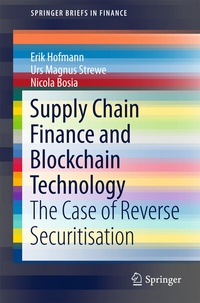
Supply Chain Finance and Blockchain Technology
Description

This book investigates how the Blockchain Technology (BCT) for Supply Chain Finance (SCF) programs allows businesses to come together in partnerships and accelerate cash flows throughout the supply chain. BCT promises to change the way individuals and corporations exchange value and information over the Internet, and is perfectly positioned to enable new levels of collaboration among the supply chain actors.
The book reveals new opportunities stemming from the application of BCT to SCF financing solutions, particularly reverse factoring - or approved payables financing. To do so, it first identifies the principal barriers and pain points in delivering financing solutions. Then, a possible blockchain-driven supply chain model is defined.
Using this framework, the book subsequently discusses relevant use cases for the technology, which could open up new opportunities in the SCF space. It demonstrates that blockchain and distributed ledgers technologies could deliver substantial benefits for all parties involved in SCF transactions, promising to expedite the processes and lower the overall costs of financing programs.
Industry giants such as IBM, Maersk, China-based Dianrong and FnConn (a Foxconn subsidiary) are currently working to digitize the global, cross-border supply chain using blockchain technology, and will likely soon create blockchain platforms for supply chain finance. These solutions aim to reduce complexity and make data sharing more secure, accurate and efficient. This book offers a highly topical resource for stakeholders across the entire supply chain, helping them prepare for the upcoming technological revolution.
More details
Other editions
Additional editions
Persons
Erik Hofmann (Dr. rer. pol., University of Technology, Darmstadt, Germany) is Director of the Chair of Logistics Management as well as a Senior Lecturer at the University of St.Gallen, Switzerland. He is also the Head of the Supply Chain Finance-Lab (SCF-Lab) of the Swiss Post. His primary research focuses on supply management as well as the intersections of operations management and finance issues. He has published in several operations management journals, and is co-author of several bestselling Springer books like "Supply Chain Finance Solutions", "Ways Out of the Working Capital Trap", "Performance Measurement and Incentive Systems in Purchasing", and "Financing the End-to-End Supply Chain" (Kogan Page).
Urs Magnus Strewe (lic. oec. HSG, University of St. Gallen) is serial entrepreneur and an expert for implementing technology-driven business models for banks and financial service providers. As the Chief Operating Officer (COO) of CRX Markets, he was in charge to build the service offering of the company which is an independent marketplace for supply chain financing solutions.
Nicola Bosia holds a Bachelor of Arts degree in management from the University of Lausanne (HEC), and a Master of Arts in accounting and finance from the University of St. Gallen (HSG).
