

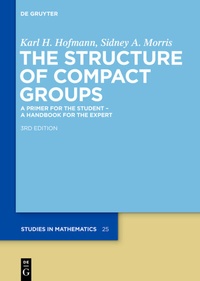
The Structure of Compact Groups
Description

The subject matter of compact groups is frequently cited in fields like algebra, topology, functional analysis, and theoretical physics. This book serves the dual purpose of providing a textbook on it for upper level graduate courses or seminars, and of serving as a source book for research specialists who need to apply the structure and representation theory of compact groups.
After a gentle introduction to compact groups and their representation theory, the book presents self-contained courses on linear Lie groups, on compact Lie groups, and on locally compact abelian groups. Separate appended chapters contain the material for courses on abelian groups and on category theory. However, the thrust of the book points in the direction of the structure theory of not necessarily finite dimensional, nor necessarily commutative, compact groups, unfettered by weight restrictions or dimensional bounds. In the process it utilizes infinite dimensional Lie algebras and the exponential function of arbitrary compact groups.
The first edition of 1998 and the second edition of 2006 were well received by reviewers and have been frequently quoted in the areas of instruction and research. For the present new edition the text has been cleaned of typographical flaws and the content has been conceptually sharpened in some places and polished and improved in others. New material has been added to various sections taking into account the progress of research on compact groups both by the authors and other writers. Motivation was provided, among other things, by questions about the structure of compact groups put to the authors by readers through the years following the earlier editions. Accordingly, the authors wished to clarify some aspects of the book which they felt needed improvement. The list of references has increased as the authors included recent publications pertinent to the content of the book.
Reviews / Votes
"Altogether, this book is a must for everybody who is interested in topological groups." Internationale Mathematische Nachrichten
"Each chapter and appendix has a short preface of introductory nature and a historical and theoretical postscript and is completed with a list of corresponding references. Many examples are discussed, which are mainly of general interest, and the book is endowed with many exercises, almost all of which are of the form "prove the previous assertion'' (which stresses the role of the book as both a "primer for the student'' and a "handbook for the expert''). Thus, the book is very informative. The text is quite understandable and well written (as are other texts by the authors). [...] The book by Hofmann and Morris is fresh and promising, and its ideas, approaches, and results advance the structure theory of more general topological groups; thus, it is guaranteed a vast audience." Mathematical Reviews (review of the first edition)
More details
Other editions
New editions
Additional editions
Previous edition
Persons
Content
- Intro
- Chapter 1. Basic Topics and Examples
- Definitions and Elementary Examples
- Actions, Subgroups, Quotient Spaces
- Products of Compact Groups
- Applications to Abelian Groups
- Projective Limits
- Totally Disconnected Compact Groups
- Some Duality Theory
- Postscript
- References for this Chapter-Additional Reading
- Chapter 2. The Basic Representation Theory of Compact Groups
- Some Basic Representation Theory for Compact Groups
- The Haar Integral
- Consequences of Haar Measure
- The Main Theorem on Hilbert Modules for Compact Groups
- Postscript
- References for this Chapter-Additional Reading
- Chapter 3. The Ideas of Peter and Weyl
- Part 1: The Classical Theorem of Peter and Weyl
- An Excursion into Linear Algebra
- The G-modules E' ? E, Hom(E,E) and Hom(E,E)'
- The Fine Structure of R(G,K)
- Part 2: The General Theory of G-Modules
- Vector Valued Integration
- The First Application: The Averaging Operator
- Compact Groups Acting on Convex Cones
- More Module Actions, Convolutions
- Complexification of Real Representations
- Postscript
- References for this Chapter-Additional Reading
- Chapter 4. Characters
- Part 1: Characters of Finite Dimensional Representations
- Part 2: The Structure Theorem of Efin
- Cyclic Modules
- Postscript
- References for this Chapter-Additional Reading
- Chapter 5. Linear Lie Groups
- Preliminaries
- The Exponential Function and the Logarithm
- Differentiating the Exponential Function in a Banach Algebra
- Local Groups for the Campbell-Hausdorff Multiplication
- Subgroups of A-1 and Linear Lie Groups
- Analytic Groups
- The Intrinsic Exponential Function of a Linear Lie Group
- The Adjoint Representation of a Linear Lie Group
- Subalgebras, Ideals, Lie Subgroups, Normal Lie Subgroups
- Normalizers, Centralizers, Centers
- The Commutator Subgroup
- Forced Continuity of Morphisms between Lie Groups
- Quotients of Linear Lie Groups
- The Topological Splitting Theorem for Normal Vector Subgroups
- Postscript
- References for this Chapter-Additional Reading
- Chapter 6. Compact Lie Groups
- Compact Lie algebras
- The Commutator Subgroup of a Compact Lie Group
- The Structure Theorem for Compact Lie Groups
- Maximal Tori
- The Second Structure Theorem for Connected Compact Lie Groups
- Compact Abelian Lie Groups and their Linear Actions
- Action of a Maximal Torus on the Lie Algebra
- The Weyl Group Revisited
- The Commutator Subgroup of Connected Compact Lie Groups
- On the Automorphism Group of a Compact Lie Group
- Covering Groups of Disconnected Compact Lie Groups
- Auerbach's Generation Theorem
- The Topology of Connected Compact Lie Groups
- Postscript
- References for this Chapter-Additional Reading
- Chapter 7. Duality of Abelian Topological Groups
- The Compact Open Topology and Hom-Groups
- Local Compactness and Duality of Abelian Topological Groups
- Basic Functorial Aspects of Duality
- The Annihilator Mechanism
- Character Groups of Topological Vector Spaces
- The Exponential Function
- Weil's Lemma and Compactly Generated Abelian Groups
- Reducing Locally Compact Groups to Compact Abelian Groups
- A Major Structure Theorem
- The Duality Theorem
- The Identity Component
- The Weight of Locally Compact Abelian Groups
- Postscript
- References for this Chapter-Additional Reading
- Chapter 8. Compact Abelian Groups
- Part 1: Aspects of the Algebraic Structure
- Divisibility, Torsion, Connectivity
- Compact Abelian Groups as Factor Groups
- Part 2: Aspects of the Point Set Topological Structure
- Topological Dimension of Compact Abelian Groups
- Arc Connectivity
- Local Connectivity
- Compact Metric Abelian Groups
- Part 3: Aspects of Algebraic Topology-Homotopy
- Free Compact Abelian Groups
- Homotopy of Compact Abelian Groups
- Exponential Function and Homotopy
- The Fine Structure of Free Compact Abelian Groups
- Part 4: Aspects of Homological Algebra
- Injective, Projective, and Free Compact Abelian Groups
- Part 5: Aspects of Algebraic Topology-Cohomology
- Cohomology of Compact Abelian Groups
- Part 6: Aspects of Set Theory
- Arc Components and Borel Subsets
- Postscript
- References for this Chapter-Additional Reading
- Chapter 9. The Structure of Compact Groups
- Part 1: The Fundamental Structure Theorems of Compact Groups
- Approximating Compact Groups by Compact Lie Groups
- The Closedness of Commutator Subgroups
- Semisimple Compact Connected Groups
- The Levi-Mal'cev Structure Theorem for Compact Groups
- Maximal Connected Abelian Subgroups
- The Splitting Structure Theorem
- Supplementing the Identity Component
- Part 2: The Structure Theorems for the Exponential Function
- The Exponential Function of Compact Groups
- The Dimension of Compact Groups
- Locally Euclidean Compact Groups Are Compact Lie Groups
- Part 3: The Connectivity Structure of Compact Groups
- Arc Connectivity
- Local Connectivity
- Compact Groups and Indecomposable Continua
- Part 4: Some Homological Algebra for Compact Groups
- The Projective Cover of Connected Compact Groups
- Part 5: The Automorphism Group of Compact Groups
- The Iwasawa Theory of Automorphism Groups
- Simple Compact Groups and the Countable Layer Theorem
- The Structure of Compact FC-Groups
- The Commutativity Degree of a Compact Group
- Postscript
- References for this Chapter-Additional Reading
- Chapter 10. Compact Group Actions
- A Preparation Involving Compact Semigroups
- Orbits, Orbit Space, and Isotropy
- Equivariance and Cross Sections
- Triviality of an Action
- Quotient Actions, Totally Disconnected G-Spaces
- Compact Lie Group Actions on Locally Compact Spaces
- Triviality Theorems for Compact Group Actions
- Split Morphisms
- Actions of Compact Groups and Acyclicity
- Fixed Points of Compact Abelian Group Actions
- Transitive Actions of Compact Groups
- Szenthe's Theory of Transitive Actions of Compact Groups
- Postscript
- References for this Chapter-Additional Reading
- Chapter 11. The Structure of Free Compact Groups
- The Category Theoretical Background
- Splitting the Identity Component
- The Center of a Free Compact Group
- The Commutator Subgroup of a Free Compact Group
- Freeness Versus Projectivity
- Postscript
- References for this Chapter-Additional Reading
- Chapter 12. Cardinal Invariants of Compact Groups
- Suitable Sets
- Generating Degree and Density
- The Cardinal Invariants of Connected Compact Groups
- Cardinal Invariants in the Absence of Connectivity
- On the Location of Special Generating Sets
- Postscript
- References for this Chapter-Additional Reading
- Appendix 1. Abelian Groups
- Examples
- Free Abelian Groups
- Projective Groups
- Torsion Subgroups
- Pure Subgroups
- Free Quotients
- Divisibility
- Some Homological Algebra
- Exact Sequences
- Whitehead's Problem
- Postscript
- References for this Appendix-Additional Reading
- Appendix 2. Covering Spaces and Groups
- Covering Spaces and Simple Connectivity
- The Group of Covering Transformations
- Universal Covering Groups
- Groups Generated by Local Groups
- Postscript
- References for this Appendix-Additional Reading
- Appendix 3. A Primer of Category Theory
- Categories, Morphisms
- Pointed Categories
- Types of Morphisms
- Functors
- Natural Transformations
- Equivalence of Categories
- Limits
- The Continuity of Adjoints
- The Left Adjoint Existence Theorem
- Commutative Monoidal Categories and its Monoid Objects
- Part 1: The Quintessential Diagram Chase
- Part 2: Connected Graded Commutative Hopf Algebras
- Part 3: Duality of Graded Hopf Algebras
- Part 4: An Application to Compact Monoids
- Postscript
- References for this Appendix-Additional Reading
- Appendix 4. Selected Results on Topology and Topological Groups
- The Arc Component Topology
- The Weight of a Topological Space
- Metrizability of Topological Groups
- Duality of Vector Spaces
- Subgroups of Topological Groups
- Wallace's Lemma
- Cantor Cubes and Dyadic Spaces
- Some Basic Facts on Compact Monoids
- Postscript
- References for this Appendix-Additional Reading
- Appendix 5. Measures on Compact Groups
- The Definition of Haar Measure
- The Required Background of Radon Measure Theory
- Product Measures
- The Support of a Measure
- Measures on Compact Groups: Convolution
- Semigroup Theoretical Characterization of Haar Measure
- Idempotent Probability Measures on a Compact Group
- Actions and Product Measures
- Postscript
- References for this Appendix-Additional Reading
- Appendix 6. Projective Limits of Well-Ordered Inverse Systems
- Well-ordered Lie chains
- Supercompactness
- Compact Homeomorphism Groups
- Postscript
- References for this Appendix-Additional Reading
- References
- Index of Symbols
- Index
