

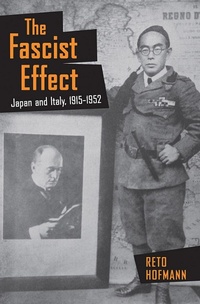
The Fascist Effect
Japan and Italy, 1915-1952
Published on 16. November 2015
222 pages
978-0-8014-5635-0 (ISBN)
Description

In The Fascist Effect, Reto Hofmann uncovers the ideological links that tied Japan to Italy, drawing on extensive materials from Japanese and Italian archives to shed light on the formation of fascist history and practice in Japan and beyond. Moving between personal experiences, diplomatic and cultural relations, and geopolitical considerations, Hofmann shows that interwar Japan found in fascism a resource to develop a new order at a time of capitalist crisis.
Hofmann demonstrates that fascism in Japan was neither a European import nor a domestic product; it was, rather, the result of a complex process of global transmission and reformulation. Far from being a vague term, as postwar historiography has so often claimed, for Japanese of all backgrounds who came of age from the 1920s to the 1940s, fascism conjured up a set of concrete associations, including nationalism, leadership, economics, and a drive toward empire and a new world order.
Hofmann demonstrates that fascism in Japan was neither a European import nor a domestic product; it was, rather, the result of a complex process of global transmission and reformulation. Far from being a vague term, as postwar historiography has so often claimed, for Japanese of all backgrounds who came of age from the 1920s to the 1940s, fascism conjured up a set of concrete associations, including nationalism, leadership, economics, and a drive toward empire and a new world order.
Reviews / Votes
Hofmann has produced a readable and exceptionally sensible volume on the global production of fascist ideology, which will be of tremendous value for scholars who teach comparative history... Hofmann's book opens the door to a debate truly worth having in Japanese history circles.(Journal of Japanese Studies) This book is an important addition to the growing body of literature that examines fascism in a transnational context. The author provides an insightful and highly original exploration of the dialogue between Italian Fascism and Japanese political and sociocultural debates of the period. Throughout the work, Reco Hofmann does especially well in highlighting the ambiguities and contradictions in the debate over fascism's applicability to Japan, in particular the tensions between its nationalist and internationalist impulses.
(The Historian)
More details
Series
Language
English
Place of publication
Ithaca
United States
Product notice
Reflowable
Illustrations
21 halftones - 21 Halftones, black and white
ISBN-13
978-0-8014-5635-0 (9780801456350)
Copyright in bibliographic data and cover images is held by Nielsen Book Services Limited or by the publishers or by their respective licensors: all rights reserved.
Schweitzer Classification
Other editions
Additional editions
Book
03/2020
Cornell University Press
€27.50
Shipment within 15-20 days
Book
06/2015
Cornell University Press
€47.04
Shipment within 10-20 days
Person
Reto Hofmann is Lecturer in Modern History at Monash University.
Content
Introduction1. Mediator of Fascism: Shimoi Harukichi, 1915-19282. The Mussolini Boom, 1928-19313. The Clash of Fascisms, 1931-19374. Imperial Convergence: The Italo- Ethiopian War and Japa nese World- Order Thinking, 1935-19365. Fascism in World History, 1937-1943Epilogue: Fascism after the New World Order, 1943-1952Notes
Bibliography
Index
Bibliography
Index
