

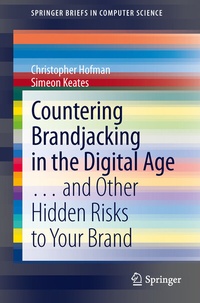
Countering Brandjacking in the Digital Age
Description

The rise of the Internet and social media in particular offer great opportunities for brand owners to increase business and brand recognition. While this has clearly been of benefit to brand owners, who have seen a consequent rise in the value of their brands, it simultaneously makes those brands more attractive for exploitation or attack by others. Brand risks can come in many different types and this book provides examples of how these risks can arise as well as providing quantitative estimates of the adverse impacts that can result from such risks.
Brand owners need to be aware of the risks and of the need to develop strategies for identifying and managing them. This book details the process by which a brand owner can develop a brand risk management process to protect a brand's reputation and value. Rather than prescribe a one-size-fits-all approach, the authors provide guidance on how a brand risk management process can be tailored to particular needs and circumstances.
This approach is underpinned by drawing on examples of best practice in the fields of risk management, interaction design and engineering design. This combined approach relies on developing an understanding of the risks faced by a particular brand owner, the full context of those risks and also the brand owner's capabilities for identifying and managing those risks.
This book contains many real-world examples and interviews with a number of brand owning organisations ranging from small companies to large multinationals.
More details
Other editions
Additional editions
Persons
Christopher Hofman Laursen
Christopher has helped companies managing their domain name portfolios since 2003. He has an extensive knowledge in online brand protection and stays close to what is happening regarding new top level domains, changes to regulations and brand protection on social media. He recently published the book Countering brandjacking in the digital age at Springer together with co-author Simeon Keates.
Christopher has an International Master in Management from EAP-ESCP and a Master in Interaction Design from the IT University in Copenhagen.
You can contact Christopher at christopher@europeandomaincentre.com.
http://www.europeandomaincentre.com/pages/about-us/management
Content
An Introduction to Brand Risk.- An Overview of Branding and its Associates Risks.- Brand Risk Management Theory.- Designing a Brand Risk Management Process.- Brand Risk in Cyberspace.- Appendix: Norwegian Air Shuttle Calculation.
