

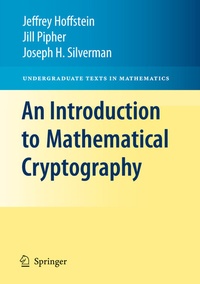
An Introduction to Mathematical Cryptography
Description

Reviews / Votes
From the reviews:
"The book is devoted to public key cryptography, whose principal goal is to allow two or more people to exchange confidential information . . The material is very well organized, and it is self-contained: no prerequisites in higher mathematics are needed. In fact, everything is explained and carefully covered . . there is abundance of examples and proposed exercises at the end of each chapter. . This book is ideal as a textbook for a course aimed at undergraduate mathematics or computer science students." (Fabio Mainardi, The Mathematical Association of America, October, 2008)
"This book focuses on public key cryptography . . Hoffstein, Pipher, and Silverman . provide a thorough treatment of the topics while keeping the material accessible. . The book uses examples throughout the text to illustrate the theorems, and provides a large number of exercises . . The volume includes a nice bibliography. . Summing Up: Highly recommended. Upper-division undergraduate through professional collections." (C. Bauer, Choice, Vol. 46 (7), March, 2009)
"For most undergraduate students in mathematics or computer science (CS), mathematical cryptography is a challenging subject. . it is written in a way that makes you want to keep reading. . The authors officially targeted the book for advanced undergraduate or beginning graduate students. I believe that this audience is appropriate. . it could even be used with students who are just learning how to execute rigorous mathematical proofs. . I strongly believe that it finds the right tone for today's students . ." (Burkhard Englert, ACM Computing Reviews, March, 2009)
"The exercises and text would make an excellent course for undergraduate independent study. . This is an excellent book. Hoffstein, Pipher and Silverman have written as good a book as is possible to explain public key cryptography. . This book would probably be best suited for a graduate course that focused on public key cryptography, for undergraduate independent study, or for the mathematician who wants to see how mathematics is used in public key cryptography." (Jintai Ding and Chris Christensen, Mathematical Reviews, Issue 2009 m)
More details
Other editions
New editions
Additional editions
Persons
Dr. Jeffrey Hoffstein has been a professor at Brown University since 1989 and has been a visiting professor and tenured professor at several other universities since 1978. His research areas are number theory, automorphic forms, and cryptography. He has authored more than 50 publications.
Dr. Jill Pipher has been a professor at Brown Univesity since 1989. She has been an invited lecturer and has received numerous awards and honors. Her research areas are harmonic analysis, elliptic PDE, and cryptography. She has authored over 40 publications.
Dr. Joseph Silverman has been a professor at Brown University 1988. He served as the Chair of the Brown Mathematics department from 2001-2004. He has received numerous fellowships, grants and awards and is a frequently invited lecturer. His research areas are number theory, arithmetic geometry, elliptic curves, dynamical systems and cryptography. Hehas authored more than120 publications and has had more than 20 doctoral students.
