

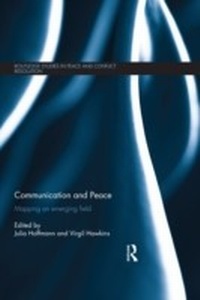
Communication and Peace
Mapping an emerging field
1st Edition
Published on 11. February 2015
348 pages
978-1-317-68048-2 (ISBN)
Description

This book analyses the use of communication in resolving conflicts, with a focus on de-escalation and processes of peacebuilding and peace formation.
From the employment of hate radio in the Rwanda genocide, to the current conflict between Russia and the Ukraine following events in the Crimea, communication and the media are widely recognized as powerful tools in conflicts and war. Although there has been significant academic attention on the relationship between the media, conflict and war, academic efforts to understand this relationship have tended to focus primarily on the links between communication and conflict, rather than on communication and peace.
In order to make sense of peace it is essential to look at communication in its many facets, mediated or not. This is true within many of the diverse strands that make up the field of communication and peace, but it is also true in the sense that a holistic and interdisciplinary approach is missing from the literature. This book addresses this widely acknowledged lacuna by providing an interdisciplinary perspective on the field, bringing together relevant, but so far largely isolated, streams of research. In doing so, it aims to provide a platform for further reflection of the meaning of, and requirements for, peace in our contemporary world with a focus on de-escalation, conflict transformation, reconciliation and processes of peacebuilding - as opposed to conflict escalation or crisis intervention.
This volume will be of much interest to students of peace and conflict studies, peacebuilding, media and communication studies, security studies and IR in general.
From the employment of hate radio in the Rwanda genocide, to the current conflict between Russia and the Ukraine following events in the Crimea, communication and the media are widely recognized as powerful tools in conflicts and war. Although there has been significant academic attention on the relationship between the media, conflict and war, academic efforts to understand this relationship have tended to focus primarily on the links between communication and conflict, rather than on communication and peace.
In order to make sense of peace it is essential to look at communication in its many facets, mediated or not. This is true within many of the diverse strands that make up the field of communication and peace, but it is also true in the sense that a holistic and interdisciplinary approach is missing from the literature. This book addresses this widely acknowledged lacuna by providing an interdisciplinary perspective on the field, bringing together relevant, but so far largely isolated, streams of research. In doing so, it aims to provide a platform for further reflection of the meaning of, and requirements for, peace in our contemporary world with a focus on de-escalation, conflict transformation, reconciliation and processes of peacebuilding - as opposed to conflict escalation or crisis intervention.
This volume will be of much interest to students of peace and conflict studies, peacebuilding, media and communication studies, security studies and IR in general.
Reviews / Votes
'The evidence is growing that media and communication in the 21st century really matter in shaping how and whether humans get on with each other or end up attacking and killing each other. We need really strong multi-disciplinary research, reflecting diverse approaches and perspectives, to better understand what we can do to support media that reduces or mitigates conflict and increases the chances of people getting on with each other. We don't have anything like enough of it and this looks like a very promising and timely contribution.' -- James Deane, BBC Media Action, UK.'An excellent book revealing both how media contribute to violence and how they could contribute to peace; like asking "Mr President, what is the conflict underlying the violence? Mr President, what are you going to do to solve that conflict.' -- Johan Galtung, TRANSCEND International
'To remain relevant, peacebuilding must prove itself to be media-savvy. Yet for too long the discussion on the contribution of media to peacebuilding has remained within the ranks of the converted, framed by high expectations of its positive impacts - expectations which, given that peacebuilding by its very nature permeates the whole of society, often seem exaggerated. Presenting a variety of experiences and lessons learned from the practice of peacebuilding, Hoffmann and Hawkins bring together important voices in this handbook, thus laying an essential - and a refreshingly critical - foundation for opening up this field to interdisciplinary reflection.' -- Rousbeh Legatis, Peace and Conflict Researcher & U.N. Correspondent for Inter Press Service (IPS) News Agency
'The dynamics between peace and communication remains a hugely under-researched area of academic inquiry. This excellent collection of essays with some stellar contributors makes a timely and much-needed intervention in the field. Highly recommended.' -- Daya Thussu, University of Westminster, UK
More details
Series
Language
English
Place of publication
London
United Kingdom
Publishing group
Taylor & Francis Ltd
Target group
College/higher education
Professional and scholarly
Illustrations
4 Tables, black and white; 6 Line drawings, black and white
File size
1,69 MB
ISBN-13
978-1-317-68048-2 (9781317680482)
Copyright in bibliographic data and cover images is held by Nielsen Book Services Limited or by the publishers or by their respective licensors: all rights reserved.
Schweitzer Classification
Other editions
Additional editions
Book
10/2016
1st Edition
Routledge
€69.50
Shipment within 10-20 days
Book
01/2015
1st Edition
Routledge
€244.10
Shipment within 10-20 days
Persons
Julia Hoffmann is Senior Advisor ICT & Media at Hivos, The Netherlands and Assistant Professor of Human Rights, Media and Conflict at the UN-mandated University for Peace in Costa Rica. She is co-editor (with Andre Nollkaemper) of The Responsibility to Protect: From Principle to Practice (2012).
Virgil Hawkins is Associate Professor at Osaka School of International Public Policy (OSIPP) at Osaka University, Japan and research associate at the University of the Free State, South Africa. He is author of Stealth Conflicts: How the World's Worst Violence Is Ignored (2010).
Virgil Hawkins is Associate Professor at Osaka School of International Public Policy (OSIPP) at Osaka University, Japan and research associate at the University of the Free State, South Africa. He is author of Stealth Conflicts: How the World's Worst Violence Is Ignored (2010).
Content
Foreword, Oliver Richmond Introduction. Julia Hoffmann and Virgil Hawkins 1. Media in Peace and Conflict Studies, Jake Lynch 2. Media Studies and the Peace Issue, Cees J. Hamelink PART I. Reporting and Representing Peace 3. Peace and the Absence of Journalism, Virgil Hawkins 4. Conflict Sensitive Journalism: (R)evolution in media peacebuilding, Ross Howard 5. The United Nations' Responsibility to Protect and the World's Press: Establishing a New Humanitarian Norm?, Simon Cottle and Martin Hughes 6. Media and War Propaganda: The Value of Exposure, Oliver Boyd-Barrett 7. Imagined Violence: Representations of Masculinity and a Culture of Peace, Lara Mazurski 8. The Media and Deconstruction of the Enemy Image, Babak Bahador PART II. Intervening for Peace 9. Still Caught in the Crossfire? UN Peace Operations and their Information Capacities, Ingrid A. Lehmann 10. Beyond Journalism: Expanding the use of media in peacebuilding, Vladimir Bratic 11. UN Peacekeeping Radio: The Way Forward, Michelle Betz and Helene Papper 12. Reflections on Using Monitoring & Evaluation to Enhance Information Interventions for Peace, Maureen Taylor 13. Digital Technology and Peace, Steven Livingston 14. Strategic communications and the Avoidance of Violent Conflict, Monroe E. Price and Nicole Stremlau 15. Capacity building, institutional change and theories of change: Creating an enabling environment for journalists in post-conflict environments, Michelle Betz 16. Confronting the conundrum of "hate speech", Julia Hoffmann 17. Media as watchdogs and election monitors in fragile states: How foreign assistance is shaping the media's role in Burundi and the Democratic Republic of Congo, Marie-Soleil Frere PART III. Enacting and Communicating Peace 18. The Role of the Media in Transitional Justice, Lisa J. Laplante 19. Communication for Memory and Peace: Articulating Violence in Post-Repressive Contexts, Kristin Sorensen 20. Community Media as Performers of Peace, Clemencia Rodriguez 21. Communication Towards a Negotiated Peace: Conflict, Contestation and the Media, Pradip Thomas
