

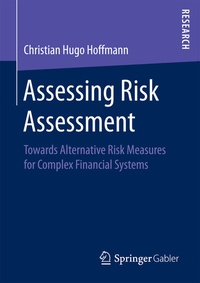
Assessing Risk Assessment
Towards Alternative Risk Measures for Complex Financial Systems
Published on 14. November 2017
XIV, 377 pages
978-3-658-20032-9 (ISBN)
Description

Christian Hugo Hoffmann undermines the citadel of risk assessment and management, arguing that classical probability theory is not an adequate foundation for modeling systemic and extreme risk in complex financial systems. He proposes a new class of models which focus on the knowledge dimension by precisely describing market participants' own positions and their propensity to react to outside changes. The author closes his thesis by a synthetical reflection on methods and elaborates on the meaning of decision-making competency in a risk management context in banking. By choosing this poly-dimensional approach, the purpose of his work is to explore shortcomings of risk management approaches of financial institutions and to point out how they might be overcome.
More details
Series
Edition
1st ed. 2017
Language
English
Place of publication
Wiesbaden
Germany
Publishing group
Springer Fachmedien Wiesbaden GmbH
Target group
Professional and scholarly
Illustrations
XIV, 377 p. 36 illus.
File size
11,49 MB
ISBN-13
978-3-658-20032-9 (9783658200329)
DOI
10.1007/978-3-658-20032-9
Schweitzer Classification
Other editions
Additional editions
Christian Hugo Hoffmann
Assessing Risk Assessment
Towards Alternative Risk Measures for Complex Financial Systems
Book
12/2017
Springer Gabler
€85.59
Shipment within 10-15 days
Person
Christian Hugo Hoffmann completed his doctoral studies at the University of St. Gallen and Yale University. He co-founded a financial risk management start-up which translates these theoretical results into practical impact.
Content
1 - Table of Contents [Seite 5]
2 - List of Tables and Figures [Seite 8]
3 - Abstract [Seite 10]
4 - Zusammenfassung [Seite 12]
5 - Introduction [Seite 14]
6 - Part I:Concepts, Model Level and Risk Assessment [Seite 33]
6.1 - 1. Introduction to Part I [Seite 34]
6.2 - 2. Literature Synthesis, Theoretical Background and Research Focus [Seite 36]
6.2.1 - 2.1. Complexity and Modern Financial Systems [Seite 36]
6.2.2 - 2.2. Risk and Risk Management in the Financial World [Seite 43]
6.2.2.1 - 2.2.1. Risk modeling [Seite 48]
6.2.2.2 - 2.2.2. Value at Risk (VaR) [Seite 52]
6.2.2.3 - 2.2.3. Expected Shortfall (ES) [Seite 58]
6.2.3 - 2.3. Systemic Risk Assessment [Seite 60]
6.2.3.1 - 2.3.1. Tools primarily for regulators: Conditional Value at Risk (CoVaR) and Systemic Expected Shortfall (SES) [Seite 62]
6.2.3.2 - 2.3.2. Extreme Value Theory (EVT) [Seite 64]
6.2.4 - 2.4. General Appraisal [Seite 66]
6.2.4.1 - 2.4.1. Advantages of conventional risk models and measures [Seite 67]
6.2.4.2 - 2.4.2. Weaknesses of conventional risk models and measures [Seite 69]
6.2.5 - 2.5. Excursus: Benoît Mandelbrot's Plea for Fractal Methods [Seite 74]
6.3 - 3. Research Questions [Seite 83]
6.4 - 4. On an Adequate Concept of Risk and Systemic Risk in the realm of Banking [Seite 85]
6.4.1 - 4.1. The Notion of Risk [Seite 85]
6.4.2 - 4.2. The Concept of Systemic Risk [Seite 101]
6.5 - 5. On the Relevance of Systemic Risks for Banks [Seite 113]
6.5.1 - 5.1. Why should Banks take account of, and try to deal with, Systemic Risks? [Seite 113]
6.5.2 - 5.2. What are concrete Systemic Risk Scenarios for Banks? [Seite 125]
6.6 - 6. Dealing with Quantitative Risk Management in Banking as a Complex Systems Problem [Seite 132]
6.6.1 - 6.1. A Trichotomy of Scientific Problems - Warren Weaver's Scheme as a General Answer to How to Manage Complexity [Seite 137]
6.6.1.1 - 6.1.1. Tackling disorganized complexity versus organized simplicity [Seite 137]
6.6.1.2 - 6.1.2. Disorganized complexity and statistical techniques [Seite 140]
6.6.1.3 - 6.1.3. Tackling organized complexity: open questions remain [Seite 143]
6.6.1.4 - 6.1.4. Synopsis [Seite 145]
6.6.2 - 6.2. Weaver's Taxonomy Revisited: Attempts of Clarification, Extension and Refinement [Seite 148]
6.6.2.1 - 6.2.1. Approaches towards the operationalization of Weaver's concept of organized complexity [Seite 148]
6.6.2.2 - 6.2.2. The bigger picture of complexity and randomness [Seite 151]
6.6.3 - 6.3. Organized Complexity, Financial Systems and Assessing Extreme and Systemic Risks [Seite 161]
6.6.3.1 - 6.3.1. On the level of structures [Seite 163]
6.6.3.2 - 6.3.2. On the level of events [Seite 164]
6.6.4 - 6.4. A Tentative Bottom Line [Seite 166]
6.7 - 7. The Fundamental Inadequacy of Probability Theory as a Foundation for Modeling Systemic and Extreme Risk in a Banking Context [Seite 168]
6.7.1 - 7.1. Philosophical Roots of the Problem of Induction: some Preliminaries [Seite 170]
6.7.2 - 7.2. Probability Theory in a Nutshell, its Embeddedness and its Applications [Seite 173]
6.7.3 - 7.3. The Central Argument against using Probability Theory for Financial Risk Management [Seite 184]
6.7.4 - 7.4. Linking the Central Argument with the Current State of the Literature (IIIa)-c)) [Seite 192]
6.8 - 8. Conclusion to Part I [Seite 195]
6.8.1 - 8.1. Résumé [Seite 196]
6.8.2 - 8.2. Outlook: Explanatory Models for In-House Risk Management in Banking [Seite 199]
7 - Part II:The Transition to the Decision Level, Risk Assessment andManagement [Seite 203]
7.1 - 9. Introduction to Part II [Seite 204]
7.2 - 10. The Critical Turn: The Renaissance of Practical Wisdom [Seite 206]
7.3 - 11. Scenario Planning in a Nutshell and its Role in Risk Management in Banking [Seite 212]
7.4 - 12. Strengths and Weaknesses of Scenario Planning as a Risk Management Tool [Seite 220]
7.5 - 13. Deriving Lessons for Rethinking the Approach to Assessing Extreme and Systemic Risks [Seite 226]
8 - Part III:In Search of a New Paradigm: The Third Way as a Road toLogic-Based Risk Modeling (LBR) [Seite 230]
8.1 - 14. Introduction to Part III [Seite 231]
8.2 - 15. Theoretical Foundations of a Logic-Based Risk Modeling (LBR) Approach [Seite 236]
8.2.1 - 15.1. A less Restrictive Axiomatization [Seite 236]
8.2.2 - 15.2. Non-Probabilistic Models of Uncertainty [Seite 244]
8.2.3 - 15.3. Ranking Theory [Seite 248]
8.2.4 - 15.4. Syntax of a Language for Describing Contracts and Correlations [Seite 251]
8.2.5 - 15.5. Semantics: Financial Contracts as Uncertain Sequences in a Non-Probabilistic Risk Model Context [Seite 257]
8.2.5.1 - 15.5.1. Uncertain sequences by example [Seite 258]
8.2.5.2 - 15.5.2. From contract value to risk [Seite 262]
8.2.5.3 - 15.5.3. Formalization of the approach [Seite 263]
8.2.5.4 - 15.5.4. Concrete instantiations of uncertainty monads: ranking functions [Seite 1]
8.2.5.5 - 15.5.5. Evaluating risk models [Seite 275]
8.2.6 - 15.6. Model Interpretation and Output: An Exact, Explanatory Scenario Planning Method [Seite 280]
8.3 - 16. Case Study: LTCM and Extreme Risk [Seite 284]
8.3.1 - 16.1. Example Trade [Seite 285]
8.3.2 - 16.2. A Fixed Income Portfolio in LBR [Seite 286]
8.3.3 - 16.3. Analysis [Seite 289]
8.3.3.1 - 16.3.1. Overview [Seite 290]
8.3.3.2 - 16.3.2. Zoom and filter [Seite 291]
8.3.3.3 - 16.3.3. Details on demand [Seite 293]
8.3.4 - 16.4. Discussion and Conclusion [Seite 293]
8.4 - 17. Managerial Implications [Seite 296]
8.5 - 18. Scales of Measurement and Qualitative Probabilities [Seite 302]
8.6 - 19. Model Validation [Seite 308]
9 - Part IV:Meta Level: Thinking about Thinking and Practices - What itMeans to Reach Effective Risk Management Decisions [Seite 325]
9.1 - 20. Introduction to Part IV as Overall Conclusion [Seite 326]
9.2 - 21. Escaping the Traps for Logicians: Towards Decision-Making Competency in Risk Management [Seite 328]
9.3 - 22. Final Remarks and a Path for Future Research [Seite 341]
10 - References [Seite 346]
11 - Appendices [Seite 377]
2 - List of Tables and Figures [Seite 8]
3 - Abstract [Seite 10]
4 - Zusammenfassung [Seite 12]
5 - Introduction [Seite 14]
6 - Part I:Concepts, Model Level and Risk Assessment [Seite 33]
6.1 - 1. Introduction to Part I [Seite 34]
6.2 - 2. Literature Synthesis, Theoretical Background and Research Focus [Seite 36]
6.2.1 - 2.1. Complexity and Modern Financial Systems [Seite 36]
6.2.2 - 2.2. Risk and Risk Management in the Financial World [Seite 43]
6.2.2.1 - 2.2.1. Risk modeling [Seite 48]
6.2.2.2 - 2.2.2. Value at Risk (VaR) [Seite 52]
6.2.2.3 - 2.2.3. Expected Shortfall (ES) [Seite 58]
6.2.3 - 2.3. Systemic Risk Assessment [Seite 60]
6.2.3.1 - 2.3.1. Tools primarily for regulators: Conditional Value at Risk (CoVaR) and Systemic Expected Shortfall (SES) [Seite 62]
6.2.3.2 - 2.3.2. Extreme Value Theory (EVT) [Seite 64]
6.2.4 - 2.4. General Appraisal [Seite 66]
6.2.4.1 - 2.4.1. Advantages of conventional risk models and measures [Seite 67]
6.2.4.2 - 2.4.2. Weaknesses of conventional risk models and measures [Seite 69]
6.2.5 - 2.5. Excursus: Benoît Mandelbrot's Plea for Fractal Methods [Seite 74]
6.3 - 3. Research Questions [Seite 83]
6.4 - 4. On an Adequate Concept of Risk and Systemic Risk in the realm of Banking [Seite 85]
6.4.1 - 4.1. The Notion of Risk [Seite 85]
6.4.2 - 4.2. The Concept of Systemic Risk [Seite 101]
6.5 - 5. On the Relevance of Systemic Risks for Banks [Seite 113]
6.5.1 - 5.1. Why should Banks take account of, and try to deal with, Systemic Risks? [Seite 113]
6.5.2 - 5.2. What are concrete Systemic Risk Scenarios for Banks? [Seite 125]
6.6 - 6. Dealing with Quantitative Risk Management in Banking as a Complex Systems Problem [Seite 132]
6.6.1 - 6.1. A Trichotomy of Scientific Problems - Warren Weaver's Scheme as a General Answer to How to Manage Complexity [Seite 137]
6.6.1.1 - 6.1.1. Tackling disorganized complexity versus organized simplicity [Seite 137]
6.6.1.2 - 6.1.2. Disorganized complexity and statistical techniques [Seite 140]
6.6.1.3 - 6.1.3. Tackling organized complexity: open questions remain [Seite 143]
6.6.1.4 - 6.1.4. Synopsis [Seite 145]
6.6.2 - 6.2. Weaver's Taxonomy Revisited: Attempts of Clarification, Extension and Refinement [Seite 148]
6.6.2.1 - 6.2.1. Approaches towards the operationalization of Weaver's concept of organized complexity [Seite 148]
6.6.2.2 - 6.2.2. The bigger picture of complexity and randomness [Seite 151]
6.6.3 - 6.3. Organized Complexity, Financial Systems and Assessing Extreme and Systemic Risks [Seite 161]
6.6.3.1 - 6.3.1. On the level of structures [Seite 163]
6.6.3.2 - 6.3.2. On the level of events [Seite 164]
6.6.4 - 6.4. A Tentative Bottom Line [Seite 166]
6.7 - 7. The Fundamental Inadequacy of Probability Theory as a Foundation for Modeling Systemic and Extreme Risk in a Banking Context [Seite 168]
6.7.1 - 7.1. Philosophical Roots of the Problem of Induction: some Preliminaries [Seite 170]
6.7.2 - 7.2. Probability Theory in a Nutshell, its Embeddedness and its Applications [Seite 173]
6.7.3 - 7.3. The Central Argument against using Probability Theory for Financial Risk Management [Seite 184]
6.7.4 - 7.4. Linking the Central Argument with the Current State of the Literature (IIIa)-c)) [Seite 192]
6.8 - 8. Conclusion to Part I [Seite 195]
6.8.1 - 8.1. Résumé [Seite 196]
6.8.2 - 8.2. Outlook: Explanatory Models for In-House Risk Management in Banking [Seite 199]
7 - Part II:The Transition to the Decision Level, Risk Assessment andManagement [Seite 203]
7.1 - 9. Introduction to Part II [Seite 204]
7.2 - 10. The Critical Turn: The Renaissance of Practical Wisdom [Seite 206]
7.3 - 11. Scenario Planning in a Nutshell and its Role in Risk Management in Banking [Seite 212]
7.4 - 12. Strengths and Weaknesses of Scenario Planning as a Risk Management Tool [Seite 220]
7.5 - 13. Deriving Lessons for Rethinking the Approach to Assessing Extreme and Systemic Risks [Seite 226]
8 - Part III:In Search of a New Paradigm: The Third Way as a Road toLogic-Based Risk Modeling (LBR) [Seite 230]
8.1 - 14. Introduction to Part III [Seite 231]
8.2 - 15. Theoretical Foundations of a Logic-Based Risk Modeling (LBR) Approach [Seite 236]
8.2.1 - 15.1. A less Restrictive Axiomatization [Seite 236]
8.2.2 - 15.2. Non-Probabilistic Models of Uncertainty [Seite 244]
8.2.3 - 15.3. Ranking Theory [Seite 248]
8.2.4 - 15.4. Syntax of a Language for Describing Contracts and Correlations [Seite 251]
8.2.5 - 15.5. Semantics: Financial Contracts as Uncertain Sequences in a Non-Probabilistic Risk Model Context [Seite 257]
8.2.5.1 - 15.5.1. Uncertain sequences by example [Seite 258]
8.2.5.2 - 15.5.2. From contract value to risk [Seite 262]
8.2.5.3 - 15.5.3. Formalization of the approach [Seite 263]
8.2.5.4 - 15.5.4. Concrete instantiations of uncertainty monads: ranking functions [Seite 1]
8.2.5.5 - 15.5.5. Evaluating risk models [Seite 275]
8.2.6 - 15.6. Model Interpretation and Output: An Exact, Explanatory Scenario Planning Method [Seite 280]
8.3 - 16. Case Study: LTCM and Extreme Risk [Seite 284]
8.3.1 - 16.1. Example Trade [Seite 285]
8.3.2 - 16.2. A Fixed Income Portfolio in LBR [Seite 286]
8.3.3 - 16.3. Analysis [Seite 289]
8.3.3.1 - 16.3.1. Overview [Seite 290]
8.3.3.2 - 16.3.2. Zoom and filter [Seite 291]
8.3.3.3 - 16.3.3. Details on demand [Seite 293]
8.3.4 - 16.4. Discussion and Conclusion [Seite 293]
8.4 - 17. Managerial Implications [Seite 296]
8.5 - 18. Scales of Measurement and Qualitative Probabilities [Seite 302]
8.6 - 19. Model Validation [Seite 308]
9 - Part IV:Meta Level: Thinking about Thinking and Practices - What itMeans to Reach Effective Risk Management Decisions [Seite 325]
9.1 - 20. Introduction to Part IV as Overall Conclusion [Seite 326]
9.2 - 21. Escaping the Traps for Logicians: Towards Decision-Making Competency in Risk Management [Seite 328]
9.3 - 22. Final Remarks and a Path for Future Research [Seite 341]
10 - References [Seite 346]
11 - Appendices [Seite 377]
