

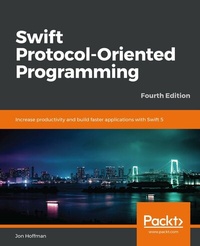
Swift Protocol-Oriented Programming
Increase productivity and build faster applications with Swift 5
4th Edition
Published on 23. September 2024
224 pages
978-1-78934-367-0 (ISBN)
Description

Embrace the Protocol-Oriented Programming paradigm, for better code maintainability and increased performance, with Swift programming.
Key Features
Leverage the power of Protocol-Oriented Programming in your applications
Leverage generics to create very flexible frameworks
Learn how to implement common design patterns in a protocol-oriented way
Book DescriptionProtocol-oriented programming is an incredibly powerful concept at the heart of Swift's design. Swift's standard library was developed using POP techniques, generics, and first-class value semantics; therefore, it is important for every Swift developer to understand these core concepts and take advantage of them. The fourth edition of this book is improved and updated to the latest version of the Swift programming language. This book will help you understand what protocol-oriented programming is all about and how it is different from other programming paradigms such as object-oriented programming. This book covers topics such as generics, Copy-On-Write, extensions, and of course protocols. It also demonstrates how to use protocol-oriented programming techniques via real-world use cases. By the end of this book, you will know how to use protocol-oriented programming techniques to build powerful and practical applications. What you will learn
Learn the differences between object-oriented programming and protocol-oriented programming
Understand why value types should be prioritized over reference types
Delve into protocols, protocol inheritance, protocol composition, and protocol extensions
Learn how to implement COW (Copy-On-Write) within your custom value types
Understand how memory management works in Swift and how to avoid common pitfalls
Design applications by starting with the protocol rather than the implementation
Who this book is forThis book is intended for Swift developers who have, at minimum an introductory knowledge of the Swift programming language and would like to understand how they can use Protocol-Oriented Programming techniques in their applications.
Key Features
Leverage the power of Protocol-Oriented Programming in your applications
Leverage generics to create very flexible frameworks
Learn how to implement common design patterns in a protocol-oriented way
Book DescriptionProtocol-oriented programming is an incredibly powerful concept at the heart of Swift's design. Swift's standard library was developed using POP techniques, generics, and first-class value semantics; therefore, it is important for every Swift developer to understand these core concepts and take advantage of them. The fourth edition of this book is improved and updated to the latest version of the Swift programming language. This book will help you understand what protocol-oriented programming is all about and how it is different from other programming paradigms such as object-oriented programming. This book covers topics such as generics, Copy-On-Write, extensions, and of course protocols. It also demonstrates how to use protocol-oriented programming techniques via real-world use cases. By the end of this book, you will know how to use protocol-oriented programming techniques to build powerful and practical applications. What you will learn
Learn the differences between object-oriented programming and protocol-oriented programming
Understand why value types should be prioritized over reference types
Delve into protocols, protocol inheritance, protocol composition, and protocol extensions
Learn how to implement COW (Copy-On-Write) within your custom value types
Understand how memory management works in Swift and how to avoid common pitfalls
Design applications by starting with the protocol rather than the implementation
Who this book is forThis book is intended for Swift developers who have, at minimum an introductory knowledge of the Swift programming language and would like to understand how they can use Protocol-Oriented Programming techniques in their applications.
More details
Edition
4th Revised edition
Language
English
Place of publication
Birmingham
United Kingdom
Target group
Professional and scholarly
US School Grade: College Graduate Student
Edition type
Revised edition
File size
2,76 MB
ISBN-13
978-1-78934-367-0 (9781789343670)
Copyright in bibliographic data and cover images is held by Nielsen Book Services Limited or by the publishers or by their respective licensors: all rights reserved.
Schweitzer Classification
Other editions
Additional editions
Jon Hoffman
Swift Protocol-Oriented Programming
Increase productivity and build faster applications with Swift 5
Book
06/2019
4th Edition
Packt Publishing
€39.50
Shipment within 3-4 weeks
Person
Hoffman Jon :
Jon Hoffman has over 25 years of experience in the field of information technology. Over these years, Jon has worked in the areas of system administration, network administration, network security, application development, and architecture. Currently, Jon works as a senior software engineer for Syn-Tech Systems. Jon has developed extensively for the iOS platform since 2008. This includes several apps that he has published in the App Store, apps that he has written for third parties, and numerous enterprise applications. He has also developed mobile applications for the Android and Windows platforms. What really drives Jon the challenges that the field of information technology provides and there is nothing more exhilarating to him than overcoming a challenge. Some of Jon's other interests are spending time with his family, robotic projects, and 3D printing. Jon also really enjoys Tae Kwon Do, where he and his oldest daughter Kailey earned their black belts together early in 2014, Kim (his wife) earned her black belt in December 2014, and his youngest daughter Kara is currently working towards her black belt.
Jon Hoffman has over 25 years of experience in the field of information technology. Over these years, Jon has worked in the areas of system administration, network administration, network security, application development, and architecture. Currently, Jon works as a senior software engineer for Syn-Tech Systems. Jon has developed extensively for the iOS platform since 2008. This includes several apps that he has published in the App Store, apps that he has written for third parties, and numerous enterprise applications. He has also developed mobile applications for the Android and Windows platforms. What really drives Jon the challenges that the field of information technology provides and there is nothing more exhilarating to him than overcoming a challenge. Some of Jon's other interests are spending time with his family, robotic projects, and 3D printing. Jon also really enjoys Tae Kwon Do, where he and his oldest daughter Kailey earned their black belts together early in 2014, Kim (his wife) earned her black belt in December 2014, and his youngest daughter Kara is currently working towards her black belt.
Content
Table of Contents
Starting with the Protocol
Our Type Choices
Extensions
Generics
Memory Management
Object-Oriented Programming
Protocol-Oriented Programming
Adopting Design Patterns in Swift
Case Studies
Starting with the Protocol
Our Type Choices
Extensions
Generics
Memory Management
Object-Oriented Programming
Protocol-Oriented Programming
Adopting Design Patterns in Swift
Case Studies
