

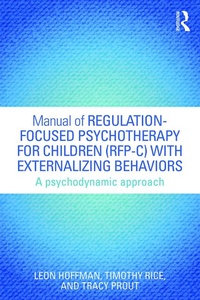
Manual of Regulation-Focused Psychotherapy for Children (RFP-C) with Externalizing Behaviors
A Psychodynamic Approach
Published on 25. September 2015
256 pages
978-1-317-56762-2 (ISBN)
Description

Manual of Regulation-Focused Psychotherapy for Children (RFP-C) with Externalizing Behaviors: A Psychodynamic Approach offers a new, short term psychotherapeutic approach to working dynamically with children who suffer from irritability, oppositional defiance and disruptiveness. RFP-C enables clinicians to help by addressing and detailing how the child's externalizing behaviors have meaning which they can convey to the child. Using clinical examples throughout, Hoffman, Rice and Prout demonstrate that in many dysregulated children, RFP-C can:
Achieve symptomatic improvement and developmental maturation as a result of gains in the ability to tolerate and metabolize painful emotions, by addressing the crucial underlying emotional component.
Diminish the child's use of aggression as the main coping device by allowing painful emotions to be mastered more effectively.
Help to systematically address avoidance mechanisms, talking to the child about how their disruptive behavior helps them avoid painful emotions.
Facilitate development of an awareness that painful emotions do not have to be so vigorously warded off, allowing the child to reach this implicit awareness within the relationship with the clinician, which can then be expanded to life situations at home and at school.
This handbook is the first to provide a manualized, short-term dynamic approach to the externalizing behaviors of childhood, offering organizing framework and detailed descriptions of the processes involved in RFP-C. Supplying clinicians with a systematic individual psychotherapy as an alternative or complement to PMT, CBT and psychotropic medication, it also shifts focus away from simply helping parents manage their children's misbehaviors. Significantly, the approach shows that clinical work with these children is compatible with understanding the children's brain functioning, and posits that contemporary affect-oriented conceptualizations of defense mechanisms are theoretically similar to the neuroscience construct of implicit emotion regulation, promoting an interface between psychodynamics and contemporary academic psychiatry and psychology.
Manual of Regulation-Focused Psychotherapy for Children (RFP-C) with Externalizing Behaviors: A Psychodynamic Approach is a comprehensive tool capable of application at all levels of professional training, offering a new approach for psychoanalysts, child and adolescent counselors, psychotherapists and mental health clinicians in fields including social work, psychology and psychiatry.
Achieve symptomatic improvement and developmental maturation as a result of gains in the ability to tolerate and metabolize painful emotions, by addressing the crucial underlying emotional component.
Diminish the child's use of aggression as the main coping device by allowing painful emotions to be mastered more effectively.
Help to systematically address avoidance mechanisms, talking to the child about how their disruptive behavior helps them avoid painful emotions.
Facilitate development of an awareness that painful emotions do not have to be so vigorously warded off, allowing the child to reach this implicit awareness within the relationship with the clinician, which can then be expanded to life situations at home and at school.
This handbook is the first to provide a manualized, short-term dynamic approach to the externalizing behaviors of childhood, offering organizing framework and detailed descriptions of the processes involved in RFP-C. Supplying clinicians with a systematic individual psychotherapy as an alternative or complement to PMT, CBT and psychotropic medication, it also shifts focus away from simply helping parents manage their children's misbehaviors. Significantly, the approach shows that clinical work with these children is compatible with understanding the children's brain functioning, and posits that contemporary affect-oriented conceptualizations of defense mechanisms are theoretically similar to the neuroscience construct of implicit emotion regulation, promoting an interface between psychodynamics and contemporary academic psychiatry and psychology.
Manual of Regulation-Focused Psychotherapy for Children (RFP-C) with Externalizing Behaviors: A Psychodynamic Approach is a comprehensive tool capable of application at all levels of professional training, offering a new approach for psychoanalysts, child and adolescent counselors, psychotherapists and mental health clinicians in fields including social work, psychology and psychiatry.
Reviews / Votes
This book gives readers a bird's eye view into the organized and focused thought processes of the experienced psychodynamic clinician in handling children with disruptive behavior disorders. As such, this is a novel book and a must-read for clinicians who work with children, as it provides a systematic, operationalized, comprehensive treatment approach that is radically different from the ubiquitous cognitive behavioral approach. It is essential that these core treatment techniques, articulated so well in this Manual, not get lost amid ever- narrowing treatments that are regularly imparted to clinicians who work with children. - Barbara Milrod, MD, Professor of Psychiatry, Weill Cornell Medical College, An expert in clinical trials in anxiety disorders in adults and children.This book addresses one of the most important issues of our modern times - how do children and adolescents learn to regulate their emotions and behaviors. The intervention presented in this book has its basis in psychodynamic principles, especially defense mechanisms. It focuses on the emotional underpinnings of behavioral disruptions especially the avoidance of and reaction to painful emotions. There is meaning in the child's behaviors, emotions, and communications. The clinician learns to understand this and communicates that understanding to the child and parents. This is done in a systematic, manualized manner which enables the child to better tolerate and deal with the unpleasant emotions. This wedding of psychodynamic principles into a systematized, clear, and manualized approach is what makes this book so imaginative and modern in its approach to a very serious problem facing children, parents, mental health clinicians, and society. - John D O'Brien, MD, Clinical Professor, Training Director, Child/Adolescent Psychiatry Residency Program Icahn School of Medicine at Mount Sinai.
This book is of such scope it must be considered a magnum opus for the field of child clinical psychology and psychiatry. It is a unique blend of review of the most recent research on externalizing behavior in children, of the underlying neuroscientific features of the disorder and the most concise summary of psychoanalytic concepts related to the treatment of the disorder. There is no book quite like this one available. As a resource for teaching it is unique in its direct, and clear writing style which make so accessible the psychotherapeutic techniques necessary for treating these often challenging cases. The book is more than a manual on delivering Regulation-Focused Psychotherapy for Children with Externalizing Behaviors, it is a manual on treating children with difficulties in regulating their affect in general and therefore is a 'must have' for every child clinician. - Miriam Steele, PhD, Professor of Psychology, Director of Clinical Training, New School for Social Research, Author of "Clinical Applications of the Adult Attachment Interview" Routledge, 2008.
This is a timely, masterful, comprehensive contribution to the sparse literature on Externalizing Disorders (ODD or DD). The authors provide rich examples from their clinical experience which will be of great value to all who treat children with aggressive behavior disorders. A must for child psychotherapists who wish to treat externalizing behavior disorders effectively. The authors provide an incredibly creative procedure that incorporates basic principles of psychodynamic treatments with findings from the affective neurosciences, developmental, and cognitive psychology and yet goes beyond. RFT goes beyond CBT because it gets at the underlying emotional component, promotes maturation of emotional regulation and removes roadblocks to normal development. The authors get to the heart of the problem by highlighting the centrality of addressing painful emotions and maladaptive ways which children and adolescents have of avoiding and protecting themselves. Careful attention to how to approach such problems in an experience near way as well as how to work with parents makes this a most comprehensive treatment approach, including a termination and evaluative process that lead to the development of protective measures that are adaptive and life changing. - Wendy Olesker, PhD, Training and Supervising Analyst at NYPSI and on the Faculty at the NYU Postdoctoral Program in Psychoanalysis and Psychotherapy.
[This] manual is a must-read for experienced clinicans as well as novices to the profession. For many raders, it will provide a new therapeutic approach. For others, it will illuminate what might be expected as treatment unfold while, for other readers, it will challenge their current practice. RFP-C is an innovation certain to be empircally tested, discussed, and adapted to meet changing guidelines and attitudes... Considering all the achievements of the manual, not the least is the extension of psychoanalytic concepts to the design of a short-term intervention model... For the science of psychoanalysis RFP-C opens new doors for empirical exploration. - Saralea Chazan, PhD, Jouranl of Infant, Child, and Adolescent Psychotherapy This book gives readers a bird's eye view into the organized and focused thought processes of the experienced psychodynamic clinician in handling children with disruptive behavior disorders. As such, this is a novel book and a must-read for clinicians who work with children, as it provides a systematic, operationalized, comprehensive treatment approach that is radically different from the ubiquitous cognitive behavioral approach. It is essential that these core treatment techniques, articulated so well in this Manual, not get lost amid ever- narrowing treatments that are regularly imparted to clinicians who work with children. - Barbara Milrod, MD, Professor of Psychiatry, Weill Cornell Medical College, An expert in clinical trials in anxiety disorders in adults and children.
This book addresses one of the most important issues of our modern times - how do children and adolescents learn to regulate their emotions and behaviors.
The intervention presented in this book has its basis in psychodynamic principles, especially defense mechanisms. It focuses on the emotional underpinnings of behavioral disruptions especially the avoidance of and reaction to painful emotions.
There is meaning in the child's behaviors, emotions, and communications. The clinician learns to understand this and communicates that understanding to the child and parents. This is done in a systematic, manualized manner which enables the child to better tolerate and deal with the unpleasant emotions.
This wedding of psychodynamic principles into a systematized, clear, and manualized approach is what makes this book so imaginative and modern in its approach to a very serious problem facing children, parents, mental health clinicians, and society. - John D O'Brien, MD, Clinical Professor, Training Director, Child/Adolescent Psychiatry Residency Program
Icahn School of Medicine at Mount Sinai.
This book is of such scope it must be considered a magnum opus for the field of child clinical psychology and psychiatry. It is a unique blend of review of the most recent research on externalizing behavior in children, of the underlying neuroscientific features of the disorder and the most concise summary of psychoanalytic concepts related to the treatment of the disorder. There is no book quite like this one available. As a resource for teaching it is unique in its direct, and clear writing style which make so accessible the psychotherapeutic techniques necessary for treating these often challenging cases. The book is more than a manual on delivering Regulation-Focused Psychotherapy for Children with Externalizing Behaviors, it is a manual on treating children with difficulties in regulating their affect in general and therefore is a 'must have' for every child clinician. - Miriam Steele, PhD, Professor of Psychology, Director of Clinical Training, New School for Social Research, Author of "Clinical Applications of the Adult Attachment Interview" Routledge, 2008.
This is a timely, masterful, comprehensive contribution to the sparse literature on Externalizing Disorders (ODD or DD). The authors provide rich examples from their clinical experience which will be of great value to all who treat children with aggressive behavior disorders. A must for child psychotherapists who wish to treat externalizing behavior disorders effectively. The authors provide an incredibly creative procedure that incorporates basic principles of psychodynamic treatments with findings from the affective neurosciences, developmental, and cognitive psychology and yet goes beyond. RFT goes beyond CBT because it gets at the underlying emotional component, promotes maturation of emotional regulation and removes roadblocks to normal development. The authors get to the heart of the problem by highlighting the centrality of addressing painful emotions and maladaptive ways which children and adolescents have of avoiding and protecting themselves. Careful attention to how to approach such problems in an experience near way as well as how to work with parents makes this a most comprehensive treatment approach, including a termination and evaluative process that lead to the development of protective measures that are adaptive and life changing. - Wendy Olesker, PhD, Training and Supervising Analyst at NYPSI and on the Faculty at the NYU Postdoctoral Program in Psychoanalysis and Psychotherapy.
More details
Series
Language
English
Place of publication
London
United Kingdom
Publishing group
Taylor & Francis Ltd
Target group
College/higher education
Professional and scholarly
File size
1,19 MB
ISBN-13
978-1-317-56762-2 (9781317567622)
Copyright in bibliographic data and cover images is held by Nielsen Book Services Limited or by the publishers or by their respective licensors: all rights reserved.
Schweitzer Classification
Other editions
Additional editions
Leon Hoffman | Timothy Rice | Tracy Prout
Manual of Regulation-Focused Psychotherapy for Children (RFP-C) with Externalizing Behaviors
A Psychodynamic Approach
Book
10/2015
1st Edition
Routledge
€247.00
Shipment within 10-20 days
Leon Hoffman | Timothy Rice | Tracy Prout
Manual of Regulation-Focused Psychotherapy for Children (RFP-C) with Externalizing Behaviors
A Psychodynamic Approach
Book
10/2015
1st Edition
Routledge
€72.50
Shipment within 10-20 days
Persons
Leon Hoffman, MD, is a child and adolescent psychiatrist and psychoanalyst, and is currently the director of the Pacella Parent Child Center at the New York Psychoanalytic Society and Institute, and Chief Psychiatrist at West End Day School.
Timothy Rice, MD, is assistant professor of psychiatry at the Icahn School of Medicine at Mount Sinai, New York City.
Tracy Prout, PhD, is assistant professor of psychology in the combined school-child clinical doctoral program at the Ferkauf Graduate School of Psychology at Yeshiva University. She is also in private practice working with children, adolescents, adults, and families.
Timothy Rice, MD, is assistant professor of psychiatry at the Icahn School of Medicine at Mount Sinai, New York City.
Tracy Prout, PhD, is assistant professor of psychology in the combined school-child clinical doctoral program at the Ferkauf Graduate School of Psychology at Yeshiva University. She is also in private practice working with children, adolescents, adults, and families.
Content
Foreword
Nick Midgley
Section 1: Introduction & Theoretical Background
Chapter 1: Introduction: Rationale for Regulation-Focused Psychotherapy for Children with Externalizing Behaviors (RFP-C)
Chapter 2: Basic Psychoanalytic and Psychodynamic Perspectives
Chapter 3: Defenses, Defense Mechanisms, or Coping Devices: An Experience-Near-Observable-Construct
Chapter 4: Affect, Emotion Regulation, and the Research Domain Criteria
Section 2: Practice Manual
Chapter 5: Foreword to Practice Manual
Chapter 6: Step 1, Introductory Meeting with the Parents
Chapter 7: Step 1, Session 1 & 2: Initial Sessions with the Child
Chapter 8: Step 1, Second Meeting with the Parents: Feedback
Chapter 9: Step 2, Sessions 3-12: Addressing child's avoidance of disturbing thoughts and feelings
Chapter 10: Step 2, Sessions 3-12:Examination of the clinician/patient relationship in the treatment of children
Chapter 11: Step 2, Ongoing Parent Contact: Check-ins & Meetings
Chapter 12: Step 3, Sessions 13-16: Termination
Chapter 13: Conclusion
Chapter 14: Appendices
Nick Midgley
Section 1: Introduction & Theoretical Background
Chapter 1: Introduction: Rationale for Regulation-Focused Psychotherapy for Children with Externalizing Behaviors (RFP-C)
Chapter 2: Basic Psychoanalytic and Psychodynamic Perspectives
Chapter 3: Defenses, Defense Mechanisms, or Coping Devices: An Experience-Near-Observable-Construct
Chapter 4: Affect, Emotion Regulation, and the Research Domain Criteria
Section 2: Practice Manual
Chapter 5: Foreword to Practice Manual
Chapter 6: Step 1, Introductory Meeting with the Parents
Chapter 7: Step 1, Session 1 & 2: Initial Sessions with the Child
Chapter 8: Step 1, Second Meeting with the Parents: Feedback
Chapter 9: Step 2, Sessions 3-12: Addressing child's avoidance of disturbing thoughts and feelings
Chapter 10: Step 2, Sessions 3-12:Examination of the clinician/patient relationship in the treatment of children
Chapter 11: Step 2, Ongoing Parent Contact: Check-ins & Meetings
Chapter 12: Step 3, Sessions 13-16: Termination
Chapter 13: Conclusion
Chapter 14: Appendices
