

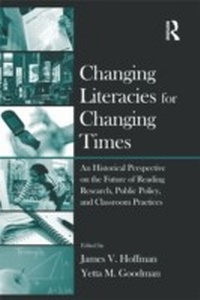
Changing Literacies for Changing Times
An Historical Perspective on the Future of Reading Research, Public Policy, and Classroom Practices
1st Edition
Published on 11. September 2009
336 pages
978-1-135-84575-9 (ISBN)
Description

Offering the wisdom that only experience and expertise in the field can bring, this book takes a critical look into the present and the future of literacy as envisioned by leading reading researchers. The lead author of each chapter, and in some cases more than one, of the authors, is a distinguished reading researcher elected by their peers into the Reading Hall of Fame. In this book these distinguished literacy leaders extend their role as researchers to speak directly to issues of practice and policy.
All chapters address the theme of literacy and the teaching of literacy as being in a constant state of change. The authors are theoretical as they describe literacy, literacy acquisition, and the teaching of literacy; they are practical as they examine the issues that classroom teachers and reading specialists engage with on a daily basis; and they are political as they advocate for informed policy at the local, state and national levels. A key message in this book is that literacy professionals must take an active role to shape change.
All chapters address the theme of literacy and the teaching of literacy as being in a constant state of change. The authors are theoretical as they describe literacy, literacy acquisition, and the teaching of literacy; they are practical as they examine the issues that classroom teachers and reading specialists engage with on a daily basis; and they are political as they advocate for informed policy at the local, state and national levels. A key message in this book is that literacy professionals must take an active role to shape change.
Reviews / Votes
"This book would be an excellent one to use in literacy foundation courses...It is rare to find a book that contextualizes current literacy practices and policies historically. This contextualization allows current researchers and teachers to have a better understanding of various topics, and to better appreciate current circumstances in literacy research and instruction."--Diane Barone, Teachers College Record (November 2009)More details
Language
English
Place of publication
London
United Kingdom
Publishing group
Taylor & Francis Ltd
Target group
College/higher education
Product notice
Reflowable
Illustrations
6 s/w Tabellen
6 Tables, black and white
File size
1,96 MB
ISBN-13
978-1-135-84575-9 (9781135845759)
Copyright in bibliographic data and cover images is held by Nielsen Book Services Limited or by the publishers or by their respective licensors: all rights reserved.
Schweitzer Classification
Other editions
Additional editions
James V. Hoffman | Yetta M. Goodman
Changing Literacies for Changing Times
An Historical Perspective on the Future of Reading Research, Public Policy, and Classroom Practices
Book
07/2009
1st Edition
Routledge
€75.10
Shipment within 15-20 days
James V. Hoffman | Yetta M. Goodman
Changing Literacies for Changing Times
An Historical Perspective on the Future of Reading Research, Public Policy, and Classroom Practices
Book
07/2009
1st Edition
Routledge
€252.60
Shipment within 15-20 days
Persons
James V. Hoffman is Professor, College of Education, University of Texas at Austin.
Yetta M. Goodman is Regents Professor of Education Emerita at the University of Arizona.
Yetta M. Goodman is Regents Professor of Education Emerita at the University of Arizona.
Content
Preface, Yetta Goodman and James V. Hoffman
Part I: Expanding Views of Literacy
1. The Communicative, Visual and Performative Arts: Core Components of Literacy Education, Diane Lapp, James Flood, Shirley Brice Heath and Judith Langer
2. From Gray to Google: Learning within a Profession, Nancy L. Roser and Sam Weintraub
3. Multimodality: In Perspective, Jerome Harste
4. Surveying the Hopescape, Rudine Sims Bishop
Part II: Literacy Development
5. The Transformation of Children's Knowledge of Language Units During Beginning and Initial Literacy, Emilia Ferreiro
6. Early Literacy: Then and Now, William H. Teale, Jessica Hoffman, Kathleen Paciga, Jennifer Garrette Lisy, Samantha Richardson and Charlise Berkel
7. Reaching/Teaching Adolescents: Literacies with a History, Donna E. Alvermann
8. The Lamplighters: Pioneers of Adult Literacy Education in the United States, Thomas Sticht
Part III: Foundational Issues in the Teaching of Reading
9. Revisiting The Concept of "Natural Learning", Brian Cambourne
10. Beyond Word Recognition: How Retrospective and Future Perspectives on Miscue Analysis Can Inform Our Teaching, Kenneth Goodman, Yetta Goodman and Eric Paulson
11. Spelling and Its Role in Literacy Education: An Historical Perspective, Richard E. Hodges
12. Readability: Insights, Sidelights, and Hindsights, Ed Fry
Part IV: Teaching, Teacher Education and Professional Development
13. Literacy Education at a Crossroad: Can We Counter the Trend to Marginalize Quality Teacher Education? Gerald G. Duffy, Sandra M. Webb and Stephanie Davis
14. Whole School Instructional Improvement through the Standards-Based Change Process: A Developmental Model, Taffy E. Raphael, Kathryn H. Au and Susan R. Goldman
Part V: Policy and Practice in Literacy Education
15. Language Policy and Literacy Instruction: The View From South Africa to South Texas, James V. Hoffman, Misty Sailors, Leketi Makalela and Bertus Matthee
16. Fifty Years of Federal Government Involvement in Reading Education, Patrick Shannon, Jacqueline Edmondson, Leticia Ortega, Susan Pitcher, and Christopher Robbins
17. Literacy Policies that are Needed: Thinking Beyond "No Child Left Behind", Richard L. Allington
18. Literacy Education 2.0: Looking through the Rear Vision Mirror as We Move Ahead, Robert J. Tierney
Index
Part I: Expanding Views of Literacy
1. The Communicative, Visual and Performative Arts: Core Components of Literacy Education, Diane Lapp, James Flood, Shirley Brice Heath and Judith Langer
2. From Gray to Google: Learning within a Profession, Nancy L. Roser and Sam Weintraub
3. Multimodality: In Perspective, Jerome Harste
4. Surveying the Hopescape, Rudine Sims Bishop
Part II: Literacy Development
5. The Transformation of Children's Knowledge of Language Units During Beginning and Initial Literacy, Emilia Ferreiro
6. Early Literacy: Then and Now, William H. Teale, Jessica Hoffman, Kathleen Paciga, Jennifer Garrette Lisy, Samantha Richardson and Charlise Berkel
7. Reaching/Teaching Adolescents: Literacies with a History, Donna E. Alvermann
8. The Lamplighters: Pioneers of Adult Literacy Education in the United States, Thomas Sticht
Part III: Foundational Issues in the Teaching of Reading
9. Revisiting The Concept of "Natural Learning", Brian Cambourne
10. Beyond Word Recognition: How Retrospective and Future Perspectives on Miscue Analysis Can Inform Our Teaching, Kenneth Goodman, Yetta Goodman and Eric Paulson
11. Spelling and Its Role in Literacy Education: An Historical Perspective, Richard E. Hodges
12. Readability: Insights, Sidelights, and Hindsights, Ed Fry
Part IV: Teaching, Teacher Education and Professional Development
13. Literacy Education at a Crossroad: Can We Counter the Trend to Marginalize Quality Teacher Education? Gerald G. Duffy, Sandra M. Webb and Stephanie Davis
14. Whole School Instructional Improvement through the Standards-Based Change Process: A Developmental Model, Taffy E. Raphael, Kathryn H. Au and Susan R. Goldman
Part V: Policy and Practice in Literacy Education
15. Language Policy and Literacy Instruction: The View From South Africa to South Texas, James V. Hoffman, Misty Sailors, Leketi Makalela and Bertus Matthee
16. Fifty Years of Federal Government Involvement in Reading Education, Patrick Shannon, Jacqueline Edmondson, Leticia Ortega, Susan Pitcher, and Christopher Robbins
17. Literacy Policies that are Needed: Thinking Beyond "No Child Left Behind", Richard L. Allington
18. Literacy Education 2.0: Looking through the Rear Vision Mirror as We Move Ahead, Robert J. Tierney
Index
