

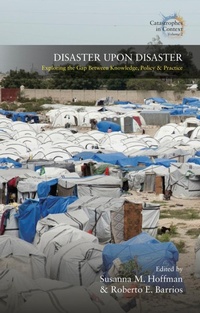
Disaster Upon Disaster
Description

A consistent problem that confronts disaster reduction is the disjunction between academic and expert knowledge and policies and practices of agencies mandated to deal with the concern. Although a great deal of knowledge has been acquired regarding many aspects of disasters, such as driving factors, risk construction, complexity of resettlement, and importance of peoples' culture, very little has become protocol and procedure. Disaster Upon Disaster illuminates the numerous disjunctions between the suppositions, realities, agendas, and executions in the field, goes on to detail contingencies, predicaments, old and new plights, and finally advances solutions toward greatly improved outcomes.
More details
Other editions
Additional editions
Persons
Susanna M. Hoffman is author, co-author, and editor of twelve books, including The Angry Earth 1 & 2 and Catastrophe and Culture, two ethnographic films, and over forty articles. She initiated the Risk and Disaster Thematic Interest Group at the Society for Applied Anthropology, is the founder and chair of the Risk and Disaster Commission for the International Union of Anthropology and Ethnographic Sciences, and was the first recipient of the Aegean Initiative Fulbright concerning the Greek and Turkish earthquakes.
Content
List of Illustrations
Acknowledgments
Introduction: Defining Disaster Upon Disaster: Why Risk Prevention and Disaster Response So Often Fail
Susanna M. Hoffman
PART I: ILLUMINATING THE FISSURES: SUPPOSITIONS, REALITIES, AGENDAS, AND EXECUTION
Chapter 1. Unwieldy Disasters: Engaging the Multiple Gaps and Connections That Make Catastrophes
Roberto E. Barrios
Chapter 2. Advocacy and Accomplishment: Contrasting Challenges to Successful Disaster Risk Management
Terry Jeggle
Chapter 3. Natural Hazard Events into Disasters: The Gap between Knowledge, Policy, and Practice as it Affects the Built Environment
Stephen Bender
Chapter 4. Humanitarian Response: Ideals Meet Reality
Adam Koons
Chapter 5. Disaster Theory Versus Practice? It's a Long Rocky Road - A Practitioner's View from the Ground
Jane Murphy Thomas
PART II: SITUATIONS AND EXPOSITIONS: PLIGHTS, PROBLEMS AND QUANDRIES
Chapter 6. Slow On-Set Disaster: Climate Change and the Gaps Between Knowledge, Policy, and Practice
Shirley J. Fiske and Elizabeth Marino
Chapter 7. Disrupting Gendered Outcomes: Addressing Disaster Vulnerability Through Stakeholder Participation
Brenda D. Phillips
Chapter 8. Resettlement for Disaster Risk Reduction: Global Knowledge, Local Application
Anthony Oliver-Smith
Chapter 9. From Nuclear Things to Things Nuclear: Minding the Gap at the Knowledge-Policy-Practice Nexus in Post-Fallout Fukushima
Ryo Morimoto
Chapter 10. "Haitians Need to be Patient" - Notes on Policy Advocacy in Washington Following Haiti's Earthquake
Mark Schuller
PART III: REVAMPING APPARATUS AND OUTCOME
Chapter 11. The Scope and Importance of Anthropology and its Core Concept of Culture in Closing the Risk and Disaster Knowledge to Policy and Practice Gap
Susanna M. Hoffman
Chapter 12. Engaged: Applying the Anthropology of Disaster to Practitioner Settings and Policy Creation
Katherine E. Browne, Elizabeth Marino, Heather Lazrus, and Keely Maxwell
Chapter 13. Future Matter Matters: Disasters as a (Potential) Vehicle for Social Change. It's About Time
Ann Bergman
Index
