

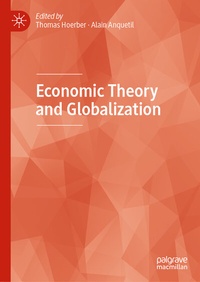
Economic Theory and Globalization
Description

What do the economic theories of thought-leaders in economics, such as Smith, Keynes, Marx and Schumpeter, tell us about globalisation in the twenty-first century? Great economic theories have provided a narrative of how society should work in all its aspects, and can offer renewed usefulness for today's society.
Each economic theory is presented for easy access, readability and simplicity; explaining the criticism a particular theory poses against its own contemporary environment, such as the poverty produced by Manchester capitalism in Marx, and then applying those historical lessons to our current time. Should some economic theories be left sitting on a shelf, safely without any impact on us, or do some great economic ideas still have something to contribute to the grand quest for a more just society in its many interpretations?
More details
Other editions
Additional editions
Persons
Thomas Hoerber is Director of the EU-Asia Institute and Professor in European Studies at Ecole Supérieure des Sciences Commerciales d'Angers (ESSCA), France. His research focuses on European integration theory, with a particular interest in the connection between History and Politics.
Alain Anquetil is Professor of Moral Philosophy and Business Ethics at Ecole Supérieure des Sciences Commerciales d'Angers (ESSCA), France.
Content
Chapter 1: Introduction; Thomas Hoerber, Alain Anquetil.- Chapter 2: The Social Liberalism of John Stuart Mill; Alain Anquetil.- Chapter 3: Karl Marx's Communism and Critique of Capital; Paul Prew.- Chapter 4: Edmund Burke's Liberalism; Thomas Hoerber.- Chapter 5: The free Liberalism of Adam Smith; Alain Anquetil.- Chapter 6: Economic Cycles by Josef Schumpeter; Assen Slim.- Chapter 7: The Bancor and International Trade Possibilities of John Maynard; David Rees.- Chapter 8: The roots of neo-liberalism in Friedrich von Hayek; Thomas Hoerber.- Chapter 9: Elinor Ostrom or the Revolution of the Commons; Fanny Verrax.- Chapter 10: The Ecological Economy of Georgescu Roegen; Gabriel Weber, Ignazio Cabras.- Chapter 11: Conclusion; Alain Anquetil, Thomas Hoerber.
