

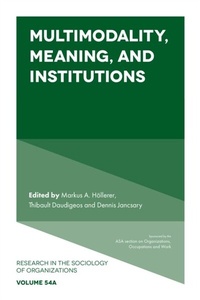
Multimodality, Meaning, and Institutions
1st Edition
Published on 6. December 2017
272 pages
978-1-78743-329-8 (ISBN)
Description

The insight that institutions, and the communicative practices that create, sustain, and challenge them, are multimodal accomplishments has garnered increasing attention from scholars in organization and management research over the last decade. Traditional understanding of social knowledge and meaning as being constituted primarily through verbal discourse has been challenged and extended by work that has promoted the centrality of visual, material, and other sign systems (e.g., audio, gestures, layout) for constructing social reality.
While some discursive approaches to organizations and institutions have acknowledged the existence and relevance of modes other than the verbal for some time, systematic research on multimodality has remained rather sparse. In particular, the interaction and orchestration of multiple modes remains terra incognita with considerable empirical, methodological, and theoretical stakes.
Together, 54A and 54B of Research in the Sociology of Organizations investigate these issues with innovative research that focuses on the relationship between different modes in the emergence, diffusion, maintenance, and challenge of social meanings and institutions. Individual contributions demonstrate the potential of multimodal approaches to rejuvenate and extend the study of institutions, they revisit research on classic phenomena in organization theory through a multimodal lens, and advance the design of relevant and rigorous methods of analysis for the study of multimodal communicative practices.
While some discursive approaches to organizations and institutions have acknowledged the existence and relevance of modes other than the verbal for some time, systematic research on multimodality has remained rather sparse. In particular, the interaction and orchestration of multiple modes remains terra incognita with considerable empirical, methodological, and theoretical stakes.
Together, 54A and 54B of Research in the Sociology of Organizations investigate these issues with innovative research that focuses on the relationship between different modes in the emergence, diffusion, maintenance, and challenge of social meanings and institutions. Individual contributions demonstrate the potential of multimodal approaches to rejuvenate and extend the study of institutions, they revisit research on classic phenomena in organization theory through a multimodal lens, and advance the design of relevant and rigorous methods of analysis for the study of multimodal communicative practices.
Reviews / Votes
Presenting their research in the sociology of organizations, scholars of business and organizations cover multimodal perspectives on institutional persistence and change, and the multimodal construction of identities. Among their topics are the multimodal construction of a rational myth: industrialization of the French building sector from 1845 to 1970, dirty oil or ethical oil: visual rhetoric in legitimation struggles, companies on the runway: fashion companies' multimodal presentation of their organizational identity in job advertising, and the architecture of city identities: a multimodal study of Barcelona and Boston. -- Annotation (c)2018 * (protoview.com) *More details
Series
Language
English
Place of publication
Bingley
United Kingdom
Target group
Professional and scholarly
File size
3,99 MB
ISBN-13
978-1-78743-329-8 (9781787433298)
Copyright in bibliographic data and cover images is held by Nielsen Book Services Limited or by the publishers or by their respective licensors: all rights reserved.
Schweitzer Classification
Other editions
Additional editions
Markus A. Hoellerer | Thibault Daudigeos | Dennis Jancsary
Multimodality, Meaning, and Institutions
Book
12/2017
Emerald Publishing Limited
€153.60
Shipment within 10-20 days
Persons
Markus A. Hoellerer is Professor of Public Management and Governance at Vienna University of Economics and Business, Austria, and is also Senior Scholar in Organization Theory at UNSW Sydney Business School, Australia.
Thibault Daudigeos is Professor of Organization Studies at Grenoble School of Management, France, and Head of the Alternative Forms of Markets and Organizations (AFMO) Research Team.
Dennis Jancsary is Assistant Professor at the Institute for Organization Studies at Vienna University of Economics and Business, Austria.
Thibault Daudigeos is Professor of Organization Studies at Grenoble School of Management, France, and Head of the Alternative Forms of Markets and Organizations (AFMO) Research Team.
Dennis Jancsary is Assistant Professor at the Institute for Organization Studies at Vienna University of Economics and Business, Austria.
Content
Introduction: Multimodality, Meaning, And Institutions; Markus A. Hoellerer, Thibault Daudigeos and Dennis JancsaryPart One: Pushing Forward the Multimodal Agenda in Organization Studies
1. Multimodal Imaginaries and The "Big Worm": Materialities, Artefacts and Analogies in Sao Paulo's Urban Renovation; Felippe De Medeiros Oliveira, Gazi Islam and Maria Laura Toraldo
2. A Call for "Strong" Multimodal Research in Institutional Theory; Tammar B. Zilber
Part Two: Methodological Advances in Multimodal Research
3. Institutions as Multimodal Accomplishments: Towards The Analysis of Visual Registers; Dennis Jancsary, Renate E. Meyer, Markus A. Hoellerer and Eva Boxenbaum
4. Protest in Style: Exploring Multimodal Concision in Rhetorical Artifacts; Wenyao (Will) Zhao
Part Three: Multimodality and The Institutionalization of Innovations
5. Towards A Multimodal Model of Theorization Processes; Melodie Cartel, Sylvain Colombero and Eva Boxenbaum
6. A Multimodal Investigation of the Institutionalization of Aesthetic Design as A Dimension of Competition in The Pc Industry; Micki Eisenman
7. Let The Games Begin: Institutional Complexity and The Design of New Products; Raissa Pershina and Birthe Soppe
1. Multimodal Imaginaries and The "Big Worm": Materialities, Artefacts and Analogies in Sao Paulo's Urban Renovation; Felippe De Medeiros Oliveira, Gazi Islam and Maria Laura Toraldo
2. A Call for "Strong" Multimodal Research in Institutional Theory; Tammar B. Zilber
Part Two: Methodological Advances in Multimodal Research
3. Institutions as Multimodal Accomplishments: Towards The Analysis of Visual Registers; Dennis Jancsary, Renate E. Meyer, Markus A. Hoellerer and Eva Boxenbaum
4. Protest in Style: Exploring Multimodal Concision in Rhetorical Artifacts; Wenyao (Will) Zhao
Part Three: Multimodality and The Institutionalization of Innovations
5. Towards A Multimodal Model of Theorization Processes; Melodie Cartel, Sylvain Colombero and Eva Boxenbaum
6. A Multimodal Investigation of the Institutionalization of Aesthetic Design as A Dimension of Competition in The Pc Industry; Micki Eisenman
7. Let The Games Begin: Institutional Complexity and The Design of New Products; Raissa Pershina and Birthe Soppe
