

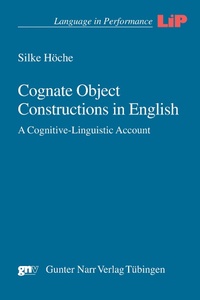
Cognate Object Constructions in English
A Cognitive-Linguistic Account
1st Edition
Published on 20. May 2009
311 pages
978-3-8233-7489-3 (ISBN)
Description

"Cognate Object Constructions in English." is the first comprehensive description of linguistic expressions such as Both died an unheroic death or Jamie grinned his tired grin, viewed from a Cognitive Linguistic perspective. Redefining the category of "cognate objects", the book provides a systematic account of prototypical and less prototypical instances of this pattern. Based on real-usage data from the BNC, the study presents a family of constructions which are equipped with their own syntactic and lexical idiosyncrasies and their own semantic-pragmatic functions, such as event structuring and event intensification. In a step-by-step fashion, the author develops a network of constructional schemas ranging from abstract to concrete, thereby investigating and corroborating the plausibility of a lexis-syntax continuum - one of the main assumptions of the Cognitive Linguistics enterprise.
The book offers important insight on concepts such as argument structure and transitivity and demonstrates the fruitful interrelationship between Cognitive Linguistics and statistical corpus linguistics.
The book offers important insight on concepts such as argument structure and transitivity and demonstrates the fruitful interrelationship between Cognitive Linguistics and statistical corpus linguistics.
More details
Other editions
Additional editions
Book
01/2010
Narr Francke Attempto
€58.00
Shipment within 7-9 days
Content
- Intro
- Acknowledgements
- Table of Contents
- List of abbreviations
- 1 Introduction
- 1.1 Aims of the book
- 1.2 Methodological issues
- 1.3 Overview of the book
- 2 Cognate Object Constructions: Past andPresent
- 2.1 Introduction
- 2.2 COCs in Descriptive / Reference Grammars
- 2.3 Generative Grammar approaches to COCs
- 2.4 Functional Grammar accounts of COCs
- 2.5. Macfarland (1995): Cognate Objects and the adjunct /argument distinction
- 2.6 Conclusion
- 3 Basic Tenets of Cognitive Linguistics
- 3.1 Introduction: Cognitive Linguistics and CognitiveGrammar
- 3.2 The non-autonomy of language
- 3.3 The symbolic nature of grammar
- 3.4 Meaning as conceptualization
- 3.5 Linguistic categorization
- 3.6 The usage-based account of language
- 3.7 Constructions and construction grammars
- 3.8 Conclusion
- 4 A Cognitive Linguistic description of COCs:General issues
- 4.1 Introduction
- 4.2 The meaning of COCs
- 4.3 Events, results, landmarks: Different types of CognateObjects
- 4.4 The composite structure [V + CO], or: How to integratean object with an intransitive verb
- 4.5 Repeated content: Redundancy vs. Iconicity
- 4.6 Summary and conclusion
- 5 Consulting the corpus: Towards a usagebasednetwork of COCs
- 5.1 Introduction
- 5.2 CL and corpus linguistics: The usage-based approachto language
- 5.3 General methodological considerations
- 5.4 Semantic classes and COC types
- 5. 5 A collexeme analysis of COCs - Measuring the associationbetween verb and construction
- 5.6 A usage-based network of argument structure constructions
- 5.7 Summary and conclusion
- 6 The Transitivity of COCs
- 6.1 Introduction
- 6.2 Transitivity in Cognitive Grammar
- 6.3 Hopper & Thompson (1980): Features of transitivity
- 6.4 The transitivity prototype
- 6.5 Other event scenarios
- 6.6 COCs - Means of elaborating event structure
- 6.7 The transitivity continuum
- 6.8 To passivize or not to passivize?
- 6.9 Summary and conclusion
- 7 'Packaged' events: Aspectual characteristicsof COCs
- 7.1 Introduction
- 7.2 Aspect, aktionsart, aspectuality
- 7.3 Boundedness: Concepts and implications
- 7.4 Iterative processes
- 7.5 Continuous processes
- 7.6 Peripheral cases
- 7. 7 Conclusion
- 8 Mid-level schemas: The make-up of the COnominal
- 8.1 Introduction
- 8.2 Determiners in the CO-phrase
- 8.3 Modification patterns
- 8.4 Summary and conclusion
- 9 COCs vs. VACs: Putting alternations to thetest
- 9.1 Preliminary considerations
- 9.2 Live happily or live a happy life?
- 9.3 Die naturally or die a natural death?
- 9.4 Smile slowly or smile a slow smile?
- 9.5 Summary and discussion
- 10 Don't have a run, run a run! - LVCs andCOCs compared
- 10.1 Introduction
- 10.2 A brief portrayal of LVCs
- 10.3 Parallels between COCs and LVCs?
- 10.4 The semantics of selected LVCs in comparison toCOCs
- 10.5 Summary and conclusion
- 11 Lower-level schemas: Collocations, idioms,register
- 11.1 Preliminary considerations
- 11.2 Variable low-level schemas
- 11.3 Fixed units
- 11.4 Register
- 11.5 Summary and conclusion: A usage-based network ofconstructions
- 12 I have a tale to tell: Conclusion and outlook
- 12.1 Summary of findings
- 12.2 Future perspectives
- 13. References
- 14. Appendix
