

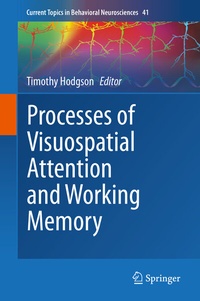
Processes of Visuospatial Attention and Working Memory
Description

More details
Other editions
Additional editions
Content
Part I Evolution and Development.- The Evolution of Gaze Shifting Eye Movements.- Visuospatial integration and hand-tool interaction in cognitive archaeology.- Development of Visual-Spatial Attention.- Variations in the beneficial effects of spatial structure and serial organization on working memory span in humans and other species.- Part II Processes, mechanisms and models.- Biasing allocations of attention via selective weighting of saliency signals: behavioral and neuroimaging evidence for the Dimension-Weighting Account.- Active inference, novelty, and neglect.- Prefrontal contributions to attention and working memory.- Functions of memory across saccadic eye movements.- What is memory-guided attention? How past experiences shape selective visuospatial attention in the present.- Superstitious perception in humans and neural networks.- Dynamic Protention: the architecture of real-time cognition for future events.- Recent studies on the relationship between covert visuo-spatial attention, visual search and saccadic eye movements.- Functional imaging of visuo-spatial attention in complex and naturalistic conditions.- Part III Neuropsychology and Neuropsychiatry.- Visuo-spatial attention and working memory in progressive supra-nuclear palsy.- Attention and working memory in Alzheimers and Parkinsons disease.- Mechanisms underlying visuospatial working memory impairments in schizophrenia.- Dopamine and working memory: The impact of genetic variation, stress and implications for mental health.- Eye movements in neuropsychological tasks.
