

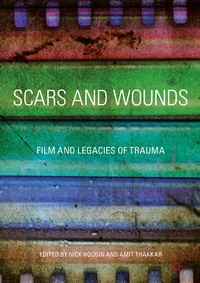
Scars and Wounds
Description

Reviews / Votes
"Scars and Wounds is an outstanding contribution to an understanding of the causes and effects of trauma. With case studies including films made in Algeria, Bosnia, Rwanda, Chile and the USA, documentaries and fictional narratives, mainstream and low-budget productions, it perfectly balances historical research with discussion of the means filmmakers use to give shape to events that tear the tissue of individual and collective bodies. It demonstrates that trauma, even if resulting from natural disasters, is always imbricated with politics, including class and gender politics." (Prof. Ewa Mazierska, Professor of Contemporary Cinema, School of Humanities and Social Sciences , UCLAN, UK)
"Scars and Wounds is essential reading for those interested in trauma and cinema. Its highly innovative approach and consistently lucid, nuanced analysis entails a somatic sensibility that explores trauma as an ever-present scar, correlatingthe physical process of wounding and scarring with the process of cinematic representation. Examining filmic depictions framed by a range of traumatic events, such as those arising from the Algerian civil war, the Bosnian war, atrocities in Rwanda, and Hurricane Katrina, through to Argentina's last military dictatorship, this collection of outstanding essays encompasses a broad geographical scope that opens up new perspectives on Michael Rothberg's concept of multidirectional memory. The anthology, skilfully brought together by Amit Thakkar and Nick Hodgin, makes a significant, timely and path-breaking contribution to scholarship on trauma and cinema." (Fran Pheasant-Kelly, Reader in Screen Studies, University of Wolverhampton, UK)
More details
Other editions
Additional editions
Persons
Amit Thakkar is Senior Lecturer in Hispanic Studies at Lancaster University, UK. He has co-edited special issues of journals on masculinities and violence in Latin America, one of which was selected for Routledge's Special Issues as Books series. He has also published articles on crash cinemas in Latin American film.
Content
Introduction: Trauma Studies and the Scar Motif.Nick Hodgin and Amit Thakkar.-1. Trauma in Recent Algerian documentary Cinema: stories of civil conflict told by the living dead.Guy Austin.-2. Elusive Figures: Children's Trauma and Bosnian War Cinema.Dijana Jelaca.-3. Conferring Visibility on Trauma within Rwanda's National Reconciliation: Kivu Ruhorahoza's Disturbing and Salutary Camera.Alexandre Dauge-Roth.-4. Proximity and distance: approaching trauma in Katrina films.Nick Hodgin.-5. Our Long National Nightmare Is Over': the resolution of trauma and male melodrama in The Tree of Life (Terrence Malick, 2011).Brian Baker.-6. Listening to the Pain of Others: Isabel Coixet's The Secret Life of Words (2005).Erin K. Hogan.-7. Australian Postcolonial Trauma and Silences in Samson and Delilah (Warwick Thornton, 2009).Ben Gook.-8. Trauma's slow onslaught: Sound and Silence in Lav Diaz's Florentina Hubaldo, CTE (2012).Nadin Mai.-9. Flesh and Blood in the
Globalized Age: Pablo Trapero's Nacido y criado/Born and Bred (2006) and Carancho/The Vulture (2010).Fiona Clancy.-10. Unclaimed Experience and the Implicated Subject in Pablo Larraín's Post Mortem.Amit Thakkar.-11. Persepolis (Vincent Paronnaud and Marjane Satrapi, 2007) telling tales of trauma.Steven Allen