

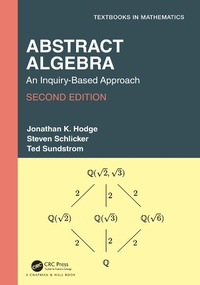
Abstract Algebra
An Inquiry-Based Approach
2nd Edition
Published on 19. December 2023
547 pages
978-1-003-81418-4 (ISBN)
Description

Abstract Algebra: An Inquiry-Based Approach, Second Edition not only teaches abstract algebra, but also provides a deeper understanding of what mathematics is, how it is done, and how mathematicians think.
The second edition of this unique, flexible approach builds on the success of the first edition. The authors offer an emphasis on active learning, helping students learn algebra by gradually building both their intuition and their ability to write coherent proofs in context.
The goals for this text include:
Allowing the flexibility to begin the course with either groups or rings
Introducing the ideas behind definitions and theorems to help students develop intuition
Helping students understand how mathematics is done. Students will experiment through examples, make conjectures, and then refine or prove their conjectures
Assisting students in developing their abilities to effectively communicate mathematical ideas
Actively involving students in realizing each of these goals through in-class and out-of-class activities, common in-class intellectual experiences, and challenging problem sets
Changes in the Second Edition
Streamlining of introductory material with a quicker transition to the material on rings and groups
New investigations on extensions of fields and Galois theory
New exercises added and some sections reworked for clarity
More online Special Topics investigations and additional Appendices, including new appendices on other methods of proof and complex roots of unity
Encouraging students to do mathematics and be more than passive learners, this text shows students the way mathematics is developed is often different than how it is presented; definitions, theorems, and proofs do not simply appear fully formed; mathematical ideas are highly interconnected; and in abstract algebra, there is a considerable amount of intuition to be found.
The second edition of this unique, flexible approach builds on the success of the first edition. The authors offer an emphasis on active learning, helping students learn algebra by gradually building both their intuition and their ability to write coherent proofs in context.
The goals for this text include:
Allowing the flexibility to begin the course with either groups or rings
Introducing the ideas behind definitions and theorems to help students develop intuition
Helping students understand how mathematics is done. Students will experiment through examples, make conjectures, and then refine or prove their conjectures
Assisting students in developing their abilities to effectively communicate mathematical ideas
Actively involving students in realizing each of these goals through in-class and out-of-class activities, common in-class intellectual experiences, and challenging problem sets
Changes in the Second Edition
Streamlining of introductory material with a quicker transition to the material on rings and groups
New investigations on extensions of fields and Galois theory
New exercises added and some sections reworked for clarity
More online Special Topics investigations and additional Appendices, including new appendices on other methods of proof and complex roots of unity
Encouraging students to do mathematics and be more than passive learners, this text shows students the way mathematics is developed is often different than how it is presented; definitions, theorems, and proofs do not simply appear fully formed; mathematical ideas are highly interconnected; and in abstract algebra, there is a considerable amount of intuition to be found.
More details
Series
Edition
2nd edition
Language
English
Place of publication
London
United Kingdom
Publishing group
Taylor & Francis Ebooks
Target group
College/higher education
Product notice
Reflowable
Illustrations
44 Halftones, black and white; 44 Illustrations, black and white
ISBN-13
978-1-003-81418-4 (9781003814184)
Copyright in bibliographic data and cover images is held by Nielsen Book Services Limited or by the publishers or by their respective licensors: all rights reserved.
Schweitzer Classification
Other editions
Additional editions
Book
12/2023
2nd Edition
Chapman & Hall/CRC
€144.60
Shipment within 15-20 days
Persons
Jonathan K. Hodge is a Professor of Mathematics and Dean of the School of Natural Sciences at St. Edward's University. Prior to joining SEU, Dr. Hodge taught mathematics for 19 years at Grand Valley State University, where he also co-directed GVSU's Summer Mathematics Research Experience for Undergraduates (REU). Dr. Hodge earned his Ph.D. in mathematics from Western Michigan University in 2002. In addition to Abstract Algebra: An Inquiry-Based Approach, he is also a co-author of The Mathematics of Voting and Elections: A Hands-On Approach, published by the American Mathematical Society.
Steven Schlicker is a Professor of Mathematics at Grand Valley State University in Allendale, MI. He earned his bachelor's degree in mathematics from Michigan State University and a Ph.D. in mathematics (in group cohomology and algebraic K-theory) from Northwestern University. In addition to being a coauthor of Abstract Algebra: An Inquiry-Based Approach, he is a contributing author to Active Calculus, the primary author of Active Calculus Multivariable, and coauthor of the texts Discovering Wavelets and Linear Algebra and Applications: An Inquiry-based Approach, and of a trigonometry book with Ted Sundstrom.
Ted Sundstrom is Professor Emeritus of Mathematics at Grand Valley State University having retired in 2017 after 44 years of service. He received a bachelor's degree in mathematics from Western Michigan University in 1968 and a Ph.D. in mathematics (ring theory) from the University of Massachusetts in 1973. In 2005, he received the award for Distinguished Teaching of College or University Mathematics by the Michigan Section of the MAA. Besides being a coauthor of Abstract Algebra: An Inquiry-Based Approach, he is the author of Mathematical Reasoning: Writing and Proof, and coauthored a trigonometry book with Steven Schlicker. In 2017, Prof. Sundstrom was the inaugural recipient of the Daniel Solow Author's Award from the Mathematical Association of America for the book Mathematical Reasoning: Writing and Proof.
Steven Schlicker is a Professor of Mathematics at Grand Valley State University in Allendale, MI. He earned his bachelor's degree in mathematics from Michigan State University and a Ph.D. in mathematics (in group cohomology and algebraic K-theory) from Northwestern University. In addition to being a coauthor of Abstract Algebra: An Inquiry-Based Approach, he is a contributing author to Active Calculus, the primary author of Active Calculus Multivariable, and coauthor of the texts Discovering Wavelets and Linear Algebra and Applications: An Inquiry-based Approach, and of a trigonometry book with Ted Sundstrom.
Ted Sundstrom is Professor Emeritus of Mathematics at Grand Valley State University having retired in 2017 after 44 years of service. He received a bachelor's degree in mathematics from Western Michigan University in 1968 and a Ph.D. in mathematics (ring theory) from the University of Massachusetts in 1973. In 2005, he received the award for Distinguished Teaching of College or University Mathematics by the Michigan Section of the MAA. Besides being a coauthor of Abstract Algebra: An Inquiry-Based Approach, he is the author of Mathematical Reasoning: Writing and Proof, and coauthored a trigonometry book with Steven Schlicker. In 2017, Prof. Sundstrom was the inaugural recipient of the Daniel Solow Author's Award from the Mathematical Association of America for the book Mathematical Reasoning: Writing and Proof.
Content
I. Number Systems
1.The Integers
2. Equivalence Relations and [Equation]n
3. Algebra in Other Number Systems
II Rings
4. An Introduction to Rings
5. Integer Multiples and Exponents
6. Subrings, Extensions, and Direct Sums
7. Isomorphism and Invariants
III Polynomial Rings
8 Polynomial Rings
9 Divisibility in Polynomial Rings
10 Roots, Factors, and Irreducible Polynomials
11 Irreducible Polynomials
12 Quotients of Polynomial Rings
IV More Ring Theory
13 Ideals and Homomorphisms
14 Divisibility and Factorization in Integral Domains
15 From [Equation] to [Equation]
V Groups
16 Symmetry
17 An Introduction to Groups
18 Integer Powers of Elements in a Group
19 Subgroups
20 Subgroups of Cyclic Groups
21 The Dihedral Groups
22 The Symmetric Groups
23 Cosets and Lagrange's Theorem
24 Normal Subgroups and Quotient Groups
25 Products of Groups
26 Group Isomorphisms and Invariants
27 Homomorphisms and Isomorphism Theorems
28 The Fundamental Theorem of Finite Abelian Groups
29 The First Sylow Theorem
30 The Second and Third Sylow Theorems
VI Fields and Galois Theory
31 Finite Fields, the Group of Units in [Equation]n, and Splitting Fields
32 Extensions of Fields
33 Galois Theory
1.The Integers
2. Equivalence Relations and [Equation]n
3. Algebra in Other Number Systems
II Rings
4. An Introduction to Rings
5. Integer Multiples and Exponents
6. Subrings, Extensions, and Direct Sums
7. Isomorphism and Invariants
III Polynomial Rings
8 Polynomial Rings
9 Divisibility in Polynomial Rings
10 Roots, Factors, and Irreducible Polynomials
11 Irreducible Polynomials
12 Quotients of Polynomial Rings
IV More Ring Theory
13 Ideals and Homomorphisms
14 Divisibility and Factorization in Integral Domains
15 From [Equation] to [Equation]
V Groups
16 Symmetry
17 An Introduction to Groups
18 Integer Powers of Elements in a Group
19 Subgroups
20 Subgroups of Cyclic Groups
21 The Dihedral Groups
22 The Symmetric Groups
23 Cosets and Lagrange's Theorem
24 Normal Subgroups and Quotient Groups
25 Products of Groups
26 Group Isomorphisms and Invariants
27 Homomorphisms and Isomorphism Theorems
28 The Fundamental Theorem of Finite Abelian Groups
29 The First Sylow Theorem
30 The Second and Third Sylow Theorems
VI Fields and Galois Theory
31 Finite Fields, the Group of Units in [Equation]n, and Splitting Fields
32 Extensions of Fields
33 Galois Theory
