

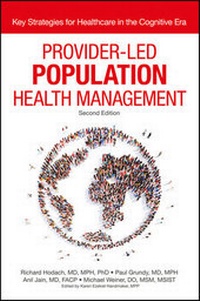
Provider-Led Population Health Management
Description

More details
Other editions
Additional editions
Persons
Richard Hodach, MD, MPH, PhD, is Vice President, IBM Watson Health, previously serving as Chief Medical Officer and Vice President of Clinical Product Strategy at Phytel, now part of IBM Watson Health. Dr. Hodach has long been recognized as a leader of population health management strategies. He is responsible for providing strategic direction and clinical expertise for the development of Phytel's solutions. Dr. Hodach is a regular contributor to prestigious peer]review journals such as The American Journal of Managed Care, The Journal of Population Health Management, hfm (published by the Healthcare Financial Management Association), The Group Practice Journal, and more. He was instrumental in the CMS Innovation Award of a $20.75 million grant which Phytel, VHA Inc., and TransforMED received from The Center for Medicare & Medicaid Innovation (CMMI). In addition to his leadership position at Phytel, Dr. Hodach also serves on the board of directors of the American College of Medical Quality. Before joining Phytel, he held senior leadership positions at Matria Healthcare and Accordant, and co]founded MED.I.A. Dr. Hodach has a Ph.D. in Pathology and an M.D. with Board Certification in Neurology and Electrodiagnosis, as well as a Master's Degree in Public Health.
Paul Grundy, MD, MPH, is Global Director, Healthcare Transformation at IBM, and President of the Patient]Centered Primary Care Collaborative. Dr. Grundy is known as the "godfather" of the patient]centered medical home. An active social entrepreneur and speaker on global healthcare transformation, he concentrates his efforts on driving comprehensive, linked, and integrated healthcare. Dr. Grundy's work has been covered by The New York Times, BusinessWeek, Health Affairs, The Economist, The New England Journal of Medicine, and other newspapers, radio, and television stations across the U.S. He is a healthcare ambassador for the nation of Denmark and adjunct professor at the University of Utah Department of Family and Preventive Medicine. Dr. Grundy is a member of National Academy of Science's Institute of Medicine, director of the ACGME, and member of the national advisory board of the National Center for Interprofessional Practice & Education, Mayo Clinic Center for Connected Care. He is a retired senior diplomat with the rank of Minister Consular U.S. State Department. Dr. Grundy graduated as valedictorian from the Southern California College, earned an M.D. from the University of California-San Francisco Medical School, and received a Masters of Public Health from the University of California-Berkeley.
Anil Jain, MD, FACP, is Senior Vice President and Chief Medical Officer, IBM Watson Health, previously serving as Chief Medical Officer of Explorys FOR SCREEN VIEWING IN BPA ONLY(now part of IBM Watson Health), formed in 2009 based on innovations that he developed while at the Cleveland Clinic. In this role, Dr. Jain directs the informatics and analytics innovations, product management, and software development, as well as leading the life sciences business unit. In addition to serving on state and national committees focused on driving quality and research through health IT, he has authored more than 100 publications and abstracts and has delivered numerous talks on the benefits of sustainable health IT innovation, clinical informatics, and big data analytics. Dr. Jain also continues to practice and teach medicine part]time in the Department of Internal Medicine at Cleveland Clinic and had previously served as an Attending Staff and Senior Executive Director of IT. He is a former leader at Better Health Greater Cleveland and had served as co]Director of Informatics of Case Western School of Medicine's CTSA. Dr. Jain is an active member of the Health Information Management & Systems Society (HIMSS) and the American Medical Informatics Association (AMIA), and is a Fellow of the American College of Medicine (ACP), and is also a Diplomat of the American Board of Internal Medicine (ABIM). He received a degree in Biomedical Engineering and a degree in Medicine from Northwestern University prior to his post]graduate training in Internal Medicine at the Cleveland Clinic.
Michael Weiner, DO, MSM, MSIST, is Chief Medical Information Officer at IBM. Prior to his current position with IBM, Dr. Weiner served as the Chief Medical Information Officer and Director of Clinical Informatics for the DoD VA Interagency Program Office, where he was responsible for creating a unified Interagency Electronic Health Record for more than 125,000 providers and 18 million beneficiaries worldwide. He is an active member of the American College of Physicians and the American Osteopathic Association, and is a former NASA Space Shuttle takeoff and landing physician. Dr. Weiner serves on the Philadelphia College of Osteopathic Medicine Alumni Board and the board of the American Medical Informatics Association, as well as having served on the Health and Human Services' Office of the National Coordinator Health Information IT Policy Committee, helping create Meaningful Use Stage 1. He has received numerous awards from the President of the United States, for his service in the Navy, including two Meritorious Service Medals, and two Air Medals. Dr. Weiner is an adjunct professor of Health Information Technology at the George Washington University and is one of only a few physicians ever to have been certified as a Chief Information Officer by the U.S. General Services Administration. He is a graduate of the U.S. Naval Academy and attended medical school at the Philadelphia College of Osteopathic Medicine. Dr. Weiner is a board-certified practicing physician in Internal Medicine, and holds a Master's degree in Management and a Master's degree in Information Systems Technology from George Washington University.
Content
Acknowledgments vi Foreword xiii
Introduction 1
Section 1: New Delivery Models 9
1 Population Health Management 11
What Is Population Health Management? 13
Key components 14
Obstacles to PHM 16
The Beginnings of Change 17
Examining the crucial role of automation 18
Managing the entire population 19
The Three Pillars of PHM 20
Conclusion 22
2 Accountable Care Organizations 25
The ACO Environment 27
Government support 28
ACO snapshots 29
Population health management 31
The role of information technology 32
Automation and analytic tools 33
Conclusion 35
3 Patient?-Centered Medical Homes 37
Initial Results Are Promising 38
Managing the Medical Neighborhood 40
PCMH Background 40
Medical home certification 41
Challenges and solutions 43
Building the medical neighborhood 44
How much will it cost? 45
Role of Information Technology 46
Automation tools 47
Conclusion 50
Section 2: How to Get There 51
4 Clinically Integrated Networks 53
Clinically Integrated Networks 54
Current definition 56
Basic requirements 56
Automation tools and CINs 58
Risk stratification 59
Patient outreach 60
Care management 60
Patient engagement 61
Post?-discharge care 63
Performance evaluation 63
The Need for Speed 64
Conclusion 64
5 Meaningful Use and Population Health Management 67
Meaningful Use Overview 68
Meaningful Use nuts?-and?-bolts 70
Upping the ante in Stages 2 and 3 71
PHM Components of Meaningful Use 71
Clinical decision support 72
Patient engagement 72
A leap forward for PHM 73
Health information exchange 74
MIPS and MACRA 76
Conclusion 77
6 Data Infrastructure 79
Data Sources 83
Administrative data 83
Clinical data 84
Claims data 84
Patient?-generated data 85
Provider attribution 86
Patient matching 87
Unstructured data 87
Data governance 88
Big Data's Role 88
Data lake approach 89
Data normalization 91
Analytics 91
Registries 92
Work lists 93
Predictive modeling 93
Risk stratification 94
Performance evaluation 95
Timely Response 95
Other Big Data Directions 96
Conclusion 97
7 Predictive Modeling 99
Predictive Modeling Basics 101
Turning Predictions into Action 103
Prescriptive analytics 104
Risk stratification 104
Directing resources 105
Making a difference 105
Automation tools 106
Clinical judgment and culture 107
Provider Attribution 108
Risk Adjustment 109
Financial Risk 110
Data Sources 112
Claims data 113
Clinical data 113
Patient?-reported data 114
Broadening the data palette 115
Conclusion 116
8 Automation Solutions and the ROI of Change 119
Transition to value?-based payments 121
The new return on investment 123
Automated Population Health Management 124
How Automation Produces ROI 126
Patient outreach 126
Analytics 127
Care management 128
Patient engagement 128
Transitions of care 129
How to Calculate ROI 130
Patient outreach: Additional visit revenues 131
Pay-for-performance: Maximizing incentives 131
Risk contracts: Lowering overall costs 132
The bottom line 132
Conclusion 133
Section 3: Implementing Change 135
9 Care Coordination 137
Defining Care Coordination 139
The Physician Group Practice Demonstration 140
The Patient?-Centered Medical Home 141
Technology solutions 142
NCQA criteria 143
Technology Use in Care Coordination 145
Key building blocks 146
Continuum of care 148
Conclusion 149
10 Lean Care Management 151
A Lean Foundation in Health Care 154
High?-Performing Practices 157
Performing at top of license 158
Care?-coordination approaches 159
Lean Care Management 160
Automation in Lean Processes 162
Basic automation tools 163
Top?-of?-license approach 166
Downstream value 166
Conclusion 167
11 Patient Engagement 169
The Physician?-Patient Relationship 171
How to Engage Patients 172
Activation models 173
Obstacles to patient engagement 174
Care Management 175
Patient outreach 175
Risk stratification 176
Patient education 177
Telemedicine 178
Mobile health apps 179
Personal health records 180
Social media 181
Conclusion 182
12 Automated Post?-Discharge Care 185
New Government Incentives 186
Gaps in Care Transitions 188
Poor educational techniques 188
Poor handovers 189
Best Practices 190
IHI's patient?-centered approach 190
Coleman Care Transitions Intervention 191
Naylor Transitional Care Model 191
Automation 192
Assessing patient risk 193
Patient education and engagement 194
Connecting providers to each other 194
Conclusion 195
13 Social and Behavioral Determinants of Health 197
SDH Impact on Health 200
Approaches to SDH 201
Model 1: Targeting health behaviors 201
Model 2: Referral to community services 203
Model 3: Targeted social support within a healthcare framework 204
Model 4: Patient?-centered medical homes 205
Model 5: Holistic care management 206
Behavioral Health 208
Advantages of integration 209
Solving the SDH Puzzle 210
Team?-based approach 212
Harnessing technology 213
Other data sources 214
Conclusion 216
14 Cognitive Computing: The Future of Population Health Management 219
Cognitive Computing 101 223
IBM Watson arrives 224
Natural Language Processing 225
Unstructured EHR data 226
Medical literature 228
Data Types 228
Genomic data 229
Imaging data 230
Monitoring data 230
Non?-healthcare data 232
Population Health Management 232
Predictive modeling 233
Patient engagement 234
Care coordination 235
Workflow integration 235
Conclusion 236
Conclusion 239
End Notes 241
INTRODUCTION
The $3.2 trillion healthcare industry, as conventional wisdom has it, is a big ship to turn around. But employers, consumers, and government can no longer afford healthcare costs that, while growing more slowly than in past years, have reached stratospheric levels.1 The fee-for-service payment system that rewards providers for the volume of services has been implicated in the high cost of health care.2 So, with a concerted push from payers, the industry is in the midst of a rapidly accelerating shift from fee-for-service to various forms of pay-for-value.
The Centers for Medicare and Medicaid Services (CMS) has already taken a number of steps in its transition to value-based payments. To start with, the Medicare Shared Savings Program (MSSP) is rewarding accountable care organizations (ACOs) that create savings and meet quality goals.3 Though most of the 434 ACOs participating in this program today are taking only upside risk in the form of shared savings, many of them will have to accept downside risk as well, starting in 2018, if they choose to renew their MSSP contracts.4 Moreover, CMS has launched a Next Generation ACO program with 21 ACOs that have agreed to take financial risk in return for higher rewards.5 CMS also has placed a small portion of hospitals' Medicare revenue at risk for achieving cost and quality goals, and it began applying a similar pay-for-performance program to physicians in 2015.6,7
By the end of 2018, half of Medicare payments are expected to go to alternative payment models (APMs) such as ACOs, patient-centered medical homes (PCMHs), and bundled payments.8 Further, the new law that replaces the sustainable growth rate (SGR) formula with a different Medicare payment approach gives physicians involved in APMs a 5 percent annual bonus from 2019 to 2024.9
Private payers are moving in tandem with CMS. In March 2014, Anthem BlueCross BlueShield, one of the nation's largest health insurers, said that it had tied a third of its commercial reimbursements to pay-for-value quality programs.10 UnitedHealth Group said it was expanding its incentive programs, with a goal of offering at least half of its network physicians the ability to earn bonuses for value, quality, and efficiency within a few years.11 Aetna is paying incentives to practices that have achieved PCMH recognition and is working with scores of provider groups and health systems to create ACOs.12
About half of the 700-plus ACOs have contracts with private payers. Most of these contracts are based on shared savings rather than on capitation, which is a set monthly fee for each member of a patient population. But 45 percent of private-payer agreements include downside risk, meaning that providers can lose money if their healthcare spending exceeds their budget.13
What all of this means is that healthcare providers can no longer avoid the reality that their current business models are obsolete. As they transition to new care-delivery methods, they must stop basing business decisions on how their clinicians and facilities can produce additional, and ever more costly, billable services. Those services and facilities have been profit centers until now; but in the new world of value-based reimbursement and financial risk, they are becoming cost centers.
The fulcrum of profitability in this new world is maintaining or improving patients' health and delivering good outcomes. The only proven way to achieve these goals is to manage population health effectively and efficiently. To do that, healthcare organizations need advanced health IT, including analytics and automation tools that enable them to transform their mindset, culture, and work processes.
Changing the Mindset
Except for group-model health maintenance organizations (HMOs) such as Kaiser Permanente and Group Health Cooperative, certain large groups and independent practice associations (IPAs) in California, and a few healthcare systems in other states, healthcare providers are not well positioned for population health management (PHM). While many healthcare organizations are creating new structures to prepare for value-based reimbursement, health care is still oriented to fee-for-service. Physician practices still organize care around office visits, and hospitals focus on acute care within their four walls.
One recent study found that physician practices of all sizes increased their use of evidence-based care management processes from 2006 to 2013. But, by the end of that period, even large groups used fewer than half of the recommended processes for chronic disease management, on average.14
The concept of caring for entire patient populations on a continuous basis, whether or not individual patients seek care, is only gradually seeping into the consciousness of healthcare managers and providers. And it is still difficult for many provider organizations to accept the idea that filling beds and appointment slots is less important than ensuring that all patients receive recommended preventive and chronic condition care.
To transform themselves, above all, organizations must have a leadership team that understands and embraces the implications of changing from a volume-based culture to a value-based one and the tenacity to stay the course. Health systems acknowledge the road to value is not smooth, but many report it is rewarding, even joyful for clinicians and staff at all levels.15
In terms of the work to be done, organizations must reduce two kinds of waste: first, the avoidable tests, procedures, and hospital admissions and readmissions that lead to high costs for employers and consumers; and second, the internal waste that inflates the cost of care delivery. The reorganization of care processes can address both kinds of waste simultaneously by improving the quality and efficiency of care.
Organizations that go down this path need to adopt consistent policies and procedures, starting with a common set of clinical protocols. They must form care teams that can coordinate care for every patient, tailoring their approach to the individual's health risks and conditions; restructure workflows so that each member of the care team is working up to the limit of his or her training and skill sets; and use their care managers as efficiently as possible in order to provide appropriate support to all patients who need help.
Electronic health records (EHRs) are essential to any PHM strategy. But EHRs are not designed to support PHM. Though they can supply much of the data required to track and monitor patients' health and identify care gaps, they must be combined with claims data to provide a broad view of population health and to track individual patients across care settings. Moreover, providers need electronic registries to identify care gaps and provide the near-real-time data required to intervene with subgroups of patients efficiently and in a timely manner. Although some EHRs include such registries, they're not as complete, flexible, or usable as those available from third-party developers.
The IT infrastructure for PHM must also include applications that automate the routine, repetitive work of care management. These automation tools offer several advantages: First, they can lower the cost of care management by taking over time-consuming chart research and outreach work. Second, they free up care managers to devote personal attention to high-risk patients who urgently need their help. Third, they allow providers to do essential pre-visit planning and post-visit follow up on a consistent basis. Fourth, they can bring noncompliant patients back in touch with their personal physicians. And fifth, these tools enable organizations to quickly scale up their care management efforts so that they can continuously care for all patients in their population.
Most important, the combination of these tools offers a mechanism for engaging patients in their own health care. Without patient engagement, population health management is impossible.
Current Trends
The rise of accountable care organizations in recent years reflects the concurrent emergence of value-based reimbursement and financial-risk contracts. Composed of physicians and hospitals that are committed to lowering costs and improving quality, ACOs must be able to deliver high-quality care within a budget. Strategies such as admitting patients to lower-cost hospitals and de-emphasizing expensive tests can help them do this in the short term; but in the long term, ACOs will have to manage population health well to be successful.
The patient-centered medical home - a holistic approach to primary care that includes a whole-person orientation and integrated care coordination - is considered an essential building block of ACOs. The National Committee for Quality Assurance (NCQA) has awarded medical home recognition to more than 10,000 practices, composed of over 48,000 providers, and the number of PCMHs is growing rapidly.16
The growth of patient-centered medical homes bodes well for the transformation of health care through ACOs and other APMs. But to coordinate care effectively across care settings, the primary care physicians who have built medical homes must gain the cooperation of specialists, hospitals, and other healthcare players in the medical neighborhood.
This might seem like a...
