

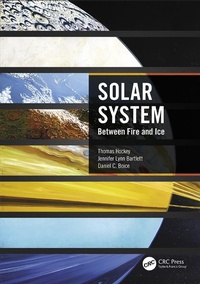
Solar System
Between Fire and Ice
1st Edition
Published on 12. August 2021
352 pages
978-1-000-42541-3 (ISBN)
Description

Combining the latest astronomical results with a historical perspective, Solar System: Between Fire and Ice takes you on a fabulous tour of our intriguing Solar System. Not content with a conventional discourse restricted to the major and minor bodies, astronomers Hockey, Bartlett, and Boice venture beyond the limits of our system to look at exoplanets and to consider future trends in space exploration and tourism. They discuss not only what scientists know about planets, asteroids, and comets but how the discoveries were made. With extensive teaching experience, their accessible prose clearly explains essential physical concepts. Lavishly illustrated as well as carefully researched, Solar System: Between Fire and Ice delights the eyes as well as feeding the mind. Detailed appendices provide additional technical data and resources for your own on-line voyage of discovery. Whether you are an educated layperson, student, teacher, amateur astronomer, or merely curious, you will come away having learned the most up-to-date knowledge and enjoyed the process.
The authors bring a unique perspective to this subject, combining their years of experience in research, teaching, and history of planetary science. Prof. Thomas Hockey is a professor of astronomy, specializing in planetary science and the history of science. Dr. Jennifer Bartlett is an astronomer with a forte in dynamical motions of asteroids with liberal arts teaching experience. Dr. Daniel Boice is an active research astronomer in planetary science, especially comets, with considerable teaching experience.
"In the 1980s and 90s the Viking and Voyager missions provided droves of exciting information, generating a new level of public interest. Textbooks were rewritten and scientists worked to understand the data during mission poor period that followed. In recent times, however, we have entered a new era. There has been a multinational effort to expand our knowledge of the Solar System. Data from these missions has been freely shared and has again raised the level of public interest. Within this era of renewed interest, it is appropriate, as is done in this book, to provide the public with an effort to present an integrated view of our Solar System and questions that the discovery of extrasolar planets have raised with regard to the Solar System as a whole." Professor Reta Beebe, recipient of NASA's Exceptional Public Service Medal
"I understand this book to be aimed at a general audience, but I can also see its use as a text in astronomy classes, especially in a community school or situations where students typically resist reading the textbook. The writing is light and entertaining, and will engage students, yet it thoroughly covers all the basic concepts of a typical Astro 101 class." - Dr. Katy Garmany, winner of the American Astronomical Society's Annie J. Cannon Award.
The authors bring a unique perspective to this subject, combining their years of experience in research, teaching, and history of planetary science. Prof. Thomas Hockey is a professor of astronomy, specializing in planetary science and the history of science. Dr. Jennifer Bartlett is an astronomer with a forte in dynamical motions of asteroids with liberal arts teaching experience. Dr. Daniel Boice is an active research astronomer in planetary science, especially comets, with considerable teaching experience.
"In the 1980s and 90s the Viking and Voyager missions provided droves of exciting information, generating a new level of public interest. Textbooks were rewritten and scientists worked to understand the data during mission poor period that followed. In recent times, however, we have entered a new era. There has been a multinational effort to expand our knowledge of the Solar System. Data from these missions has been freely shared and has again raised the level of public interest. Within this era of renewed interest, it is appropriate, as is done in this book, to provide the public with an effort to present an integrated view of our Solar System and questions that the discovery of extrasolar planets have raised with regard to the Solar System as a whole." Professor Reta Beebe, recipient of NASA's Exceptional Public Service Medal
"I understand this book to be aimed at a general audience, but I can also see its use as a text in astronomy classes, especially in a community school or situations where students typically resist reading the textbook. The writing is light and entertaining, and will engage students, yet it thoroughly covers all the basic concepts of a typical Astro 101 class." - Dr. Katy Garmany, winner of the American Astronomical Society's Annie J. Cannon Award.
More details
Edition
1. Auflage
Language
English
Place of publication
London
United Kingdom
Publishing group
Taylor & Francis Ltd
Target group
College/higher education
Professional and scholarly
Illustrations
53 Line drawings, black and white; 257 Halftones, black and white; 310 Illustrations, black and white
ISBN-13
978-1-000-42541-3 (9781000425413)
Copyright in bibliographic data and cover images is held by Nielsen Book Services Limited or by the publishers or by their respective licensors: all rights reserved.
Schweitzer Classification
Other editions
Additional editions
Book
08/2021
1st Edition
CRC Press
€58.50
Shipment within 15-20 days
Book
08/2021
1st Edition
CRC Press
€145.60
Shipment within 10-20 days
Persons
Thomas Hockey joined the faculty of the University of Northern Iowa where he has taught astronomy to ten thousand students. He is the author of numerous professional papers and books. He is most well-known for serving as Editor-in-Chief for the prizewinning Biographical Encyclopedia of Astronomers (four volumes, editions 1 & 2, Springer) and for writing How we See the Sky: A Naked-Eye Tour of Day and Night (University of Chicago Press). Hockey also edited the journal Astronomy Education Review. He is a Fellow of the Royal Astronomical Society and member of the International Astronomical Union. In 2017, asteroid (25153) 1998 SY53 was named Tomhockey.
Jennifer Lynn Bartlett is an astronomer with the U.S. Naval Observatory, where she computes the positions and motions of planets and other celestial bodies while promoting traditional celestial navigation. She is also currently a member of the Organizing Committee for the International Astronomical Union (IAU) Commission A1 Astrometry. Previously, she taught introductory astronomy at Hampden-Sydney College and had a professional career as an engineer.
Daniel C. Boice is the principal astronomer at Scientific Studies & Consulting in San Antonio, Texas. Prior to this position, he performed cometary research sponsored by NASA and the National Science Foundation for 26 years in the Space Science and Engineering Division at Southwest Research Institute. Concurrently, he held a faculty appointment for 20 years in the Department of Physics and Astronomy at the University of Texas at San Antonio, where he taught undergraduate and graduate courses to our next generation of astronomers.
Jennifer Lynn Bartlett is an astronomer with the U.S. Naval Observatory, where she computes the positions and motions of planets and other celestial bodies while promoting traditional celestial navigation. She is also currently a member of the Organizing Committee for the International Astronomical Union (IAU) Commission A1 Astrometry. Previously, she taught introductory astronomy at Hampden-Sydney College and had a professional career as an engineer.
Daniel C. Boice is the principal astronomer at Scientific Studies & Consulting in San Antonio, Texas. Prior to this position, he performed cometary research sponsored by NASA and the National Science Foundation for 26 years in the Space Science and Engineering Division at Southwest Research Institute. Concurrently, he held a faculty appointment for 20 years in the Department of Physics and Astronomy at the University of Texas at San Antonio, where he taught undergraduate and graduate courses to our next generation of astronomers.
Content
1. Origin of Our Solar System. 2. Characterizing Planets. 3. Orbits. 4. Luna, our Moon. 5. Sun-scorched Mercury. 6. Hothouse Venus. 7. Terra, Our Earth. 8. Rusty Mars. 9. Small Bodies: Asteroids & Meteoroids. 10. Gas Giants: Jupiter and Saturn. 11. Ice Giants: Uranus & Neptune. 12. Satellites of Ice and Fire. 13. Small Bodies: Comets.14. From Kuiper Belt to Oort Cloud. 15. Sol, Our Sun. 16. Alien Worlds. 17. Future Exploration and Adventure in Our Solar System
