

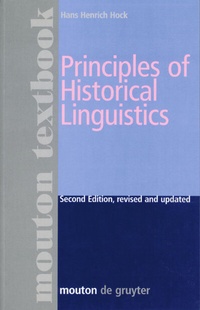
Principles of Historical Linguistics
Description

Historical linguistic theory and practice contains a great number of different 'layers' which have been accepted in the course of time and have acquired a permanency of their own. These range from neogrammarian conceptualizations of sound change and analogy to present-day ideas on rule change and language mixture. To get a full grasp of the principles of historical linguistics it is therefore necessary to understand the nature and justifications (or shortcomings) of each of these 'layers', not just to look for a single 'overarching' theory. The major purpose of the book is to provide in up-to-date form such an understanding of the principles of historical linguistics and the related fields of comparative linguistics and linguistic reconstruction. In addition, the book provides a very broad exemplification of the principles of historical linguistics.
Reviews / Votes
"[...] a manual and state-of-the-art-report for readers already committed to linguistic study."O. W. Robinson in: Journal of English and German PhilologyMore details
Other editions
New editions
Additional editions
Previous edition
Content
2 - Contents [Seite 14]
3 - Maps and charts [Seite 15]
4 - 1. Introduction [Seite 16]
5 - 2. Phonetics, transcription, terminology, abbreviations [Seite 26]
6 - 3. Sound change: The regularity hypothesis [Seite 49]
7 - 4. Sound change and phonological contrast [Seite 67]
8 - 5. Sound change: Assimilation, weakening, loss [Seite 76]
9 - 6. Sound change: Dissimilation, haplology, metathesis [Seite 122]
10 - 7. Sound change: Epenthesis, elimination of hiatus, other changes [Seite 132]
11 - 8. Sound change: Structure and function [Seite 163]
12 - 9. Analogy: General discussion and typology [Seite 182]
13 - 10. Analogy: Tendencies of analogical change [Seite 225]
14 - 11. Analogy and generative grammar [Seite 253]
15 - 12. Semantic change [Seite 295]
16 - 13. Syntactic change [Seite 324]
17 - 14. Linguistic contact: Lexical borrowing [Seite 395]
18 - 15. Linguistic contact: Dialectology [Seite 441]
19 - 16. Linguistic contact: Koines, convergence, pidgins, creoles, language death [Seite 487]
20 - 17. Internal reconstruction [Seite 547]
21 - 18. Comparative method: Establishing linguistic relationship [Seite 571]
22 - 19. Comparative reconstruction [Seite 596]
23 - 20. Linguistic change: Its nature and causes [Seite 642]
24 - Notes [Seite 678]
25 - References [Seite 696]
26 - Index [Seite 744]
